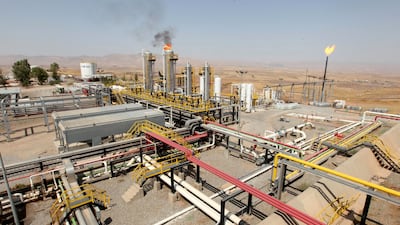

Iraq’s Kurdistan region has resumed oil production at all its oilfields except Sarsang, with output reaching up to 230,000 barrels per day, after a series of drone attacks during the war.
Some oil and gas companies operating in the semi-autonomous Kurdistan region had stopped production due to drone attacks on their energy infrastructure.
Iraq asked oil companies to resume operations in Kurdistan in June.

Kamal Mohammed, Minister of Natural Resources in the Kurdistan Regional Government, confirmed on Saturday that oil production in the region has resumed and that all companies have returned to work.
“All oilfields have restarted production, with the exception of the Sarsang field, which was damaged by several drone strikes and has not yet resumed production,” the Iraqi News Agency cited him as saying.
“Oil production currently ranges between 220,000 and 230,000 barrels per day, part of which is used for domestic consumption.”
Iraq, Opec’s second-largest producer, has been hit hard by the blockade of the Strait of Hormuz since the regional war broke out on February 28.
Almost all of Iraq’s oil exports, which stood at about 3.4 million bpd on average before the war, collapsed when the conflict began.
Since early August, exports have been rising again to average about 2 million bpd, Iraqi Oil Minister Bassem Khudair said this month. That is mainly because Iraq has been moving to secure alternative export routes.
Iraqi President Nizar Amidi also said on August 22 that Iran had granted permission for several Iraqi oil tankers to pass through the Strait of Hormuz, after repeated requests from Baghdad.
“There is facilitation for some tankers carrying Iraqi oil in the Strait of Hormuz,” Mr Amidi said, without providing further details.
Iran's state news agency, Irna, reported separately that Tehran had given permission for several Iraqi oil tankers to cross the waterway.
Refining capacity
Separately, Mr Mohammed stressed for the need to increase the amount of oil refining in the Kurdistan region, the Iraqi News Agency said.
“The current amount is only 50,000 bpd, while the local demand reaches 140,000 bpd,” he said.
“The federal government estimates the cost of refining oil in its refineries at 5,900 dinars, or about $4 per barrel, while the cost for the Kurdistan Regional Government is estimated at $16.”
If the Iraqi government calculates the amount of oil it supplies to the Kurdistan region at $4 per barrel, petrol would be sold for 450 dinars, he added.
The current cost of petrol in the region is at around 750 dinars per litre.