

The global energy crisis is not only the result of recent geopolitical shocks from the Iran war. It reflects how the system itself was built with known vulnerabilities.
Since late February, oil prices have risen by about 30 per cent, contributing to inflation and slowing growth across major economies. To the extent that in the Middle East, the International Monetary Fund on Thursday said the region faced one of its sharpest six-month economic downgrades since the 2008 financial crisis.
While the scale of the disruption is vast, it exposes a deeper issue. A reliance on a small number of large energy hubs has created a system that is efficient in stable conditions but highly exposed to disruption. When facilities such as Saudi Arabia’s Ras Tanura refinery or Qatar’s Ras Laffan are hit, the effect is immediate and global.
Disruption at Ras Tanura affected up to 7 per cent of global oil supply, while the hit to Ras Laffan, the world’s largest liquefied natural gas hub, could take a fifth of global LNG exports offline.

Renewables, experts say, are more decentralised and less prone to widespread shocks when human or natural disasters strike – yet have experienced slower adoption for technical and economic reasons.
Core vulnerabilities
Experts say the vulnerability of oil and gas is rooted in how they operate. “Globally, the electricity system is heavily centralised,” says Robbie Orvis, senior director of modelling and analysis at Energy Innovation, an energy and climate policy think tank based in San Francisco.
As “most electricity globally … does come from large central generators and then goes across the transmission system,” if there is a disruption to those fuels or that infrastructure, “it affects the whole system.”
That is a vital issue, Mr Orvis told The National on the sidelines of the IMF and World Bank Spring Meetings. This structure ties entire economies to commodities – fuels such as oil and gas – whose prices can shift rapidly.
In practical terms, it means energy systems that depend on commodities can rise by 20 to 50 per cent within weeks, often due to events outside any one country’s control. Those swings feed directly into electricity prices, transport costs and inflation. Renewables, on the other hand, do not act the same way and are more contained in their impact, he says.
Andrea Zanon, a policy adviser with experience across the Middle East and North Africa, says this fragility was foreseeable.
“What I saw consistently was not a lack of resources or technology [in renewables],” he says. “It was a failure to treat concentration risk as a real problem until it became an emergency.”
He says the crisis exposed risks that had been building for decades. “The closure of the Strait of Hormuz did not create a vulnerability. It revealed one that decades of decisions had quietly assembled,” he says.
Those decisions were driven by how energy projects were financed. Large, centralised infrastructure was easier to fund and scale, reinforcing concentration.
“The international architecture … was built around bankability, and bankability rewarded concentration and scale,” says Mr Zanon, the founder of entrepreneurship advisory, Confidente.
Are renewables the answer?
Experts say solar, hydrogen and wind energy could have reduced the severity of the energy crisis, though not eliminated it. The benefits of renewables lie in how renewable energy behaves. Unlike fossil fuels, they are not tied to global commodity markets.
“Renewables, they don't have fuel costs,” Mr Orvis says, meaning prices are more stable once assets are built.
Renewable systems are also more distributed in smaller sites, from rooftop solar to regional wind farms, spreading supply across multiple sources rather than concentrating it in a few large facilities.
This structure makes them less exposed to global supply shocks as energy is generated locally.
In practice, this means renewable-heavy systems are less vulnerable to sudden price surges, attacks and disruption that ripple through global markets.
So why hasn't the world shifted to renewables? The issues circle around storage and volume, as well as policy. Scaling them fast enough to replace fossil fuels remains a structural and policy challenge. Currently, renewables supply about one third of global electricity, about 33 to 34 per cent, according to the International Energy Agency and analysis from Ember.
However, their expansion faces key constraints. Integrating large shares of renewables requires significant investment in energy storage, including batteries and hydrogen, grid expansion to connect new sources of supply, and more flexible demand systems that can respond to changes in generation.
If there's a will …
The slow pace of transition is not only technological but political, with the IMF highlighting the persistence of fossil fuel subsidies and “entrenched interests” as a reason.
Mary Rose de Valladares, a clean energy expert and non-executive director at Atome PLC, a company focused on producing large-scale green hydrogen, ammonia, and fertiliser, says this transition has unfolded in waves over decades.
“We have actually been at this process since the 1980s, and it has gone in cycles,” she says.
Those cycles have included early renewable deployment following the oil shocks of the 1970s, when supply disruptions and Opec embargoes sent prices soaring, renewed policy momentum in Europe and Japan in the 1990s amid concerns over energy security and import dependence, and more recent global investment surges after the Paris Agreement in 2015. Progress, she says, has never been linear.
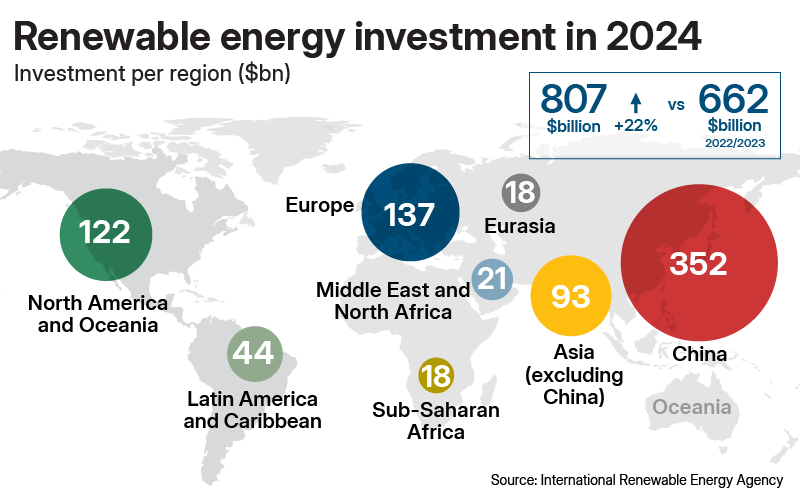
“There has not been total synchrony … every country or every jurisdiction has a different budget-making process,” she says, explaining why adoption has varied widely across regions.
Today's crisis might push the transition forward as some countries rethink their energy security.
“There’s a question right now about how much … countries like Indonesia, Vietnam and others are going to commit to LNG in the long run,” adds Mr Orvis, after the current disruptions to contracts amid the current energy crisis.
Also, experts say the economic case to rely more on renewables is being made.
Analysis by the UK Climate Change Committee estimates that reaching net zero would cost around 0.5 to 1 per cent of GDP per year, much of which is offset by reduced fossil fuel spending.
By contrast, recent energy shocks have imposed far larger losses in a much shorter time. The IMF estimates the energy crisis reduced output in parts of Europe by around 2 to 3 per cent of GDP, with some countries experiencing even bigger impacts.
The total cost of transition to net zero in the UK was on par with dealing with one fossil fuel shock, according to calculations by the Climate Change Committee last year.
"It found that the total additional cost of a single fossil fuel price spike of 2022 magnitude is likely to be as large as the total net additional cost of meeting the pathway to Net Zero across every year to 2050," the report stated.
In effect, a single fossil fuel-driven crisis can cost as much as several years of clean energy investment.
"Clean energy is now insurance against these types of shocks," said Mr Orvis, as these types of crises are unavoidable. "You can all but guarantee these supply shocks will continue happening every five to 10 years," he added.
This is not new information, and has been voiced by industry leaders for decades. Daniel Yergin, energy historian and vice chairman of S&P Global, says “energy security is about diversification of supply.”
Fatih Birol, head of the IEA, also warns that systems dependent on a narrow set of fuels are inherently exposed to shocks. He reiterated this at the Spring Meetings in Washington last week.
For Mr Zanon, the conclusion is unequivocal. “Yes. I am certain of it,” he says, when asked whether different investment decisions could have softened the crisis.
“Not because the geopolitical conflict could have been prevented,” he adds, “but because the fragility of the system that the conflict is now exposing was built through specific, traceable choices.”

