Ships stranded on the coastline of a vanished sea, now a wasteland of sand contaminated with salt and pesticides, form a vivid portrait of ecological breakdown.
But the Central Asian states clustered around the near-vanished Aral Sea are trying to restore their environment. These oil- and gas-rich countries with their salty lakes and hot, arid plains have much to learn from, and to teach, the Gulf.
The Central Asian region is one of the world’s key hydrocarbon provinces. The last decade has brought the broader Caspian region into close oil co-operation with Opec for the first time.

Kazakhstan is a leading member of the Opec+ alliance, Uzbekistan is a significant though declining gas producer, and Turkmenistan holds the world’s fourth-largest gas reserves. Azerbaijan, also an Opec+ member, holds a crucial strategic position as an oil and gas supplier to Europe.
The area spans remarkable topography: from Tajikistan’s highest mountain, Ismoil Somoni at 7,495 metres, to Kazakhstan’s Karagiya Depression which sits 134 metres below sea-level near the Caspian Sea. The glaciers and gorges of the Pamir and Tian Shan mountains are a natural battery, able to store water and electricity for inner Asia as well as Afghanistan and Pakistan, and to balance seasonal shifts in renewable output.
But overuse of water for agriculture, dating back to destructive Soviet-era schemes tapping the Amu Darya and Syr Darya rivers, have dried up the Aral Sea. Once the third-largest lake in the world, only a small northern remnant in Kazakhstan still survives. Astana has battled hard to save the lake: a dam has allowed water levels in the northern part to rise again. However, the historic Amu Darya, running through Turkmenistan and Uzbekistan, now ends in the dusty depression short of the Aral.
The drying up of the Aral Sea – in pictures
-

The memorial to the Aral Sea at Moynaq in Uzbekistan. All photos: Daniel Bardsley/The National -

A rusting fishing vessel at the town of Moynaq in Uzbekistan, which was a thriving fishing port when it was on the Aral Sea, but which is now 150 kilometres from water -
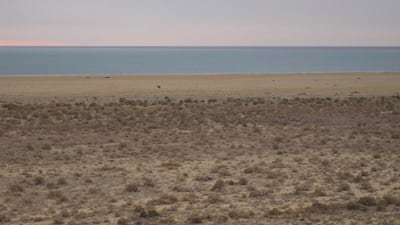
The Aral Sea in Uzbekistan -

The desert beside Moynaq, where the Aral Sea used to be -

Rusting fishing vessels at the town of Moynaq in Uzbekistan, which was a thriving fishing port when it was on the Aral Sea, but which is now 150 kilometres from water -

Rusting fishing vessels at the town of Moynaq in Uzbekistan -

The town of Moynaq in Uzbekistan -

Rusting fishing vessels at the town of Moynaq in Uzbekistan -

Rusting fishing vessels at the town of Moynaq in Uzbekistan -

Rusting fishing vessels at the town of Moynaq in Uzbekistan -

The Aral Sea shimmers in the distance


Even the much larger Caspian is in danger. Climate change has brought higher temperatures, elevated evaporation, and lower rainfall. Along with reduced inflow from rivers such as the Volga, the Caspian Sea's water levels could drop 9 to 18 metres by 2100. This would particularly affect the shallow northern sector, mostly shared by Kazakhstan and Russia. This is a crucial site of oil production and includes Kashagan, one of the world’s biggest fields. In waters currently just 3 to 6 metres deep, further retreat could leave infrastructure stranded far from the shoreline.
The region, though, is doing its best to confront these challenges. Baku hosted the UN Cop29 climate talks, the year after Dubai held it in 2023. In April this year, after two years of preparation, Kazakhstan’s Ministry of Ecology and Natural Resources will host the 2026 Regional Ecological Summit. The Abu Dhabi-headquartered International Renewable Energy Agency is one of the event’s main partners, with more than 20,000 visitors expected to attend.
Gulf countries have significantly stepped up their energy and environmental engagement with Central Asia in recent years. Dragon Oil, a subsidiary of Dubai’s Enoc, has long produced oil successfully in the Turkmen sector of the Caspian Sea. Adnoc’s international unit XRG acquired a 38 per cent stake in Turkmenistan’s Block I gas asset in the Caspian in May. State company Turkmengaz announced in October that it was discussing with Adnoc co-operating on the Galkynysh gasfield, one of the world’s largest, and a vital supplier to China.
In August 2023, Adnoc bought a 30 per cent stake in Azerbaijan’s Absheron gasfield. This month, XRG finalised a stake in the Southern Gas Corridor company, and now holds interest in the crucial offshore Shah Deniz gasfield, which has pipelines from Azerbaijan through Turkey to Europe.
The UAE's Masdar and Acwa Power of Saudi Arabia have major solar, wind, hydropower, hydrogen, battery and water desalination projects spanning all five Central Asian states, Azerbaijan and Armenia. This includes offshore wind in the Azeri sector of the Caspian. Earlier this month, Acwa Power commissioned a major battery storage system in Uzbekistan. Qatar’s Nebras Power also has a joint venture for electricity generation in Kazakhstan and Azerbaijan.
In September, Uzbekistan began its first green hydrogen project, backed by Acwa, using renewable energy to replace natural gas feedstock for fertilisers. Kazakhstan and Azerbaijan have major green hydrogen ambitions.
Green hydrogen production, though, demands sizeable amounts of water. The Gulf and the Central Asian countries can engage productively on coping with arid conditions and rising temperatures, including the sustainable use of desalination. In October, Kazakhstan and the UAE agreed to work on cloud seeding, which has successfully boosted rainfall in the UAE.
There are other important potential areas of co-operation. Turkmenistan has been one of the worst global offenders in leakage of methane, a powerful greenhouse gas. But, after satellite images highlighted the problem, it has moved to clean up. Adnoc, meanwhile, enjoys one of the lowest rates of methane escape among global oil producers.
Kazakhstan extracts huge amounts of sulphur from “sour” gas, which accumulates in pyramids in the steppe. Adnoc, dealing with a similar challenge, is one of the world’s largest sulphur exporters. Finding new markets for the yellow element turns it from waste product into value. This could include innovative sulphur-based cements, which are highly resistant to corrosive and salty environments.
Carbon capture and storage, another vital technology for decarbonising the energy industry, is an area of expertise for the Gulf countries. It relies on good understanding of the subsurface. Carbon storage in ecosystems, such as revitalising and expanding mangroves, and tackling desertification more generally, is an important part of net-zero plans.
Conservation beyond energy
In a broader sense, conservation is a common mission. The UAE and Oman have successfully reintroduced the oryx to the wild after excessive hunting reduced its numbers. Kazakhstan seeks to preserve snow leopards, the Caspian seal, and has brought back the saiga antelope and Przewalski’s wild horse.
The Gulf is a key stopover for migratory birds travelling between East Africa and Central Asia. The UAE supports both the International Fund for Houbara Conservation, and the Sheikh Khalifa Houbara Breeding Centre in Kazakhstan, which hosts 80 per cent of the wild population of this endangered bird.
Diversifying the economy while defending the environment is a shared goal. Both regions seek a just low-carbon transition that acknowledges the continuing essential role of their hydrocarbons. The Gulf and Central Asia can draw closer still in the quest to keep the energy flowing, while bringing back the water.