


Reviving Argentina’s economy has long seemed like flogging a dead horse. But in northern Patagonia lies a resource that just might do the trick. A dead cow could be the country’s salvation – the Vaca Muerta.
This is the name for a vast shale oil and gas formation that underlies the flat scrublands of the Neuquén Basin. Its windswept plains are almost as far as it’s possible to get from the Middle East, geographically or in apparent relevance. But what happens in our region affects the Vaca Muerta, and now, vice versa.
One of the remarkable things about the US shale revolution is how hard it has proved to repeat. Petroleum-rich, low permeability rocks are found all over the world. But other than some modest production in Canada, a little in China and Russia, and initial steps in the UAE, Saudi Arabia, Australia and a few other places, no other country has successfully extracted significant oil or gas commercially.
The Vaca Muerta, covering an area the size of Belgium, is geologically similar to the Eagle Ford of south Texas, which yielded at its peak 1.7 million barrels a day of oil. It holds light, low-sulphur crude oil. Consultancy Rystad says the yield of wells per metre drilled is better than in the major US shale formations.
The US Energy Information Administration estimates the Vaca Muerta holds 16 billion barrels of technically recoverable oil, and 308 trillion cubic feet of gas, putting Argentina among the world’s top five shale resource holders. For context, although the figures aren’t strictly comparable, the oil is more than the reserves of Brazil or Algeria, and the gas is more than that of the UAE or Saudi Arabia.
Production began in 2011, not much later than the main US tight formations. But in 2012, the government nationalised YPF, the former state company which had been bought by Spain’s Repsol in 1999. Progress was held back by endemic economic and inflation crises, and government regulation of commodity prices and currency transactions. Buenos Aires moved slowly on completing state-backed pipelines and a railway to bring supplies to the remote region.

Libertarian president Javier Milei was inaugurated in December 2023, promising to make the shale a motor of national economic growth. His government plans to remove import and export taxes and liberalise prices and foreign exchange.
He is friendly with Donald Trump, another pro-oil president, and the Vaca Muerta’s progress now resembles that of some of its US cousins. From about 70,000 bpd of production in early 2019, and an inevitable flat patch in the Covid year of 2020, it has fountained to 400,000 bpd in the third quarter of last year.
In 2021, new pipelines and stronger oil prices encouraged more intensive drilling, and modern horizontal wells and hydraulic fracturing were adopted widely.
The formation has compensated for declining conventional fields in Argentina, taking overall output almost back to the levels of about 750,000 bpd reached in the early 2000s. Now, the country is about to overtake Colombia as South America’s third-biggest producer. Production costs are estimated at a reasonable $36 per barrel.
Rystad says the shale formation could reach 1 million bpd by 2030. Oscar Scarpari, chief executive of Argentinian engineering group Techint, suggested last March that “We have in mind 1.5 million bpd in six to seven years.”
About half the production is operated by state company YPF, another 50,000 bpd by US-listed Vista Energy, and the rest by international companies, including Shell, ExxonMobil and Chevron, and smaller players.
Meanwhile, its gas output has also soared and kept national production roughly constant despite the drop-off of conventional fields. The government itself expects 14.1 billion cubic feet of daily output by 2030, while the country consumes today only 4.3 billion cubic feet.
Production costs of $1.60 per million British thermal units are lower than US prices, and cheap enough to make liquefied natural gas (LNG) exports viable. Argentina wants to become an important exporter of LNG, with up to 30 million tonnes of annual capacity, not far short of half of Qatar’s current level. This will need heavy private investment, with Mr Milei making it clear state funding of pipelines is no longer an option.
The swelling output is important for four reasons. First, and most of all, for Argentina, which has never regained the heights of the early 20th century, when farming made it one of the world’s wealthiest countries. An oil- and gas-led boom could represent 20 per cent of gross domestic product by 2030, fixing the balance of payments, spurring investment and bringing an end to recurrent economic panics.
But this depends on good macroeconomic policies. Mr Milei’s heterodox approach has some promising features, but could be doomed by excessive ideology in the face of economic practicalities. Although Vaca Muerta has a low carbon footprint of production, his opposition to climate change policies could raise barriers to investment and exports.
Conversely, with limited support in Congress and no provincial governorships, Mr Milei faces challenges in pushing through parts of his agenda. His planned privatisation of YPF has been blocked. And he is betting the private sector will step up to build critical pieces of infrastructure such as the railway, pipelines and LNG plant, without guarantees that he or a like-minded successor will be around after the next presidential elections in 2027.
Argentina has repeatedly swung through cycles of liberalisation and state intervention. A later populist leader might again splurge the petroleum earnings on handouts and white elephants, as has happened in so many oil-producing countries.
-
-
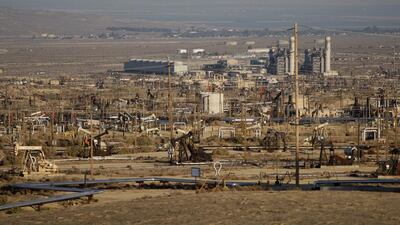
Pump jacks and wells are seen in an oil field on the Monterey Shale formation. Critics of fracking in California cite concerns over water usage and possible chemical pollution of ground water sources as California farmers are forced to leave unprecedented expanses of fields fallow in one of the worst droughts in California history. David McNew / Getty Images / AFP -

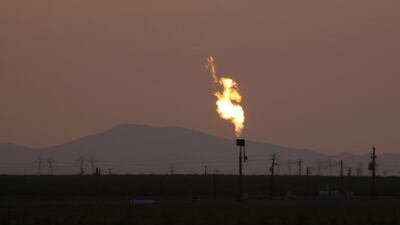
Gas is flared as waste from the Monterey Shale formation. Concerns also include the possibility of earthquakes triggered by the fracking process which injects water, sand and various chemicals under high pressure into the ground to break the rock to release oil and gas for extraction though a well. David McNew / Getty Images / AFP -
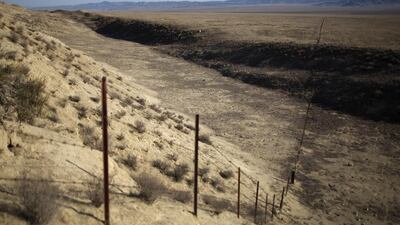
The 800-mile-long San Andreas Fault runs north and south on the western side of the Monterey Formation in the Central Valley and is thought to be the most dangerous fault in the nation. David McNew / Getty Images / AFP -

Pump jacks are seen at dawn in an oil field over the Monterey Shale formation. David McNew / Getty Images / AFP -

Proponents of the fracking boom saying that the expansion of petroleum extraction is good for the economy and security by developing more domestic energy sources and increasing gas and oil exports. David McNew / Getty Images / AFP -

Swallows fly past a high pressure gas line crossing a canal in an oil field over the Monterey Shale formation. David McNew / Getty Images / AFP -

US shale gas production has risen rapidly in recent years. David McNew / Getty Images / AFP -

Dairy cattle are lit from behind by the glow of gas being flared as waste from the Monterey Shale formation. David McNew / Getty Images / AFP -
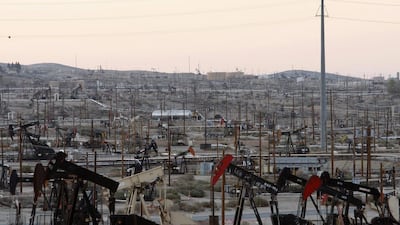
Pump jacks and wells are seen in an oil field on the Monterey Shale formation. David McNew / Getty Images / AFP -
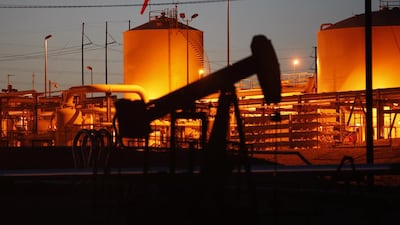
Night falls on the Monterey Shale formation. David McNew / Getty Images / AFP


Second, it threatens to swell the impending LNG glut in the late 2020s, first by replacing its own imports, then by potential exports. Most forecasts don’t even take account of significant Argentinian LNG supplies by the early 2030s.
Third, it further entrenches the dominance of the Americas in oil output growth: the US, Canada, Brazil and new entrant Guyana are the other major gainers over the past five years, while the Opec+ alliance has repeatedly had to restrain production.
And fourth, it is a warning to Opec that competitors can pop up in unexpected places. The Vienna-based organisation is lucky that shale has not yet surfaced outside the US. Now, it may be about to. Argentina’s success might encourage emulation by Mexico, Australia or another holder of big resources. Then, more dead cows will haunt Opec's future.

