

Iran is expected to maintain consistency in its oil policy following the death of president Ebrahim Raisi, industry experts have said.
However, they warned that Iranian crude supply faces a greater threat from a potential return of Donald Trump to the White House.
Iran has managed to endure US sanctions imposed in 2018, aimed at crippling its oil exports – a major source of revenue for the country.
Since President Joe Biden assumed office in 2021, sanctions enforcement has relaxed, leading China to become a significant purchaser of Iranian oil, often at discounted prices.
“In terms of energy policy, this is a period where Iran needs as much consistency as possible. They need continued revenue flows [and] they need to be able to count on resources to be able to support this internal political transition,” said Carlos Pascual, senior vice president, geopolitics and international affairs at S&P Global Commodity Insights.
“The expectation of its principal importers, particularly China, will be that they need to continue to rely on those resources. And I would expect that Iran would remain consistent in the implementation of its energy policy,” Mr Pascual told The National on the sidelines of an energy event in Dubai this week.
-
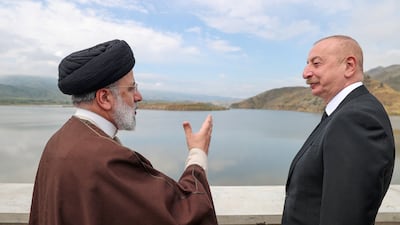
President Raisi and Azerbaijan's President Ilham Aliyev visit the Qiz-Qalasi dam on the Azerbaijan-Iran border on May 19. Reuters -
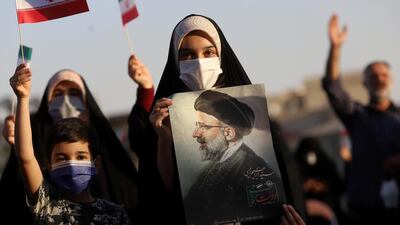
A supporter of Iranian President Ebrahim Raisi holds his portrait during a celebratory rally for his presidential election victory in Tehran in 2021. Wana -
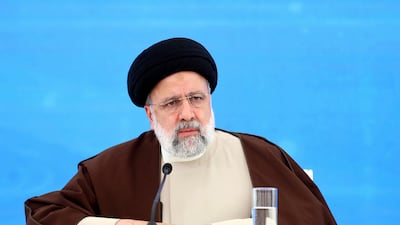
Mr Raisi at the inauguration ceremony of the dam of Qiz Qalasi. AP -
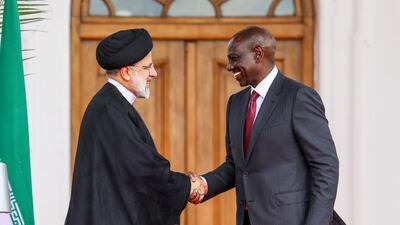
Kenyan President William Ruto, right, shakes hand with Mr Raisi at the Statehouse in Nairobi, Kenya, on July 12, 2023. EPA -
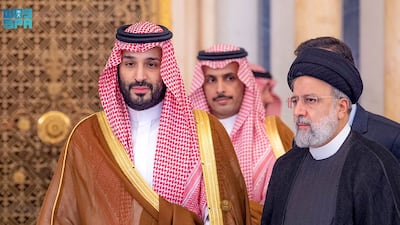
Saudi Crown Prince Mohammed bin Salman, left, and Mr Raisi at a meeting of the Arab League and the Organisation of Islamic Co-operation in Riyadh. AFP -
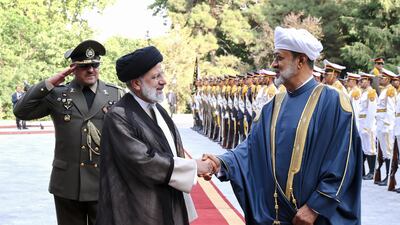
Sultan of Oman, Haitham bin Tariq, right, being welcomed by Mr Raisi during a ceremony in Tehran, Iran, on May 28, 2023. EPA -
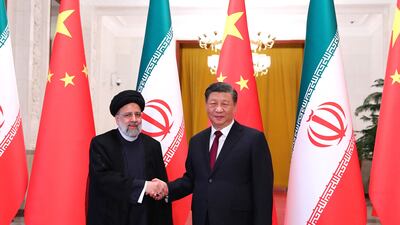
Chinese President Xi Jinping and Mr Raisi. AFP -
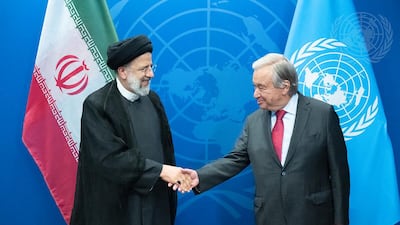
United Nations Secretary-General Antonio Guterres, right, and Mr Raisi on the sidelines of the 77th session of the United Nations General Assembly at the UN headquarters in New York City on September 22, 2022. AFP -
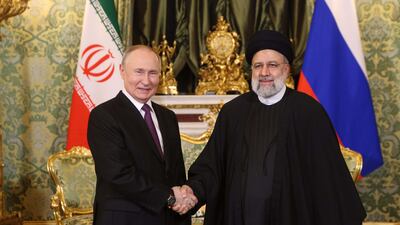
Russian President Vladimir Putin, left, greets Mr Raisi during their meeting at the Grand Kremlin Palace on December 7, 2023. Getty Images -
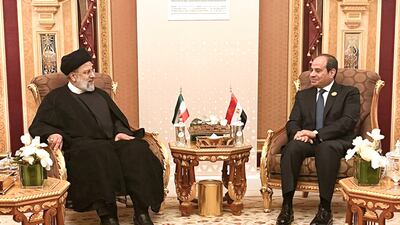
Mr Raisi, left, with Egypt's President Abdel Fatah Al-Sisi. AFP -

Mr Raisi, right, greeted by Pakistan's Prime Minister Shehbaz Sharif in Islamabad. AFP -
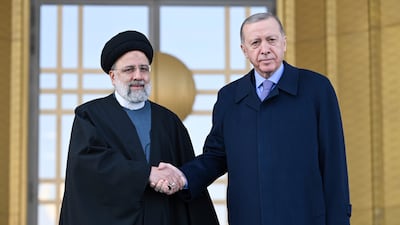
Turkish President Recep Tayyip Erdogan, right, shakes hands with Mr Raisi before their meeting at the Presidential palace in Ankara, Turkey, on January 24. AP -
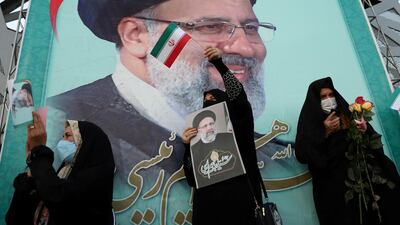
The affinity between incoming Iranian president Ebrahim Raisi and supreme leader Ayatollah Ali Khamenei goes back decades. Wana via Reuters -

Mr Raisi shakes hands with Qatari Emir Sheikh Tamim bin Hamad al-Thani during a welcoming ceremony in Tehran, on May 12, 2022. Reuters -
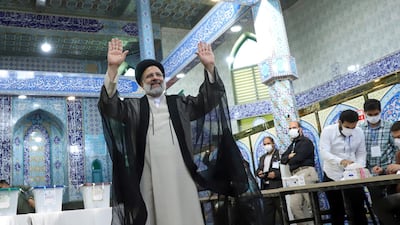
Mr Raisi gestures after he votes during presidential elections at a polling station in Tehran. -
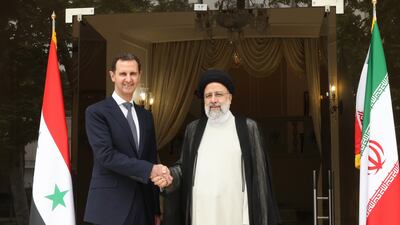
Mr Raisi, right, greets his Syrian counterpart Bashar Assad in Tehran, on May 8, 2022. EPA -
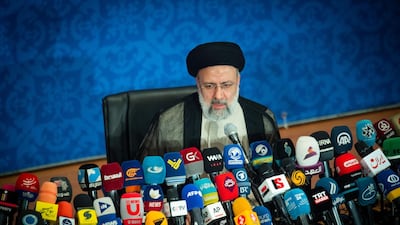
Mr Raisi, Iran's president-elect, speaks after his victory in the election on June 21. Bloomberg -
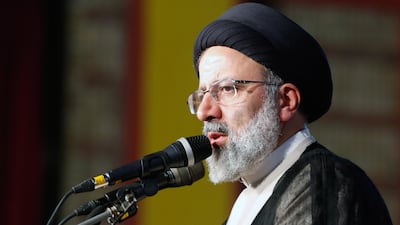
Mr Raisi speaks to the crowd during an election camping rally in Tehran on April 29, 2017. EPA


Mr Raisi, who was seen as a potential successor to supreme leader Ayatollah Ali Khamenei, was killed on Sunday when his helicopter crashed in mountains near the Azerbaijan border.
Foreign Minister Hossein Amirabdollahian, East Azerbaijan provincial governor Malik Rahmati and Mohammed Ali Ale Hashem, Mr Ali Khamenei's representative to East Azerbaijan, also died in the crash in north-west Iran.
What lies ahead for crude production?
Iran was the second-largest source of crude supply growth last year after the US, with production reaching about 3.4 million barrels per day and exports at about 1.5 million bpd.
“We are seeing now the production stabilising at 3.2-3.3 million bpd and exports are holding, and we think they’ll be able to do that,” said Toril Bosoni, head of oil industry and markets division at the International Energy Agency (IEA).
The Paris-based agency is monitoring how the recent development might affect Iranian politics and what actions a possible new US administration might take regarding sanctions on Iran, Ms Bosoni told The National.
“China is the main buyer of Iranian oil, and they seem to circumvent the sanctions that are already in place, so it's an open question,” she said.
Most of Iran’s crude is exported to China through a network of dark fleet tankers, which has grown over the past five years as both countries seek to bypass international sanctions.
The US suspects that Tehran uses Malaysia as an intermediary, transferring crude oil to Malaysian vessels or conducting ship-to-ship transfers in the country's waters. This process allegedly conceals the Iranian origin before the oil reaches its final destination, likely China.
“We see little appetite from the Biden administration to tighten sanctions enforcement given its desire to keep oil prices low, although it may look for opportunities to make Iran offer deeper discounts,” said Richard Bronze, head of geopolitics at Energy Aspects.
The London-based consultancy expects Iranian oil smuggling to continue at about 1.5 million bpd for the rest of this year.
Impact of sanctions on supply
If Mr Trump, the Republican presidential candidate, were to return to the White House next year, his administration is expected to enforce sanctions against Iran more aggressively, “creating downside risks to Iranian supplies, which, in turn, could undermine Iran’s already fragile economy”, Mr Bronze said.
Iran's gross domestic product growth is projected to decline to 3.3 per cent this year compared with 4.7 per cent in 2023 amid sanctions, according to the International Monetary Fund.
Earlier this month, US officials raised concerns with the Malaysian government about ship-to-ship transfers of sanctioned Iranian oil off the coast of the South-East Asian country. However, Malaysian Prime Minister Anwar Ibrahim has denied these claims.
“Will a President Trump somehow change the mind of the Malaysians; I don't think so. But even [if he manages to do so], it takes time for any sanctions [to] really have an impact,” Jim Burkhard, vice president, oil markets, energy and mobility, S&P Global, told The National.
Oil policy outlook
As far as Iran’s oil policy in the short-term is concerned, Mr Burkhard does not expect to see a significant impact from the president’s death.
“It does add a degree of uncertainty about Iranian policy, but the supreme leader is the person who decides the overall course [of] the direction of policies [and] he's still there,” he said.
However, questions are being raised about a potential successor for the 85-year-old leader, who took over the country’s highest role in 1989 after the death of the Islamic Republic's founding father, Ayatollah Khomeini.
It would also come at a time when the regime faces high levels of domestic discontent, as well as serious international challenges. Iran and its arch-foe Israel were recently involved in a series of retaliatory attacks related to the war in Gaza.
“Even if the government is not particularly popular … [it] can still endure for some time to come. What really matters is that the Supreme Leader is of an age where the question of who's going to replace him is relevant and very important,” Mr Burkhard said.
“And that leadership change, when it happens … that will be a big decision point.”

