Renewable energy sources are reducing electricity prices across Europe, potentially bringing down returns for producers and investors, EU energy commissioner Kadri Simson has said.
Speaking at the Irena Assembly in Abu Dhabi on Wednesday, Ms Simson said Europe needed to invest heavily in transmission and distribution grids because renewable energy requires more flexibility.
“Our regulators recorded more than 6,000 occasions where our electricity prices were zero because [of] renewables and nuclear power,” she said.
“That also sends a very confusing signal to the renewables investors. How can they expect revenues?”
Europe has made significant strides in clean energy adoption, driven by its net-zero goals as the region looks to reduce its reliance on Russian fossil fuel imports.
“Two years ago, we brought online 63 gigawatts of new renewables capacity [and] last year, we brought online 70 gigawatts,” Ms Simson said. "This year, we do expect that there will be even bigger volumes.
“The challenge is that we have to invest heavily in transmission and distribution grids because renewables do demand more flexibility."
Electricity prices in the continent surged to record highs after Russia’s invasion of Ukraine in 2022, amid concerns of severe gas supply shortages.
Europe has since boosted its natural gas stockpiles and entered long-term liquefied natural gas supply agreements, which have helped bring down gas and power prices.
In February, wholesale day-ahead electricity prices in key European markets reached their lowest levels since the first half of 2021, energy think tank Ember reported.
Cities in Germany, Denmark and the Netherlands have encountered negative electricity prices during periods of high renewable energy generation, such as strong winds or sunny days, when supply exceeds demand.
The trend is not restricted to Europe.
Last May, China's Shandong province experienced a record 22 consecutive hours of negative electricity prices due to excess generation from coal and renewables.
China’s electricity demand grew by 6.4 per cent in 2023 compared with 3.7 per cent in 2022 as the easing of stringent pandemic measures drove higher power consumption in the country’s services and industrial sectors, the International Energy Agency said in a February report.
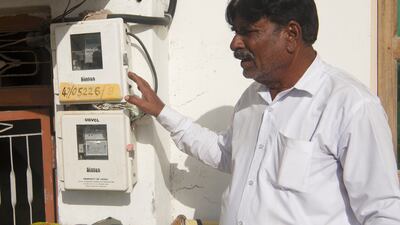
Meanwhile, demand for electricity in India increased by 7 per cent last year, lower than the growth rate of 8.6 per cent recorded in 2022, the IEA said.
“India remains the only market that did not post a substantial drop in wholesale electricity prices in 2023. Prices fell 4 per cent in 2023 … but were still almost double those in 2019,” the agency said.
The government recently invoked an emergency clause mandating companies to operate underutilised gas-based power plants by importing the fuel to meet the expected high demand for electricity during the summer months.
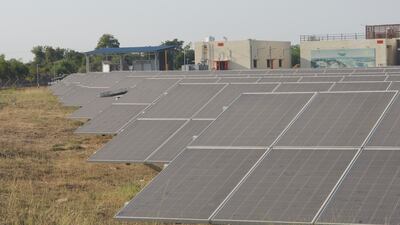
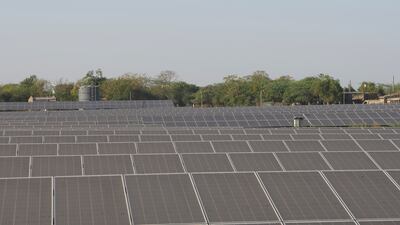
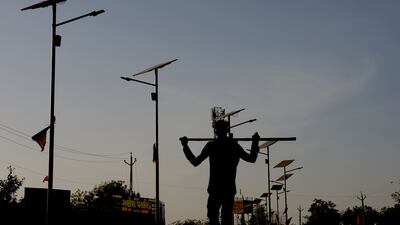
The country, which plans to reach a renewable energy capacity of 500 gigawatts by the end of the decade, has already hit 198 gigawatts, or about 40 per cent of its target, a senior Indian energy official told The National on the sidelines of the Irena Assembly.
India this year signed an initial agreement with the UAE to invest in renewable energy projects in the South Asian country, potentially reaching a total capacity of 60 gigawatts. The deal included green hydrogen and solar.
“Anybody is free to invest in India, but we want to step up that possibility of co-operation with the UAE on investments in the renewable energy sector,” said Bhupinder Bhalla, secretary of the Ministry of New and Renewable Energy.
He also said a large majority of India’s green hydrogen would be exported once production comes online over the next few years to markets such as the EU and Japan.
The country aims to produce 5 million tonnes of green hydrogen annually by 2030, with the potential to reach 10 million tonnes as export markets grow.
“The capacities that are coming up for the refineries will be purely domestic … but capacities that are coming up without any linkages [and are] still open can be supplied abroad or to the energy industry,” Mr Bhalla said.

Zayed Sustainability Prize
Ten tax points to be aware of in 2026
1. Domestic VAT refund amendments: request your refund within five years
If a business does not apply for the refund on time, they lose their credit.
2. E-invoicing in the UAE
Businesses should continue preparing for the implementation of e-invoicing in the UAE, with 2026 a preparation and transition period ahead of phased mandatory adoption.
3. More tax audits
Tax authorities are increasingly using data already available across multiple filings to identify audit risks.
4. More beneficial VAT and excise tax penalty regime
Tax disputes are expected to become more frequent and more structured, with clearer administrative objection and appeal processes. The UAE has adopted a new penalty regime for VAT and excise disputes, which now mirrors the penalty regime for corporate tax.
5. Greater emphasis on statutory audit
There is a greater need for the accuracy of financial statements. The International Financial Reporting Standards standards need to be strictly adhered to and, as a result, the quality of the audits will need to increase.
6. Further transfer pricing enforcement
Transfer pricing enforcement, which refers to the practice of establishing prices for internal transactions between related entities, is expected to broaden in scope. The UAE will shortly open the possibility to negotiate advance pricing agreements, or essentially rulings for transfer pricing purposes.
7. Limited time periods for audits
Recent amendments also introduce a default five-year limitation period for tax audits and assessments, subject to specific statutory exceptions. While the standard audit and assessment period is five years, this may be extended to up to 15 years in cases involving fraud or tax evasion.
8. Pillar 2 implementation
Many multinational groups will begin to feel the practical effect of the Domestic Minimum Top-Up Tax (DMTT), the UAE's implementation of the OECD’s global minimum tax under Pillar 2. While the rules apply for financial years starting on or after January 1, 2025, it is 2026 that marks the transition to an operational phase.
9. Reduced compliance obligations for imported goods and services
Businesses that apply the reverse-charge mechanism for VAT purposes in the UAE may benefit from reduced compliance obligations.
10. Substance and CbC reporting focus
Tax authorities are expected to continue strengthening the enforcement of economic substance and Country-by-Country (CbC) reporting frameworks. In the UAE, these regimes are increasingly being used as risk-assessment tools, providing tax authorities with a comprehensive view of multinational groups’ global footprints and enabling them to assess whether profits are aligned with real economic activity.
Contributed by Thomas Vanhee and Hend Rashwan, Aurifer
Who's who in Yemen conflict
Houthis: Iran-backed rebels who occupy Sanaa and run unrecognised government
Yemeni government: Exiled government in Aden led by eight-member Presidential Leadership Council
Southern Transitional Council: Faction in Yemeni government that seeks autonomy for the south
Habrish 'rebels': Tribal-backed forces feuding with STC over control of oil in government territory
Red flags
- Promises of high, fixed or 'guaranteed' returns.
- Unregulated structured products or complex investments often used to bypass traditional safeguards.
- Lack of clear information, vague language, no access to audited financials.
- Overseas companies targeting investors in other jurisdictions - this can make legal recovery difficult.
- Hard-selling tactics - creating urgency, offering 'exclusive' deals.
Courtesy: Carol Glynn, founder of Conscious Finance Coaching
'Top Gun: Maverick'
Rating: 4/5
Directed by: Joseph Kosinski
Starring: Tom Cruise, Val Kilmer, Jennifer Connelly, Jon Hamm, Miles Teller, Glen Powell, Ed Harris
Company%20Profile
%3Cp%3E%3Cstrong%3EName%3A%20%3C%2Fstrong%3EDirect%20Debit%20System%3Cbr%3E%3Cstrong%3EStarted%3A%3C%2Fstrong%3E%20Sept%202017%3Cbr%3E%3Cstrong%3EBased%3A%3C%2Fstrong%3E%20UAE%20with%20a%20subsidiary%20in%20the%20UK%3Cbr%3E%3Cstrong%3EIndustry%3A%3C%2Fstrong%3E%20FinTech%3Cbr%3E%3Cstrong%3EFunding%3A%3C%2Fstrong%3E%20Undisclosed%3Cbr%3E%3Cstrong%3EInvestors%3A%3C%2Fstrong%3E%20Elaine%20Jones%3Cbr%3E%3Cstrong%3ENumber%20of%20employees%3A%3C%2Fstrong%3E%208%3Cbr%3E%3C%2Fp%3E%0A
MO
%3Cp%3E%3Cstrong%3ECreators%3A%20%3C%2Fstrong%3EMohammed%20Amer%2C%20Ramy%20Youssef%3C%2Fp%3E%0A%3Cp%3E%3Cstrong%3EStars%3A%20%3C%2Fstrong%3EMohammed%20Amer%2C%20Teresa%20Ruiz%2C%20Omar%20Elba%3C%2Fp%3E%0A%3Cp%3E%3Cstrong%3ERating%3A%3C%2Fstrong%3E%204%2F5%3C%2Fp%3E%0A
Company%20profile
%3Cp%3E%3Cstrong%3ECompany%20name%3A%20%3C%2Fstrong%3EHakbah%0D%3Cbr%3E%3Cstrong%3EStarted%3A%20%3C%2Fstrong%3E2018%0D%3Cbr%3E%3Cstrong%3EFounder%3A%20%3C%2Fstrong%3ENaif%20AbuSaida%0D%3Cbr%3E%3Cstrong%3EBased%3A%20%3C%2Fstrong%3ESaudi%20Arabia%0D%3Cbr%3E%3Cstrong%3ESector%3A%20%3C%2Fstrong%3EFinTech%0D%3Cbr%3E%3Cstrong%3ECurrent%20number%20of%20staff%3A%20%3C%2Fstrong%3E22%20%0D%3Cbr%3E%3Cstrong%3EInitial%20investment%3A%20%3C%2Fstrong%3E%24200%2C000%0D%3Cbr%3E%3Cstrong%3EInvestment%20stage%3A%20%3C%2Fstrong%3Epre-Series%20A%0D%3Cbr%3E%3Cstrong%3EInvestors%3A%20%3C%2Fstrong%3EGlobal%20Ventures%20and%20Aditum%20Investment%20Management%0D%3Cbr%3E%3Cbr%3E%3C%2Fp%3E%0A
What the law says
Micro-retirement is not a recognised concept or employment status under Federal Decree Law No. 33 of 2021 on the Regulation of Labour Relations (as amended) (UAE Labour Law). As such, it reflects a voluntary work-life balance practice, rather than a recognised legal employment category, according to Dilini Loku, senior associate for law firm Gateley Middle East.
“Some companies may offer formal sabbatical policies or career break programmes; however, beyond such arrangements, there is no automatic right or statutory entitlement to extended breaks,” she explains.
“Any leave taken beyond statutory entitlements, such as annual leave, is typically regarded as unpaid leave in accordance with Article 33 of the UAE Labour Law. While employees may legally take unpaid leave, such requests are subject to the employer’s discretion and require approval.”
If an employee resigns to pursue micro-retirement, the employment contract is terminated, and the employer is under no legal obligation to rehire the employee in the future unless specific contractual agreements are in place (such as return-to-work arrangements), which are generally uncommon, Ms Loku adds.
Quick pearls of wisdom
Focus on gratitude: And do so deeply, he says. “Think of one to three things a day that you’re grateful for. It needs to be specific, too, don’t just say ‘air.’ Really think about it. If you’re grateful for, say, what your parents have done for you, that will motivate you to do more for the world.”
Know how to fight: Shetty married his wife, Radhi, three years ago (he met her in a meditation class before he went off and became a monk). He says they’ve had to learn to respect each other’s “fighting styles” – he’s a talk it-out-immediately person, while she needs space to think. “When you’re having an argument, remember, it’s not you against each other. It’s both of you against the problem. When you win, they lose. If you’re on a team you have to win together.”
UAE v Gibraltar
What: International friendly
When: 7pm kick off
Where: Rugby Park, Dubai Sports City
Admission: Free
Online: The match will be broadcast live on Dubai Exiles’ Facebook page
UAE squad: Lucas Waddington (Dubai Exiles), Gio Fourie (Exiles), Craig Nutt (Abu Dhabi Harlequins), Phil Brady (Harlequins), Daniel Perry (Dubai Hurricanes), Esekaia Dranibota (Harlequins), Matt Mills (Exiles), Jaen Botes (Exiles), Kristian Stinson (Exiles), Murray Reason (Abu Dhabi Saracens), Dave Knight (Hurricanes), Ross Samson (Jebel Ali Dragons), DuRandt Gerber (Exiles), Saki Naisau (Dragons), Andrew Powell (Hurricanes), Emosi Vacanau (Harlequins), Niko Volavola (Dragons), Matt Richards (Dragons), Luke Stevenson (Harlequins), Josh Ives (Dubai Sports City Eagles), Sean Stevens (Saracens), Thinus Steyn (Exiles)