

Business actions aimed at reducing energy demand intensity could result in annual savings of at least $2 trillion for the global economy if measures are taken by the end of this decade, according to a World Economic Forum report.
Those measures would increase growth, save companies money, and deliver competitive advantage while also reducing emissions, the WEF said in a white paper on energy demand on Monday.
The report, which was launched in collaboration with PwC and supported by members of the International Business Council, comes weeks after the Cop28 climate conference in the UAE where countries pledged to triple the world’s renewable energy capacity by 2030.
Governments also agreed to double the rate of energy efficiency improvement over the same period.
The report highlights practical actions that businesses can take immediately to act on energy demand, which would be driven by energy-intensity reductions in buildings, industry, and transport.
Measures could include using artificial intelligence to optimise factory line design, value chain collaboration, industrial clustering to share clean energy initiatives, retrofitting buildings and electrification of transport, the report said.
Actions on energy demand may result in a 31 per cent reduction in energy intensity by 2030, shared across all economic sectors, potentially eliminating the need for 3,000 extra power stations, the report said.
“Policymakers and business leaders need to collaborate to accelerate an energy transition that creates positive outcomes for people, society and the planet,” said Olivier Schwab, managing director, of the WEF.
“The private sector can play a leading role in this transformation.”
Governments and politicians have in the past neglected energy efficiency as a tool to lower emissions, while greatly focusing on the need to grow renewable energy adoption.
Regulation and policies will be required to drive progress coupled with public-awareness campaigns to highlight the importance of increasing energy efficiency, the report said.
The report, which surveyed chief executives who are members of the IBC, found that about half of the respondents cited a lack of supportive regulations for businesses to act on reducing energy demand.
“Although progress is being made, there is a lot more to be done, and the fact is that our energy demand continues to rise at unsustainable rates,” said Ana Botin, group executive chair, Banco Santander, and chair of the IBC.
“By using technology that is available and scalable today, we can reduce current energy intensity by up to a third, without decreasing output,” Ms Botin said.
-

Henrietta Moon, founder of Finnish start-up Carbo Culture, says carbon removal technology companies are valuable. Chris Whiteoak / The National -

Carbo Culture uses bio-char generated from dust pellets and waste wood to lock in carbon. Photo: Carbo Culture -

The company aims to extract 3,000 tonnes of carbon dioxide from the atmosphere. Photo: Carbo Culture -
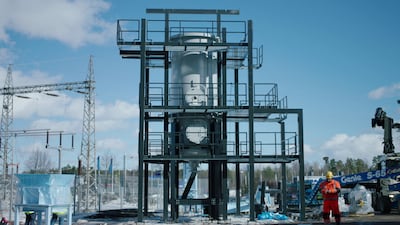
It has plants in the US and Europe and its bio-char can be used to improve soil quality. Photo: Carbo Culture -

Jolis Nduwimana, an entrepreneur from Burundi, says he built connections at Cop28 to support his sustainability ambitions. Khushnum Bhandari / The National -

His start-up Wege collects plant, banana and paper waste from 15,200 small-scale farms that would otherwise be burnt. Photo: Jolis Nduwimana -
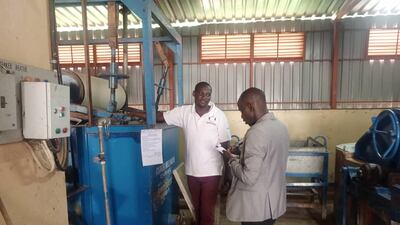
The waste is boiled in vats and transformed into eco-friendly bags. Photo: Jolis Nduwimana -

The company now makes 500 eco-friendly bags each day with ambition to grow to 2,000. Photo: Jolis Nduwimana -

A Burundi ban on plastic bags set Mr Nduwimana thinking about a solution. Photo: Jolis Nduwimana -

The team spends hours separating paper, banana and rice waste before its converted to pulp. Photo: Jolis Nduwimana -

The waste would otherwise be burnt or rot in landfills. Photo: Jolis Nduwimana -

The pulp is dried in the sun before being used to make bags. Photo: Jolis Nduwimana -

Wege sells the bags to boutiques and pharmaceutical companies Photo: Jolis Nduwimana


Global progress towards energy efficiency has accelerated on supportive policies and higher investment following Russia’s invasion of Ukraine, which resulted in a drastic reduction in gas supplies to Europe.
Energy efficiency progress, as measured by improvements in primary energy intensity, rose to 2.2 per cent in 2022, double the average over the previous five years and four times the rate achieved in 2020 and 2021, the International Energy Agency said in a report last year.
“It is crucial we address energy demand alongside supply, reducing the energy intensity of current activity and increasing the energy efficiency of future growth,” said Bob Moritz, global chair of PwC.
“We need to raise awareness of the business case for change, align policy and private incentives, and develop new financial solutions to unlock action,” he added.
The 54th annual meeting of the WEF is set to take place in Davos, Switzerland from January 15th until January 19th.
The event will bring together governments and business leaders against the backdrop of two major geopolitical conflicts and growing momentum in climate change discussions.

