

The adoption of new “disruptive” technology along with improvements in energy efficiency could help limit global temperature rises to 1.6°C under the Paris Agreement, a report has found.
Emerging technology is being adopted rapidly enough to “outcompete” fossil fuels, restricting carbon-dioxide emissions within the range of 650 to 1,200 gigatonnes for the period 2018–2100, Rystad Energy said in a report this week.
That would correspond to global temperatures increases of 1.6°C to 1.9°C, aligned with the Paris Agreement goal of holding warming “well below 2°C”, Rystad said, citing the carbon budget scenarios of the Intergovernmental Panel on Climate Change (IPCC).
A carbon budget is the cumulative amount of carbon dioxide emissions permitted over a period to keep within a certain temperature threshold.
Advancement in methane emission reduction technology offers the potential to prevent up to 0.2°C of global warming, the Norway-based consultancy said.
The belief that primary energy will continue to grow at pace with the global economy and that fossil fuels would be too expensive to replace are “behind the times”, said Jarand Rystad, chief executive of Rystad.
Primary energy supply, including all fossil fuels and renewables, is currently about 600 exajoules (EJ) after growing rapidly since 1965 on the back of strong population growth and economic progress.
However, primary energy supply is likely to peak soon at about 630 EJ by 2030 and then decline, Rystad said.
Of the 500 EJ of primary energy from fossil fuels currently, only 250 goes to the end user, while about 440 would be made available if the total came from solar, wind or hydropower, the report said.
"Moreover, energy efficiency improvements in buildings, appliances and machines have been 1 per cent per year over the last decades led by better materials and design. This trend is now accelerating," Rystad said.
The consultancy also expects a peak in global carbon-dioxide emissions around 2027, reflecting the growing impact of renewable energy sources and transition to cleaner fuels across all sectors.
“Historically, emissions reductions in the power sector have been the strongest contributor to declining total emissions in the US and in the EU,” Rystad said.
“This has been largely incentivised by competitive natural gas prices, which motivated coal-to-gas switching, and declining costs of renewable energy, like wind and solar PV [photovoltaic],” the consultancy said.
Investments in low-carbon energy solutions such as solar and wind would eclipse those in oil and gas by 2025, marking a pivotal shift, the consultancy said.
Geothermal and carbon capture, utilisation and storage are also expected to contribute to the investment surge.
“Suppliers are responding to this change, strategically expanding their portfolios to incorporate renewable technologies,” said Rystad.
“This expansion is strategic, allowing suppliers to maintain their footing in the fossil fuel sector, while embracing the burgeoning demand for renewable solutions."
-
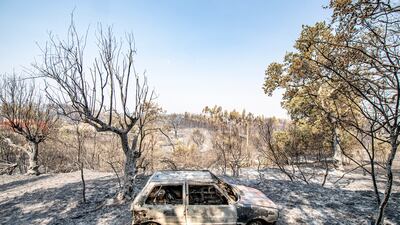
A burnt car in Alvaiazere, Portugal, after wildfires swept across the central part of the country in July 2022. Heatwaves in 2022 may have caused more than 70,000 deaths across Europe, a study has found. All photos: Getty Images -

Cooling off in fountains at the Eiffel Tower. Temperatures in Paris soared towards 40°C in June 2022 -

Low water levels at Baitings Reservoir in Ripponden, England, revealed an ancient pack horse bridge in August 2022 as drought conditions continued -

Burnt wheat after a field fire in July 2022, in Zoerbig, Germany -

Firefighters tackle a forest fire in July 2022 in Albergaria a Velha, Portugal -

The rubble and destruction in Wennington, England, after an enormous fire in July 2022, as the UK experienced a record heatwave -

Parisians cool down at a water station in June 2022 -

A bottle sits in dried mud on the shore of the Beacons Reservoir in Wales, in August 2022 -

A man cools off in the city centre of Frankfurt, Germany, as temperatures reached up to 40°C -

The Po River basin dwindles amid Italy's drought in July 2022 -

Firefighters rest after attending to fires in Wennington, England, in July 2022


Renewable energy is expected to make up nearly half of the global electricity mix by 2030 under current policies, but stronger measures would be required to meet the goals of the Paris Agreement, the International Energy Agency said last month.
By the end of the decade, there will be 10 times as many electric cars on the road worldwide, with the share of renewable energy in power generation rising to 50 per cent from 20 per cent now, the Paris-based agency said in its World Energy Outlook.

