

A group of more than 250 organisations published an open letter calling on world leaders to work towards the target of tripling renewable energy capacity to 11,000 gigawatts by 2030.
The call came ahead of the Cop28 UN climate conference in UAE later this year, which is set to deliver the first five-yearly “global stocktake” ordered by the Paris Agreement, the deal that set the target of limiting global warming to 1.5°C.
Major supporters and signatories of the letter include the Global Renewables Alliance members, the International Renewable Energy Agency (Irena), the Cop28 Presidency, and the United Nations Industrial Development Organisation (Unido).
“Irena’s World Energy Transitions Outlook calls for an immediate course-correction for a 1.5°C climate pathway, enabled by the tripling of renewable energy capacity by 2030,” said Francesco La Camera, director-general of Irena.
“The business case for renewables has never been stronger. But we must urgently overcome the systemic barriers across infrastructure, policy, and institutional capabilities in the coming years and build a new energy system that is run on renewables,” he said.
Annual renewable power capacity must add an average of 1,000 gigawatts annually by 2030 to meet Paris Agreement goals, according to Irena.
Although global renewable capacity in the power sector grew by a record 300 gigawatts last year, the gap between actual progress and the development required to achieve long-term climate goals has continued to grow, the Abu Dhabi-based agency said in June.
“The renewables industry is ready, willing and able to step up but we need policymakers to take urgent action to deliver on the goals of the Paris Agreement,” said Bruce Douglas, chief executive of the Global Renewables Alliance.
Governments must start “implementing the key enablers like accelerated permitting for projects, investment in grids and sustainable supply chains”, he added.
The annual meeting of the United Nations took place at its headquarters in New York this week and top officials discussed the yearly agenda and global issues, including climate change and the war in Ukraine.
In his address to the UN General Assembly, US President Joe Biden referenced natural disasters around the world, including the recent flooding in Libya, as evidence of the threat that a warming world presented.

“Taken together, these snapshots tell an urgent story of what awaits us if we fail to reduce our dependence on fossil fuels and begin to climate-proof our world,” Mr Biden said.
Investment in renewable energy needs to double to more than $4 trillion by the end of the decade to meet net-zero emissions targets by 2050, the International Energy Agency said in its World Energy Outlook last year.
The IEA’s stated policies scenario (Steps), which is based on the latest policy settings worldwide, expects clean energy investment to rise to slightly more than $2 trillion by 2030.
“It is imperative that we deploy the renewable industry’s solutions at scale today to make net zero by 2050 a reality and help deliver a clean, secure and just energy transition,” Mr Douglas said.
-

Mohamad Sabsabi explains how his wind turbine creation, named Green X, provides alternative energy in Bebnine, Lebanon. All photos: Reuters -

He generates power to light his and some neighbours’ houses -
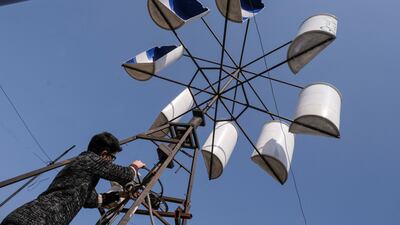
He built the wind turbine using recycled materials -

A view of Green X on the roof of the Sabsabi family building -

Electricity has been scarce in parts of Lebanon for some time -
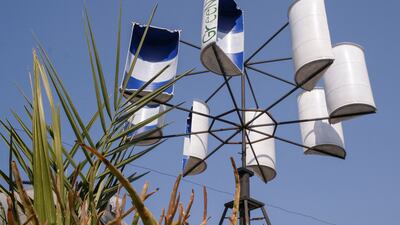
So Mr Sabsabi devised his own way to create power



