

Searing temperatures from Texas to Tokyo over the summer are the latest reminder of a growing headache for the energy system, as extreme heat becomes a threat to fuel supply.
In addition to causing surges in electricity demand as people fire up air conditioners, the scorching temperatures have led to a spate of disruption at oil refineries. That’s helped keep US petrol prices high, while diesel cost increases easily outpace those for crude.
This summer was particularly gruelling: July was the world’s hottest month on record, following the hottest June.
The searing heat led to refiners cutting oil processing by at least 2 per cent globally over those two months, according to Macquarie Group.
While that might not seem much, the cuts have hit a refining system that’s been stretched by years of underinvestment and oil product markets that were already tight due to the war in Ukraine.
“The extreme weather conditions we have seen this year really are a big deal,” said Ben Luckock, co-head of oil trading at commodities behemoth Trafigura Group.
“The heat has created huge problems for refineries in Europe and America, with more outages and problems that are harder to fix,” he said in Singapore this week.
European crude processing dropped by 700,000 barrels a day over the summer from a year earlier, according to an estimate from industry consultant FGE. That’s about 6 per cent of regional throughput, based on figures from BP's latest Statistical Review of World Energy.
More than half of the drop was due to the heat, said Steve Sawyer, FGE’s director of refining and head of downstream.
As well as constraining supply, the rising temperatures are boosting demand for fuel oil that is commonly used to generate electricity in the Middle East and South Asia. They’re also adding to transport costs by drying up vital waterways such as the Rhine and the Panama Canal.
-
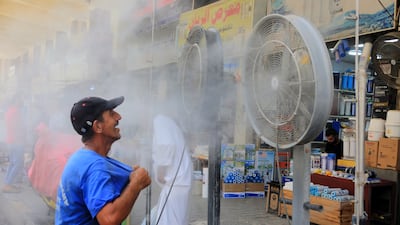
An Iraqi man cool himself off in a spray of water during a sweltering hot day at the Al-Khilani square in central Baghdad, Iraq. EPA -

Children play on water jets at a public square on a very hot afternoon in Madrid, Spain. Getty Images -

A costumed spiderman drinks during a heat wave in New York. Bloomberg -

A pedestrian carries an umbrella during a heat wave in Miami, Florida, US. Bloomberg -

A Palestinian, Mustafa Abdou, repairs fan in his shop amid a heatwave at Shati refugee camp in Gaza City. Reuters -

A man dives into a canal during a hot day in Larkana district of Sind province. AFP -

A man cools himself with a fan while browsing his phone on a sweltering day in Beijing. AP -

People drink coconut water at a market in Dubai to cope with the hot weather. AFP -
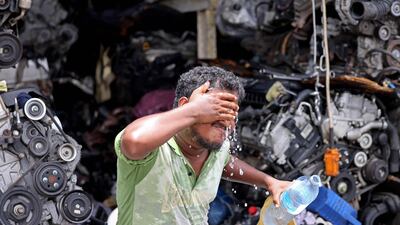
A worker washes his face to cope with the hot weather in Dubai. AFP -

An Egyptian girl cools off in the water amid a heatwave, at a Red Sea resort in Hurghada Egypt. Reuters -

Pedestrians hold umbrellas for protection from the sun during a heat wave in New York, US. Bloomberg -

A homeless person holds an umbrella to block out the sun on a hot day in New York City. AFP -

Bottles of water being delivered on a hot summer day in Istanbul. AP -

Diving into the Treska river near Skopje, as temperatures in North Macedonia soared. AFP -

A woman takes a photograph of the Acropolis in Athens in high temperatures. AFP -

A woman shelters from the sun during a heatwave in Rome. Reuters -

Shelia Nunez, 40, cools her dog with ice while sitting under a shaded bus stop in Phoenix, Arizona. AFP -

A lion eats an icy treat containing meat and ostrich eggs to cool down during a regional heatwave at the Safari Zoological Centre in Ramat Gan, Israel. Reuters -

Children play in a water fountain near the walls of Jerusalem's Old City. Reuters -

Traffic warden Rai Rogers works on his street corner under the hot sun in Las Vegas. AFP -

A woman uses a fan amid an alert for a heatwave in Shanghai. Reuters -

Andrea Washington pours water on herself in the Hungry Hill neighbourhood of Austin, Texas. Getty -

A busy beach in Rabat, Morocco. EPA -

A person receives medical attention after collapsing in a shop in Phoenix, Arizona, in high heat. AFP -

An Iraqi dives into the Tigris to beat the heat in Baghdad. AP -

Youths play in a fountain at a park in the Syrian capital Damascus, as temperatures exceed 35°C. AFP


“Rising ambient temperatures are limiting operating efficiencies of refinery units” and there are also more problems due to ageing plants, said Serena Huang, lead Asia analyst at Vortexa.
“Disruptions to refinery supply or shipping operations is almost certain to amplify uncertainty and price volatility in the market.”
Extreme heat is still much more of a problem for stretched electricity grids than fuel refiners. But its impact on fuel markets has been magnified by dwindling stockpiles, with US inventories of middle distillates, including diesel, near a five-year seasonal low.
That’s supporting diesel costs ever more, with profits from making the industrial and heating fuel from crude near seasonal highs in Singapore.
US diesel futures have also shifted into the widest backwardation since March, a market structure where prompt contracts trade at premiums to longer-dated ones.
And it’s not only the rising mercury threatening refinery operations and fuel prices.
“Climate change is also causing more extreme winter weather across the Northern Hemisphere as a warming Pacific can move northward and push south the polar vortex, causing cold spikes in North Asia, Europe and North America,” said Henning Gloystein, director of energy climate and resources at Eurasia Group.
The freeze in the US in late December was an example of that. Refinery throughput dropped by about 2 million barrels a day over the period, said Parsley Ong, the head of Asia energy and chemicals research at JP Morgan Chase.
The increase in weather-driven refinery disruption highlights the growing array of challenges as the world attempts to wean itself off fossil fuels, while at the same time trying to cope with their impact on the climate.
“The market is overly sensitive to any unexpected supply disruption anywhere,” said Frederic Lasserre, global head of research and analysis at Gunvor Group.
“Everyone knows there’s no plan B. We have no stocks and we have no excess capacity anywhere.”

