A gas flare in Lago Agrio, Ecuador. Global emissions rose at a slower rate last year, an IEA report says. Reuters

Global carbon emissions in 2022 were offset by growth in renewables, IEA says


  • English
  • Arabic

Global carbon dioxide emissions rose by less than 1 per cent last year as the growth of renewable energy and electric vehicles helped offset a surge in crude oil and coal consumption, the International Energy Agency said.

Carbon dioxide emissions grew by 0.9 per cent in 2022 to reach a new high of more than 36.8 billion tonnes, the agency said in its 'CO2 Emissions' report on Thursday.

The emissions, considerably lower than the 6 per cent surge in 2021, are still growing at an “unsustainable” rate, said the Paris-based agency, which called for stronger measures to speed up the transition to clean energy.

“The impacts of the energy crisis didn’t result in the major increase in global emissions that was initially feared — and this is thanks to the outstanding growth of renewables, EVs, heat pumps and energy efficient technologies,” said IEA executive director Fatih Birol.

“However, we still see emissions growing from fossil fuels, hindering efforts to meet the world’s climate targets.”

Emissions falling below last year’s global economic growth rate of 3.2 per cent signals a shift to a “decade-long” trend that was interrupted in 2021 due to a swift economic recovery from the Covid-19 crisis, the IEA said.

The deployment of clean energy technology helped offset emissions from extreme weather events, such as droughts and heatwaves, and the shutdown of a large number of nuclear power plants, it said.

Carbon dioxide emissions from coal grew 1.6 per cent as the global energy crisis resulted in more switching from gas to coal, the agency said.

Meanwhile, crude oil emissions rose by 2.5 per cent but remained below pre-pandemic levels.

“International and national fossil-fuel companies are making record revenue and need to take their share of responsibility, in line with their public pledges to meet climate goals,” Mr Birol said.

“It’s critical that they review their strategies to make sure they’re aligned with meaningful emissions reductions.”

The global oil and gas industry's income jumped to almost $4 trillion last year, from its recent average of $1.5 trillion, the agency said last month.

China’s emissions were “broadly flat” last year as the country’s strict zero-Covid policy led to weaker economic growth.

The EU’s emissions fell by 2.5 per cent thanks to “record” deployment of renewables, a warm winter and energy conservation measures, the agency said.

Meanwhile, emissions grew by 0.8 per cent in the US as buildings increased their energy consumption to cope with extreme temperatures.

Excluding China, emissions from Asia’s emerging and developing economies increased by 4.2 per cent amid rapid economic and energy demand growth.

Global energy industry’s methane emissions surged to 135 million tonnes last year, slightly below 2019’s record highs, the agency said in a report last month.

Methane is responsible for about a third of global temperature increases since the Industrial Revolution. It dissipates faster than carbon dioxide but is a much more powerful greenhouse gas during its short lifespan.

The energy sector accounts for about 40 per cent of total methane emissions attributable to human activity, second only to agriculture.

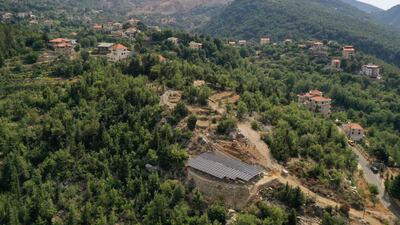
  • An aerial view of the solar panels installed in the village of Toula in northern Lebanon. All photos by AFP
    An aerial view of the solar panels installed in the village of Toula in northern Lebanon. All photos by AFP
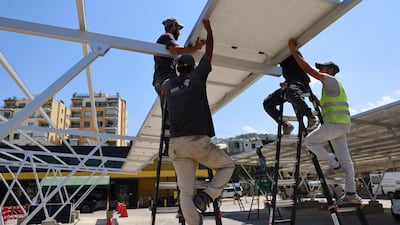
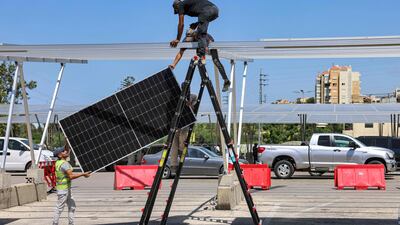
  • Workers instal solar panels as shades for vehicles in the car park of a shopping mall in the city of Byblos in northern Lebanon.
    Workers instal solar panels as shades for vehicles in the car park of a shopping mall in the city of Byblos in northern Lebanon.
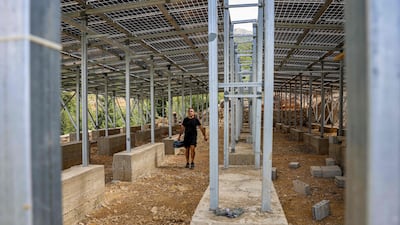
  • A technician works on the solar panel system installed for the village of Toula in northern Lebanon.
    A technician works on the solar panel system installed for the village of Toula in northern Lebanon.
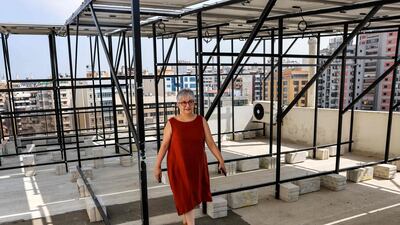
  • Lebanese homemaker Zeina Sayegh walks beneath the solar panels she installed atop her apartment building in Lebanon's capital Beirut.
    Lebanese homemaker Zeina Sayegh walks beneath the solar panels she installed atop her apartment building in Lebanon's capital Beirut.
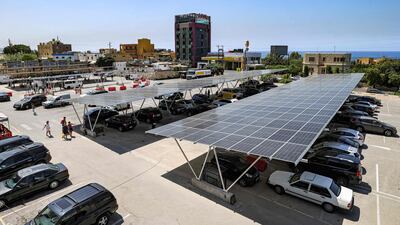
  • Solar panels cover a shopping mall's car park in the city of Byblos in northern Lebanon.
    Solar panels cover a shopping mall's car park in the city of Byblos in northern Lebanon.
  • Workers instal solar panels over parking spaces at a shopping mall in Byblos, Lebanon.
    Workers instal solar panels over parking spaces at a shopping mall in Byblos, Lebanon.
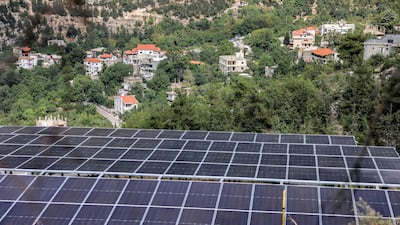
  • The solar panel system installed on a hillside above the village of Toula in northern Lebanon.
    The solar panel system installed on a hillside above the village of Toula in northern Lebanon.
  • Solar panels cover the roof of a shopping mall in Byblos, Lebanon.
    Solar panels cover the roof of a shopping mall in Byblos, Lebanon.
RESULTS
%3Cp%3E3.30pm%3A%20Al%20Maktoum%20Challenge%20Round%203%20%E2%80%93%20Group%201%20(PA)%20%2475%2C000%20(Dirt)%202%2C000m%3Cbr%3EWinner%3A%20Jugurtha%20De%20Monlau%2C%20Pat%20Dobbs%20(jockey)%2C%20Jean-Claude%20Pecout%20(trainer)%3C%2Fp%3E%0A%3Cp%3E4.05pm%3A%20Dubai%20City%20Of%20Gold%20%E2%80%93%20Group%202%20(TB)%20%24250%2C000%20(Turf)%202%2C410m%3Cbr%3EWinner%3A%20Global%20Storm%2C%20William%20Buick%2C%20Charlie%20Appleby%3C%2Fp%3E%0A%3Cp%3E4.40pm%3A%20Burj%20Nahaar%20%E2%80%93%20Group%203%20(TB)%20%24250%2C000%20(D)%201%2C600m%3Cbr%3EWinner%3A%20Discovery%20Island%2C%20James%20Doyle%2C%20Bhupat%20Seemar%3C%2Fp%3E%0A%3Cp%3E5.15pm%3A%20Nad%20Al%20Sheba%20Turf%20Sprint%20%E2%80%93%20Group%203%20(TB)%20%24250%2C000%20(T)%201%2C200m%3Cbr%3EWinner%3A%20Al%20Dasim%2C%20Mickael%20Barzalona%2C%20George%20Boughey%3C%2Fp%3E%0A%3Cp%3E5.50pm%3A%20Al%20Bastakiya%20%E2%80%93%20Listed%20(TB)%20%24170%2C000%20(D)%201%2C900m%3Cbr%3EWinner%3A%20Go%20Soldier%20Go%2C%20Adrie%20de%20Vries%2C%20Fawzi%20Nass%3C%2Fp%3E%0A%3Cp%3E6.25pm%3A%20Al%20Maktoum%20Challenge%20Round%203%20%E2%80%93%20Group%201%20(TB)%20%24450%2C000%20(D)%202%2C000m%3Cbr%3EWinner%3A%20Salute%20The%20Soldier%2C%20Adrie%20de%20Vries%2C%20Fawzi%20Nass%3C%2Fp%3E%0A%3Cp%3E7.10pm%3A%20Ras%20Al%20Khor%20%E2%80%93%20Conditions%20(TB)%20%24300%2C000%20(T)%201%2C400m%3Cbr%3EWinner%3A%20Al%20Suhail%2C%20William%20Buick%2C%20Charlie%20Appleby%3C%2Fp%3E%0A%3Cp%3E7.45pm%3A%20Jebel%20Hatta%20%E2%80%93%20Group%201%20(TB)%20%24350%2C000%20(T)%201%2C800m%3Cbr%3EWinner%3A%20Alfareeq%2C%20Dane%20O%E2%80%99Neill%2C%20Charlie%20Appleby%3C%2Fp%3E%0A%3Cp%3E8.20pm%3A%20Mahab%20Al%20Shimaal%20%E2%80%93%20Group%203%20(TB)%20%24250%2C000%20(D)%201%2C200m%3Cbr%3EWinner%3A%20Sound%20Money%2C%20Mickael%20Barzalona%2C%20Bhupat%20Seemar%3C%2Fp%3E%0A

Mercer, the investment consulting arm of US services company Marsh & McLennan, expects its wealth division to at least double its assets under management (AUM) in the Middle East as wealth in the region continues to grow despite economic headwinds, a company official said.

Mercer Wealth, which globally has $160 billion in AUM, plans to boost its AUM in the region to $2-$3bn in the next 2-3 years from the present $1bn, said Yasir AbuShaban, a Dubai-based principal with Mercer Wealth.

Within the next two to three years, we are looking at reaching $2 to $3 billion as a conservative estimate and we do see an opportunity to do so,” said Mr AbuShaban.

Mercer does not directly make investments, but allocates clients’ money they have discretion to, to professional asset managers. They also provide advice to clients.

“We have buying power. We can negotiate on their (client’s) behalf with asset managers to provide them lower fees than they otherwise would have to get on their own,” he added.

Mercer Wealth’s clients include sovereign wealth funds, family offices, and insurance companies among others.

From its office in Dubai, Mercer also looks after Africa, India and Turkey, where they also see opportunity for growth.

Wealth creation in Middle East and Africa (MEA) grew 8.5 per cent to $8.1 trillion last year from $7.5tn in 2015, higher than last year’s global average of 6 per cent and the second-highest growth in a region after Asia-Pacific which grew 9.9 per cent, according to consultancy Boston Consulting Group (BCG). In the region, where wealth grew just 1.9 per cent in 2015 compared with 2014, a pickup in oil prices has helped in wealth generation.

BCG is forecasting MEA wealth will rise to $12tn by 2021, growing at an annual average of 8 per cent.

Drivers of wealth generation in the region will be split evenly between new wealth creation and growth of performance of existing assets, according to BCG.

Another general trend in the region is clients’ looking for a comprehensive approach to investing, according to Mr AbuShaban.

“Institutional investors or some of the families are seeing a slowdown in the available capital they have to invest and in that sense they are looking at optimizing the way they manage their portfolios and making sure they are not investing haphazardly and different parts of their investment are working together,” said Mr AbuShaban.

Some clients also have a higher appetite for risk, given the low interest-rate environment that does not provide enough yield for some institutional investors. These clients are keen to invest in illiquid assets, such as private equity and infrastructure.

“What we have seen is a desire for higher returns in what has been a low-return environment specifically in various fixed income or bonds,” he said.

“In this environment, we have seen a de facto increase in the risk that clients are taking in things like illiquid investments, private equity investments, infrastructure and private debt, those kind of investments were higher illiquidity results in incrementally higher returns.”

The Abu Dhabi Investment Authority, one of the largest sovereign wealth funds, said in its 2016 report that has gradually increased its exposure in direct private equity and private credit transactions, mainly in Asian markets and especially in China and India. The authority’s private equity department focused on structured equities owing to “their defensive characteristics.”

Innotech Profile

Date started: 2013

Founder/CEO: Othman Al Mandhari

Based: Muscat, Oman

Sector: Additive manufacturing, 3D printing technologies

Size: 15 full-time employees

Stage: Seed stage and seeking Series A round of financing 

Investors: Oman Technology Fund from 2017 to 2019, exited through an agreement with a new investor to secure new funding that it under negotiation right now. 

Persuasion
%3Cp%3E%3Cstrong%3EDirector%3A%20%3C%2Fstrong%3ECarrie%20Cracknell%C2%A0%3C%2Fp%3E%0A%3Cp%3E%3Cstrong%3EStars%3A%20%3C%2Fstrong%3EDakota%20Johnson%2C%20Cosmo%20Jarvis%2C%20Richard%20E%20Grant%2C%20Henry%20Golding%20and%20Nikki%20Amuka-Bird%3C%2Fp%3E%0A%3Cp%3E%3Cstrong%3ERating%3A%3C%2Fstrong%3E%201.5%2F5%3C%2Fp%3E%0A
Company profile

Company name: Dharma

Date started: 2018

Founders: Charaf El Mansouri, Nisma Benani, Leah Howe

Based: Abu Dhabi

Sector: TravelTech

Funding stage: Pre-series A 

Investors: Convivialite Ventures, BY Partners, Shorooq Partners, L& Ventures, Flat6Labs

Updated: March 02, 2023, 6:56 AM