

There is a ritual involved in creating the perfect Sichuan hot pot and it involves fat — lots of it. Diners first immerse slivers of meat in a spicy soup rich in molten animal tallow, then dip each morsel in a plate of vegetable oil, before finally devouring it.
It is a rich delicacy that produces about 12,000 tonnes of waste oil each month in the Chinese city of Chengdu.
So, in 2016, a start-up began exporting some of that leftover restaurant grease to Europe and Singapore, where it is recycled into fuel pure enough to fly aircraft.
Responsible for about 2 per cent of the world’s total emissions of planet-warming gases, the aviation industry is under pressure to find greener ways to power its jet engines.
Several major airlines including British Airways, Cathay Pacific Airways and Delta Air Lines, have pledged to replace about 10 per cent of their jet fuel with a sustainable alternative by 2030.
More than 50 have started to experiment with it, but cleaner substitutes are still being developed.
Waste oil from kitchens is emerging as a major source of sustainable jet fuel because it does not displace food production or encourage deforestation to make way for crops.
China is already the largest exporter.
“Our mission is to make gutter oil fly to the sky,” said Zhong Guojun, vice president of Sichuan Jinshang Environmental Technology, which is behind the project.
The Chengdu-based company collects used oil, mostly from hot pot restaurants in the Sichuan capital of 16 million and removes impurities such as sodium and metal particles.
Its end product is a biofuel precursor usually called industrial mixed oil, which is then packed on ships that travel to Shanghai. From there it is exported to Neste Oyj, the world’s largest producer of sustainable aviation fuel, and global energy companies including BP and Eni SpA, to be further refined into biodiesel or jet fuel.
Jinshang began to export the leftover fat for industrial use in 2016, when demand for biofuels from international refiners first took off.
China consumes more edible oil than any other country — more than 41 million tonnes a year. So far, less than 3 million tonnes of it ends up in the supply chain for biodiesel, a major type of biofuel that has surged in price amid rising European demand, the state-owned People’s Daily reported last year.
That leaves a lot of room for growth, especially as governments and industry regulators tighten rules to meet emissions targets that are key to tackling climate change.
The International Civil Aviation Organisation launched a carbon offsetting and reduction scheme in 2016 that encourages the use of sustainable fuels in addition to technical and operational improvements.
The EU is also tightening its rules, introducing requirements that its planes and airports blend in 5 per cent sustainable aviation fuels by 2030, gradually rising to 85 per cent in 2050.
Sustainable aviation fuel remains much more expensive than its conventional counterpart, but those targets are forcing airlines to respond, with some teaming up with start-ups developing cleaner technology.
-
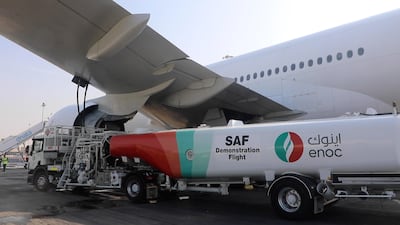
Emirates successfully tested a Boeing 777 with one engine entirely powered by sustainable aviation fuel. All photos: Andrew Scott / The National -

Specially chosen pilots flew the plane for an hour to test the performance of the sustainable aviation fuel -

Sustainable aviation fuel emits 75-80 per cent less CO2 per lifecycle -

By 2030, every plane made by Boeing will fly using sustainable aviation fuel -
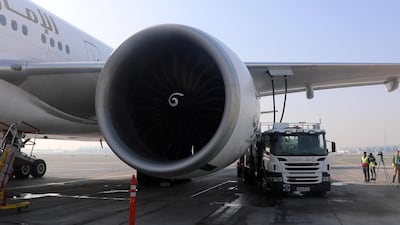
It is the first commercial flight to use biofuel -

Emirates plans to run the same test flight with an Airbus A380 -
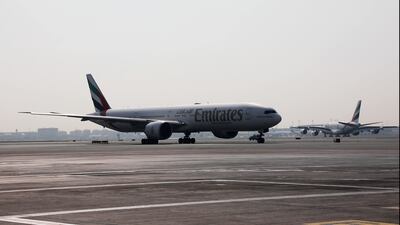
The Boeing 777-300ER was the first in the Mena region to be powered by 100% SAF in one of two engines


“When there is a demand, the supply will catch up, and the demand is already here,” said Chong Cheng Tung, associate professor at the China-UK Low Carbon College, Shanghai Jiao Tong University.
“So either you switch your fuel to green fuel, like bio jet fuel, or you have to pay a lot of premium for travelling.”
Neste last year announced plans to invest 1.9 billion euros ($2.05 billion) to expand its renewable product capacity. It aims to be able to produce 1.2 million tonnes of sustainable jet fuel a year in 2026.
While there were only two companies in the world making sustainable aviation fuel at a commercial scale before 2021, several big players, including TotalEnergies, Chevron Corp, Eni, and BP have since begun small-scale production and plan to ramp up, BloombergNEF said.
“These companies will need to buy more waste cooking oil, and the Chinese market will for sure see growth,” said Ye Hao, head of Jinshang’s global business team.
Jinshang aims to nearly double its production capacity this year by building new facilities and collecting more oil from provinces beyond Sichuan, the company said.
It also plans to build facilities to refine the gutter oil into biofuel itself.
But rising demand from airlines could eventually outstrip China’s supply. Waste fats, oils and greases may be able to meet about 4 per cent of global demand for jet fuel by 2030, BloombergNEF has estimated.
“When we reach capacity and all these food waste oils have been utilised,” said Mr Chong. "Then we have to look for other feedstocks.”

