From left: Rovshan Najaf, President of Socar; Mikayil Jabbarov, Azerbaijan's Minister of Economy; Dr Sultan Al Jaber, UAE Minister of Industry and Advanced Technology and chairman of Masdar; and Mohamed Al Ramahi, chief executive of Masdar. Photo: Masdar
From left: Rovshan Najaf, President of Socar; Mikayil Jabbarov, Azerbaijan's Minister of Economy; Dr Sultan Al Jaber, UAE Minister of Industry and Advanced Technology and chairman of Masdar; and Moham

Masdar signs agreements with Azerbaijan to develop renewable energy projects


  • English
  • Arabic

Abu Dhabi’s clean energy company Masdar has signed agreements with Azerbaijan’s state oil firm Socar to develop renewable energy projects with a total capacity of 4 gigawatts.

The agreements were signed for onshore wind and solar projects as well as integrated offshore wind and green hydrogen projects, on the sidelines of Abu Dhabi Sustainability Week, Masdar said in a statement on Tuesday.

“These agreements will serve to strengthen the already powerful relationship between the UAE and the Republic of Azerbaijan, and are a testament to our shared commitment to diversifying our energy mix and developing low- and zero-carbon solutions,” said Dr Sultan Al Jaber, the UAE Minister of Industry and Advanced Technology and chairman of Masdar. He is also the President-designate of Cop28 and managing director and group chief executive of Adnoc.

Last August, Masdar achieved a financial close on its 230-megawatt Garadagh solar power plant in Azerbaijan.

The plant is expected to generate half a billion kilowatt-hours of electricity annually, meeting the needs of more than 110,000 homes.

Azerbaijan, which largely relies on natural gas to meet its energy needs, plans to increase its installed power capacity to 30 per cent from renewable sources by 2030 in an effort to diversify its economy and reduce greenhouse gas emissions.

The country is developing several clean energy projects.

In January last year, Saudi Arabia's Acwa Power and Azerbaijan's energy ministry started work on a $300 million, 240-megawatt wind power station.

“Masdar sees Azerbaijan as a key strategic partner, one we are proud to support in its clean energy journey,” said Mohamed Al Ramahi, chief executive of Masdar.

“This signing marks a milestone on the development and delivery of a significant collaboration that will advance Azerbaijan’s renewable energy goals and support its ongoing sustainable economic development.”

Earlier this month, Masdar signed an agreement with Kyrgyzstan’s energy ministry to develop clean energy projects with a capacity of up to 1 gigawatt.

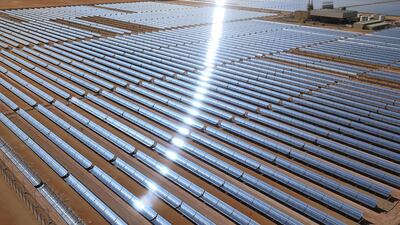
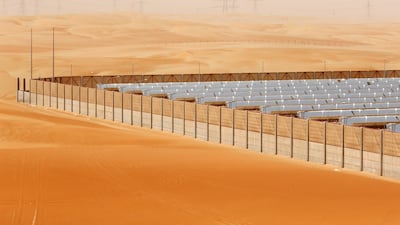
  • Shams 1 Solar Power Station in Abu Dhabi's Al Dhafra region. Photo: Masdar
    Shams 1 Solar Power Station in Abu Dhabi's Al Dhafra region. Photo: Masdar
  • Shams 1 opened in 2013 and generates enough electricity to power tens of thousands of homes. Photo: Masdar
    Shams 1 opened in 2013 and generates enough electricity to power tens of thousands of homes. Photo: Masdar
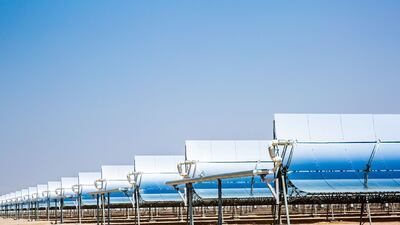
  • Shams uses 'parabolic trough' systems, meaning it directs heat on to liquid, which causes steam that then drives a turbine. Photo: Masdar
    Shams uses 'parabolic trough' systems, meaning it directs heat on to liquid, which causes steam that then drives a turbine. Photo: Masdar
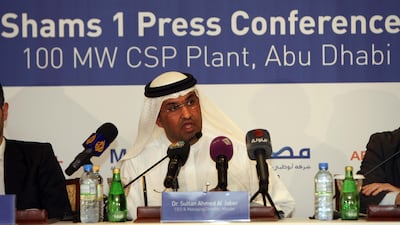
  • Dr Sultan Al Jaber announces the Shams 1 project back in 2010. Stephen Lock / The National
    Dr Sultan Al Jaber announces the Shams 1 project back in 2010. Stephen Lock / The National
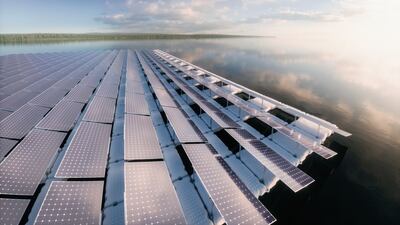
  • Cirata, a floating solar plant in Indonesia, expected to enter operation in 2022. Photo: Masdar
    Cirata, a floating solar plant in Indonesia, expected to enter operation in 2022. Photo: Masdar
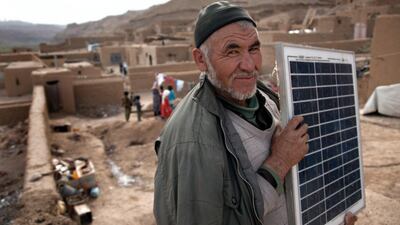
  • Masdar helped thousands of people in Afghanistan to access power though solar rooftop panels. Photo: Masdar
    Masdar helped thousands of people in Afghanistan to access power though solar rooftop panels. Photo: Masdar
  • It was the first time thousands of Afghan people had an electricity supply. Photo: Masdar
    It was the first time thousands of Afghan people had an electricity supply. Photo: Masdar
  • Masdar's rooftop project in Afghanistan. Photo: Masdar
    Masdar's rooftop project in Afghanistan. Photo: Masdar
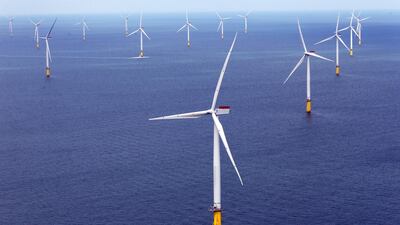
  • The London Array, the world's largest offshore wind farm in the Thames Estuary off the coast of the UK. Stephen Lock / The National
    The London Array, the world's largest offshore wind farm in the Thames Estuary off the coast of the UK. Stephen Lock / The National
  • Another view of the London Array. Stephen Lock / The National
    Another view of the London Array. Stephen Lock / The National
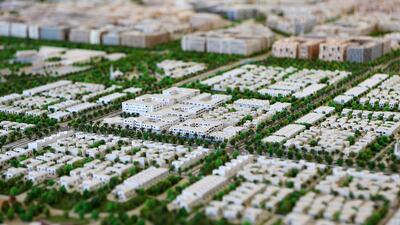
  • A model of Masdar City, which champions sustainable living. Pawan Singh / The National
    A model of Masdar City, which champions sustainable living. Pawan Singh / The National
  • The opening of Shams 1 in 2013. Silvia Razgova / The National
    The opening of Shams 1 in 2013. Silvia Razgova / The National
  • The Shams 1 plant was one of the first concentrated solar power plants in the region. Christopher Pike / The National
    The Shams 1 plant was one of the first concentrated solar power plants in the region. Christopher Pike / The National
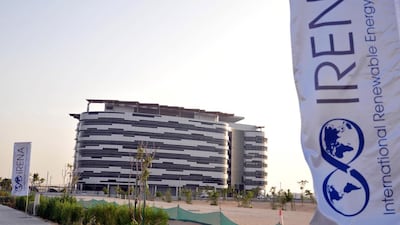
  • Irena's headquarters in Masdar City, Abu Dhabi. Wam
    Irena's headquarters in Masdar City, Abu Dhabi. Wam
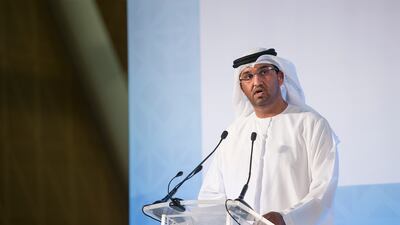
  • Dr Al Jaber is leading the charge to a greener tomorrow. Mona Al Marzooqi / The National
    Dr Al Jaber is leading the charge to a greener tomorrow. Mona Al Marzooqi / The National

The pipeline of projects will start with a 200-megawatt solar photovoltaic plant, which is expected to begin operations by 2026.

Last month, the Abu Dhabi National Energy Company — better known as Taqa — Mubadala Investment Company and Adnoc completed a deal to become shareholders in Masdar.

The move is expected to help Masdar grow rapidly on a global scale under an expanded mandate that covers renewable power, green hydrogen and other clean energy technology.

The UAE, Opec's third-largest oil producer, plans to invest Dh600 billion ($163.3 billion) by 2050 in renewable and clean energy capacity and achieve net-zero emissions in the next three decades.

Established by Mubadala in 2006, Masdar has taken a leadership role in the global clean energy sector and has also helped to drive the nation’s economic diversification and climate action agenda.

Masdar currently operates in 40 countries and has a total investment of about $20 billion.

The company has an ambitious target to grow its capacity to at least 100 gigawatts of renewable energy capacity globally by 2030. The largest share of this capacity will come from wind and solar technology.

Beyond the initial goals, the company seeks to develop more than 200 gigawatts of renewable energy.


UAE Premiership

Results
Dubai Exiles 24-28 Jebel Ali Dragons
Abu Dhabi Harlequins 43-27 Dubai Hurricanes

Fixture
Friday, March 29, Abu Dhabi Harlequins v Jebel Ali Dragons, The Sevens, Dubai

Mercer, the investment consulting arm of US services company Marsh & McLennan, expects its wealth division to at least double its assets under management (AUM) in the Middle East as wealth in the region continues to grow despite economic headwinds, a company official said.

Mercer Wealth, which globally has $160 billion in AUM, plans to boost its AUM in the region to $2-$3bn in the next 2-3 years from the present $1bn, said Yasir AbuShaban, a Dubai-based principal with Mercer Wealth.

Within the next two to three years, we are looking at reaching $2 to $3 billion as a conservative estimate and we do see an opportunity to do so,” said Mr AbuShaban.

Mercer does not directly make investments, but allocates clients’ money they have discretion to, to professional asset managers. They also provide advice to clients.

“We have buying power. We can negotiate on their (client’s) behalf with asset managers to provide them lower fees than they otherwise would have to get on their own,” he added.

Mercer Wealth’s clients include sovereign wealth funds, family offices, and insurance companies among others.

From its office in Dubai, Mercer also looks after Africa, India and Turkey, where they also see opportunity for growth.

Wealth creation in Middle East and Africa (MEA) grew 8.5 per cent to $8.1 trillion last year from $7.5tn in 2015, higher than last year’s global average of 6 per cent and the second-highest growth in a region after Asia-Pacific which grew 9.9 per cent, according to consultancy Boston Consulting Group (BCG). In the region, where wealth grew just 1.9 per cent in 2015 compared with 2014, a pickup in oil prices has helped in wealth generation.

BCG is forecasting MEA wealth will rise to $12tn by 2021, growing at an annual average of 8 per cent.

Drivers of wealth generation in the region will be split evenly between new wealth creation and growth of performance of existing assets, according to BCG.

Another general trend in the region is clients’ looking for a comprehensive approach to investing, according to Mr AbuShaban.

“Institutional investors or some of the families are seeing a slowdown in the available capital they have to invest and in that sense they are looking at optimizing the way they manage their portfolios and making sure they are not investing haphazardly and different parts of their investment are working together,” said Mr AbuShaban.

Some clients also have a higher appetite for risk, given the low interest-rate environment that does not provide enough yield for some institutional investors. These clients are keen to invest in illiquid assets, such as private equity and infrastructure.

“What we have seen is a desire for higher returns in what has been a low-return environment specifically in various fixed income or bonds,” he said.

“In this environment, we have seen a de facto increase in the risk that clients are taking in things like illiquid investments, private equity investments, infrastructure and private debt, those kind of investments were higher illiquidity results in incrementally higher returns.”

The Abu Dhabi Investment Authority, one of the largest sovereign wealth funds, said in its 2016 report that has gradually increased its exposure in direct private equity and private credit transactions, mainly in Asian markets and especially in China and India. The authority’s private equity department focused on structured equities owing to “their defensive characteristics.”

Updated: January 17, 2023, 3:33 PM