Tesla Model 3 vehicles at the car maker's factory in Shanghai, China. Reuters

Tesla set to announce electric vehicle assembly plant in Mexico next week


  • English
  • Arabic

Tesla is finalising plans to build an electric vehicle assembly plant in an industrial area of northeastern Mexico and may announce the factory as early as next week.

The plant is to be located in Santa Catarina in Monterrey city, the capital of Nuevo Leon state, sources said.

Final details are being worked out, and the talks with the company have involved both the state government and Mexico’s foreign relations ministry, one said.

Chief executive Elon Musk visited Nuevo Leon in October and met officials, and the company’s relationship with the state’s government has earned it an exclusive customs lane for parts crossing the border into Texas.

The factory would be Tesla’s first south of the US border with Mexico and part of a push to expand global manufacturing that has included new plants in Austin, Texas, and Berlin, as well as a factory in Shanghai.

Tesla has long mulled building a third factory in North America, with Mr Musk telling shareholders in August that a decision might be made before the end of the year.

The announcement would come just days after Mexico and Canada won a trade dispute with the US over cars shipped across regional borders, a development that gives car makers more incentive to manufacture in those nations.

A Mexican-made electric vehicle would be likely to qualify for subsidies under US legislation signed in August designed to spur adoption of EVs, as long as it met battery content requirements.

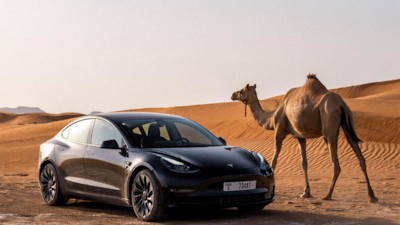
Tesla field engineers heat-test vehicles in Dubai — in pictures

  • Tesla field quality engineers have been in Dubai at the hottest time of the year, analysing the electric cars for their durability and performance in extreme temperatures. All photos: Tesla
    Tesla field quality engineers have been in Dubai at the hottest time of the year, analysing the electric cars for their durability and performance in extreme temperatures. All photos: Tesla
  • Tesla posted about the tests on Instagram, saying the cars had experienced temperatures greater than 50°C.
    Tesla posted about the tests on Instagram, saying the cars had experienced temperatures greater than 50°C.
  • The line-up of cars tested includes the Model Y, the refreshed Model X and the Model 3.
    The line-up of cars tested includes the Model Y, the refreshed Model X and the Model 3.
  • The engineers took on sand, mountain roads and gravel-strewn tracks.
    The engineers took on sand, mountain roads and gravel-strewn tracks.
  • Testing a car for durability requires it to be pushed to the limit.
    Testing a car for durability requires it to be pushed to the limit.
  • The company does its cold weather testing in Alaska, the US.
    The company does its cold weather testing in Alaska, the US.
  • The engineers may also have looked at the performance of the new heat pump, which was introduced into the Model Y last year.
    The engineers may also have looked at the performance of the new heat pump, which was introduced into the Model Y last year.
  • Hitting the dunes.
    Hitting the dunes.
  • Tesla field quality engineers will study the data to help improve the performance of the electric vehicles.
    Tesla field quality engineers will study the data to help improve the performance of the electric vehicles.

It is unclear which models Tesla will produce in its Mexican factory or when it would begin production. Those details could be announced in the coming days, the sources said.

Tesla would be locating in an automotive corridor of Nuevo Leon that is home to factories for General Motors and Kia Motors, a unit of South Korea’s Hyundai Kia Automotive Group.

Ford Motor also builds its electric Mustang Mach-E in Cuautitlan, near Mexico City.

Mr Musk has set a goal of selling 20 million electric vehicles a year by 2030, which would make Tesla twice the size of any rival and account for 20 per cent of global auto output.


Honeymoonish
%3Cp%3E%3Cstrong%3EDirector%3A%3C%2Fstrong%3E%20Elie%20El%20Samaan%3C%2Fp%3E%0A%3Cp%3E%3Cstrong%3EStarring%3A%20%3C%2Fstrong%3ENour%20Al%20Ghandour%2C%20Mahmoud%20Boushahri%3C%2Fp%3E%0A%3Cp%3E%3Cstrong%3ERating%3A%3C%2Fstrong%3E%203%2F5%3C%2Fp%3E%0A
Ten tax points to be aware of in 2026

1. Domestic VAT refund amendments: request your refund within five years

If a business does not apply for the refund on time, they lose their credit.

2. E-invoicing in the UAE

Businesses should continue preparing for the implementation of e-invoicing in the UAE, with 2026 a preparation and transition period ahead of phased mandatory adoption. 

3. More tax audits

Tax authorities are increasingly using data already available across multiple filings to identify audit risks. 

4. More beneficial VAT and excise tax penalty regime

Tax disputes are expected to become more frequent and more structured, with clearer administrative objection and appeal processes. The UAE has adopted a new penalty regime for VAT and excise disputes, which now mirrors the penalty regime for corporate tax.

5. Greater emphasis on statutory audit

There is a greater need for the accuracy of financial statements. The International Financial Reporting Standards standards need to be strictly adhered to and, as a result, the quality of the audits will need to increase.

6. Further transfer pricing enforcement

Transfer pricing enforcement, which refers to the practice of establishing prices for internal transactions between related entities, is expected to broaden in scope. The UAE will shortly open the possibility to negotiate advance pricing agreements, or essentially rulings for transfer pricing purposes. 

7. Limited time periods for audits

Recent amendments also introduce a default five-year limitation period for tax audits and assessments, subject to specific statutory exceptions. While the standard audit and assessment period is five years, this may be extended to up to 15 years in cases involving fraud or tax evasion. 

8. Pillar 2 implementation 

Many multinational groups will begin to feel the practical effect of the Domestic Minimum Top-Up Tax (DMTT), the UAE's implementation of the OECD’s global minimum tax under Pillar 2. While the rules apply for financial years starting on or after January 1, 2025, it is 2026 that marks the transition to an operational phase.

9. Reduced compliance obligations for imported goods and services

Businesses that apply the reverse-charge mechanism for VAT purposes in the UAE may benefit from reduced compliance obligations. 

10. Substance and CbC reporting focus

Tax authorities are expected to continue strengthening the enforcement of economic substance and Country-by-Country (CbC) reporting frameworks. In the UAE, these regimes are increasingly being used as risk-assessment tools, providing tax authorities with a comprehensive view of multinational groups’ global footprints and enabling them to assess whether profits are aligned with real economic activity. 

Contributed by Thomas Vanhee and Hend Rashwan, Aurifer

Bullet%20Train
%3Cp%3E%3Cstrong%3EDirector%3A%3C%2Fstrong%3E%20David%20Leitch%3Cbr%3E%3Cstrong%3EStars%3A%3C%2Fstrong%3E%20Brad%20Pitt%2C%20Aaron%20Taylor-Johnson%2C%20Brian%20Tyree%20Henry%2C%20Sandra%20Bullock%3Cbr%3E%3Cstrong%3ERating%3A%3C%2Fstrong%3E%203%2F5%3C%2Fp%3E%0A
Kill%20Bill%20Volume%201
%3Cp%3E%3Cstrong%3EDirector%3C%2Fstrong%3E%3A%20Quentin%20Tarantino%3Cbr%3E%3Cstrong%3EStars%3C%2Fstrong%3E%3A%20Uma%20Thurman%2C%20David%20Carradine%20and%20Michael%20Madsen%3Cbr%3E%3Cstrong%3ERating%3C%2Fstrong%3E%3A%204.5%2F5%3C%2Fp%3E%0A
Updated: December 17, 2022, 11:09 AM