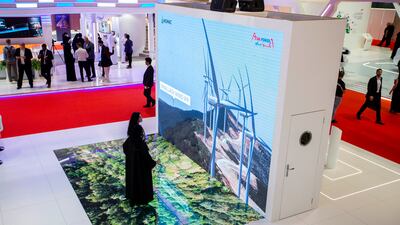
Saudi Arabia's Acwa Power is active in 13 countries, with a power capacity of about 43 gigawatts. Ruel Pableo for The National

Saudi Arabia's Acwa Power targets 120 gigawatts of power capacity in next 10 years


Fareed Rahman
  • English
  • Arabic

Saudi Arabia’s Acwa Power is targeting about 120 gigawatts of power-generating capacity in the next 10 years with a presence in 20 countries, and it plans to raise more money through the issuance of a bond at the end of this year or early next year to fund its growth plans.

The Riyadh-listed company is active in 13 countries with a power generation capacity of about 43 gigawatts, with 37 per cent of the total capacity being renewables. The company aims to take the total renewable capacity to 70 per cent in the next decade, with the rest consisting of the gas portfolio, according to its chief financial officer.

“To grow our portfolio, we are looking at a pipeline of 20 countries in the next 10 years … the new countries will be mainly in Africa and Asia including South-East Asia and Central Asia,” Abdulhameed Al Muhaidib told The National on the sidelines of the Water, Energy, Technology and Environment Exhibition in Dubai on Tuesday.

Acwa Power announced a number of new projects this year as it continues to boost its energy portfolio globally.

Last month, the company signed $12 billion worth of agreements to develop new energy projects in Uzbekistan, including the world’s largest single onshore wind project, with a total capacity of 1.5 gigawatts, in the Karakalpakstan region of the country.

It was also selected as the preferred bidder to develop two solar plants in Indonesia, South-East Asia's largest economy, and is leading a consortium to establish a 1.1-gigawatt wind project worth $1.5bn in Egypt.

Abdulhameed Al Muhaidib, Acwa Power's chief financial officer at Wetex on Tuesday. Ruel Pableo for The National

“We tend to spend time exploring the market before we go there ... we are targeting capacity of at least five to six gigawatts to grow in each country … otherwise, it does not make commercial sense for us,” Mr Al Muhaidib said.

Acwa Power, which raised 2.8bn Saudi riyals ($746 million) through the issuance of a sukuk last year, is looking to raise more money this year to fund its pipeline of projects.

“Last year, it was tranche one of the [sukuk] programme and we did not announce when tranche two would be launched. Today, we are foreseeing the second tranche of the same programme ... [5bn riyals sukuk] could be [brought to the market] by the end of this year or beginning of the next year," he said.

It will raise “more or less” the same amount equivalent to the tranche one, he added.

Acwa Power signed a preliminary agreement with France's Natixis Corporate and Investment Banking last year to secure financing of up to $2bn for its renewable projects.

The utility developer reported 743.9m riyals in net profit last year, down 17.5 per cent compared to 2020, mainly owing to its recognition of some share-based payments related to its initial public offering and an impairment loss.

However, Acwa Power's second-quarter net profit attributed to equity holders of the parent jumped 27 per cent to nearly 389.9m riyals amid the launch of new projects. It expects better financial performance this year compared to the previous year as it continues to boost its energy portfolio.

“We always target better [financial performance],” Mr Al Muhaidib said, without divulging details.

Acwa Power is bullish on hydrogen as demand for clean fuel increases globally amid the energy transition. The company is developing a $5bn green hydrogen facility in Saudi Arabia’s Neom city in partnership with US-based Air Products and Neom. It is also teaming up with Oman’s OQ energy company and Air Products to create a multi-billion-dollar green hydrogen-based ammonia production unit in Oman's Salalah Free Zone.

“Green hydrogen is part of our growth story, so we have formally added that together with power and water,” Mr Al Muhaidib said, adding that the company is exploring new hydrogen opportunities in Egypt and Morocco.

Acwa Power, which raised $1.2bn from its listing last year, also aims to become carbon neutral by 2050 and “took out coal completely” from its portfolio this year, Mr Al Muhaidib said.

UAE’s Hassyan power project was converted into a natural gas plant. Another coal-powered project in Vietnam, which was in the advanced stage of development, was discontinued amid concerns about climate change.

Saudi Arabia's sovereign wealth Public Investment Fund is the biggest shareholder in Acwa Power, with a 44 per cent stake. It also has seven other stakeholders, including the Saudi Public Pension Agency.

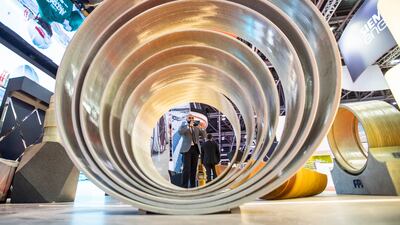
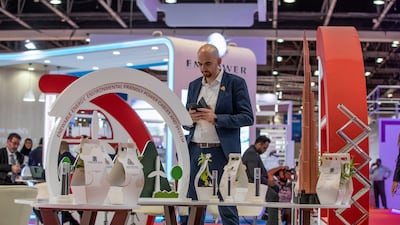
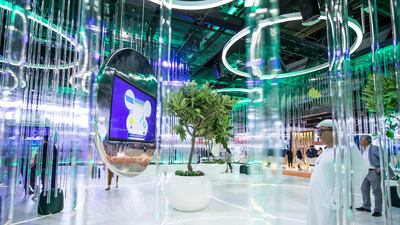
  • The FPI stand at Wetex, Dubai World Trade Centre. All photos: Ruel Pableo / The National
    The FPI stand at Wetex, Dubai World Trade Centre. All photos: Ruel Pableo / The National
  • The Masdar stand.
    The Masdar stand.
  • The Riyadh Cable Group's display.
    The Riyadh Cable Group's display.
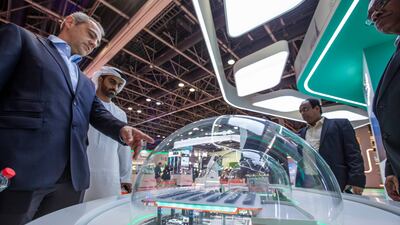
  • Exploring the Enoc stand.
    Exploring the Enoc stand.
  • A demonstration by Apova.
    A demonstration by Apova.
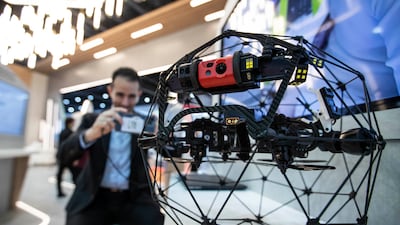
  • Dewa shows off a drone.
    Dewa shows off a drone.
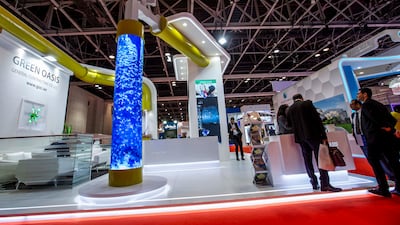
  • The Green Oasis stand.
    The Green Oasis stand.
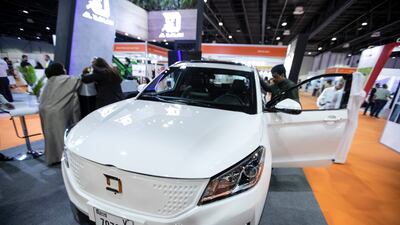
  • Al Damani electric car on display.
    Al Damani electric car on display.
  • The WJ Middle East exhibit.
    The WJ Middle East exhibit.
  • A Mercedes Benz EQS electric car on show.
    A Mercedes Benz EQS electric car on show.
  • Riyadh Cable also had a display.
    Riyadh Cable also had a display.
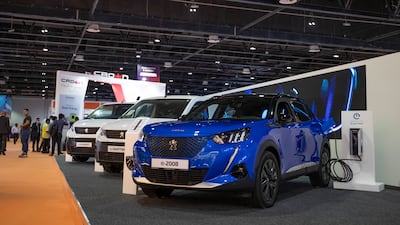
  • Peugeot's fleet of electric cars.
    Peugeot's fleet of electric cars.
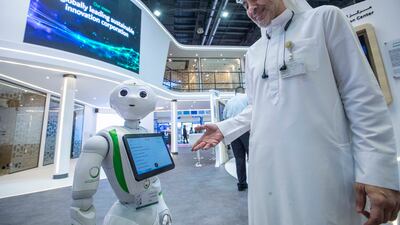
  • The Etihad Water & Electricity stand featured a robot receptionist.
    The Etihad Water & Electricity stand featured a robot receptionist.
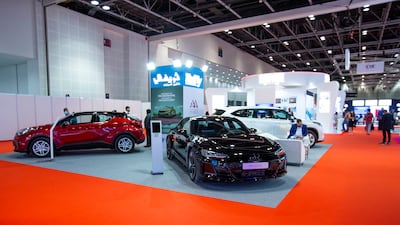
  • Audi electric cars were on show.
    Audi electric cars were on show.
  • The ACWA Power stand.
    The ACWA Power stand.
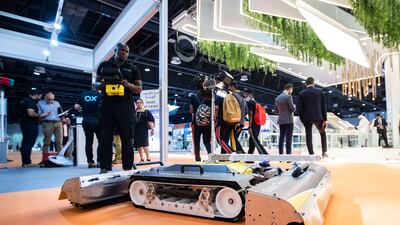
  • A SolarCleano F1 robot vacuum.
    A SolarCleano F1 robot vacuum.
  • The Dubai Municipality stand.
    The Dubai Municipality stand.
  • An electric vehicle charging station model, part of Dewa's contribution.
    An electric vehicle charging station model, part of Dewa's contribution.
  • The Siemens exhibit.
    The Siemens exhibit.
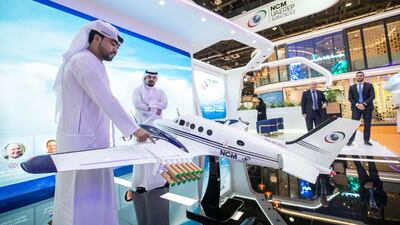
  • The NMC stand with a model of a cloud seeding plane.
    The NMC stand with a model of a cloud seeding plane.
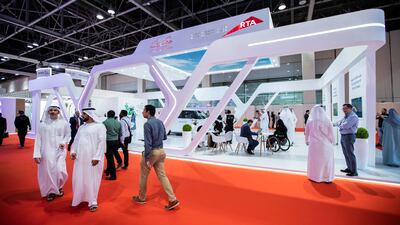
  • Dubai's Roads and Transport Authority was represented.
    Dubai's Roads and Transport Authority was represented.
  • A TX electric car.
    A TX electric car.
  • Rammas, Dewa's virtual employee.
    Rammas, Dewa's virtual employee.
COMPANY%20PROFILE
%3Cp%3E%3Cstrong%3ECompany%20name%3A%3C%2Fstrong%3E%20Revibe%20%0D%3Cbr%3E%3Cstrong%3EStarted%3A%3C%2Fstrong%3E%202022%0D%3Cbr%3E%3Cstrong%3EFounders%3A%3C%2Fstrong%3E%20Hamza%20Iraqui%20and%20Abdessamad%20Ben%20Zakour%20%0D%3Cbr%3E%3Cstrong%3EBased%3A%3C%2Fstrong%3E%20UAE%20%0D%3Cbr%3E%3Cstrong%3EIndustry%3A%3C%2Fstrong%3E%20Refurbished%20electronics%20%0D%3Cbr%3E%3Cstrong%3EFunds%20raised%20so%20far%3A%3C%2Fstrong%3E%20%2410m%20%0D%3Cbr%3E%3Cstrong%3EInvestors%3A%20%3C%2Fstrong%3EFlat6Labs%2C%20Resonance%20and%20various%20others%0D%3C%2Fp%3E%0A
Specs

Engine: Dual-motor all-wheel-drive electric

Range: Up to 610km

Power: 905hp

Torque: 985Nm

Price: From Dh439,000

Available: Now

SPECS
%3Cp%3E%3Cstrong%3EEngine%3A%20%3C%2Fstrong%3E4-litre%20flat-six%0D%3Cbr%3E%3Cstrong%3EPower%3A%20%3C%2Fstrong%3E525hp%20(GT3)%2C%20500hp%20(GT4)%0D%3Cbr%3E%3Cstrong%3ETorque%3A%20%3C%2Fstrong%3E465Nm%20(GT3)%2C%20450Nm%20(GT4)%0D%3Cbr%3E%3Cstrong%3ETransmission%3A%20%3C%2Fstrong%3ESeven-speed%20automatic%0D%3Cbr%3E%3Cstrong%3EPrice%3A%20%3C%2Fstrong%3EFrom%20Dh944%2C000%20(GT3)%2C%20Dh581%2C700%20(GT4)%0D%3Cbr%3E%3Cstrong%3EOn%20sale%3A%20%3C%2Fstrong%3ENow%0D%3Cbr%3E%3C%2Fp%3E%0A
Ten tax points to be aware of in 2026

1. Domestic VAT refund amendments: request your refund within five years

If a business does not apply for the refund on time, they lose their credit.

2. E-invoicing in the UAE

Businesses should continue preparing for the implementation of e-invoicing in the UAE, with 2026 a preparation and transition period ahead of phased mandatory adoption. 

3. More tax audits

Tax authorities are increasingly using data already available across multiple filings to identify audit risks. 

4. More beneficial VAT and excise tax penalty regime

Tax disputes are expected to become more frequent and more structured, with clearer administrative objection and appeal processes. The UAE has adopted a new penalty regime for VAT and excise disputes, which now mirrors the penalty regime for corporate tax.

5. Greater emphasis on statutory audit

There is a greater need for the accuracy of financial statements. The International Financial Reporting Standards standards need to be strictly adhered to and, as a result, the quality of the audits will need to increase.

6. Further transfer pricing enforcement

Transfer pricing enforcement, which refers to the practice of establishing prices for internal transactions between related entities, is expected to broaden in scope. The UAE will shortly open the possibility to negotiate advance pricing agreements, or essentially rulings for transfer pricing purposes. 

7. Limited time periods for audits

Recent amendments also introduce a default five-year limitation period for tax audits and assessments, subject to specific statutory exceptions. While the standard audit and assessment period is five years, this may be extended to up to 15 years in cases involving fraud or tax evasion. 

8. Pillar 2 implementation 

Many multinational groups will begin to feel the practical effect of the Domestic Minimum Top-Up Tax (DMTT), the UAE's implementation of the OECD’s global minimum tax under Pillar 2. While the rules apply for financial years starting on or after January 1, 2025, it is 2026 that marks the transition to an operational phase.

9. Reduced compliance obligations for imported goods and services

Businesses that apply the reverse-charge mechanism for VAT purposes in the UAE may benefit from reduced compliance obligations. 

10. Substance and CbC reporting focus

Tax authorities are expected to continue strengthening the enforcement of economic substance and Country-by-Country (CbC) reporting frameworks. In the UAE, these regimes are increasingly being used as risk-assessment tools, providing tax authorities with a comprehensive view of multinational groups’ global footprints and enabling them to assess whether profits are aligned with real economic activity. 

Contributed by Thomas Vanhee and Hend Rashwan, Aurifer

Awar Qalb

Director: Jamal Salem

Starring: Abdulla Zaid, Joma Ali, Neven Madi and Khadija Sleiman

Two stars

Updated: September 29, 2022, 9:59 AM