


Live updates: follow the latest news on Russia-Ukraine
Oil prices fell from 14-year highs as the UAE proposed that the Opec+ alliance increase oil production at a faster pace than its current monthly target in an effort to ease market volatility.
“We favour production increases and will be encouraging Opec to consider higher production levels,” Yousef Al Otaiba, the UAE's ambassador to the US, said.
“The UAE has been a reliable and responsible supplier of energy to global markets for more than 50 years and believes that stability in energy markets is critical to the global economy.”
Also on Wednesday, the UAE Minister of Energy and Infrastructure Suhail Al Mazrouei said the Emirates is committed to the existing agreement by the 23-member Opec+ alliance of oil producers led by Saudi Arabia and Russia, which ramps up oil supply by 400,000 barrels per day monthly.
“The UAE believes in the value Opec+ brings to the oil market. The UAE is committed to the Opec+ agreement and its existing monthly production adjustment mechanism,” Mr Al Mazrouei said on Twitter.
"There is no agreement [for the UAE] to increase production unilaterally outside the Opec+ agreement," he told the state-run news agency Wam.
For several months, Opec+ has worked to bring back 5.8 million bpd in production cuts, with another 400,000 bpd due in April, to restore supply that was greatly reduced after the onset of the Covid-19 pandemic in 2020. The alliance of producers achieved a historic reduction of 9.7 million bpd between May 2020 and July last year.
-
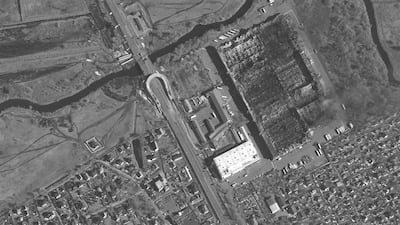
This satellite image provided by Maxar Technologies shows destroyed and burning warehouse buildings in Stoyanka, Ukraine, in the western Kyiv region, during the Russian invasion. AP -
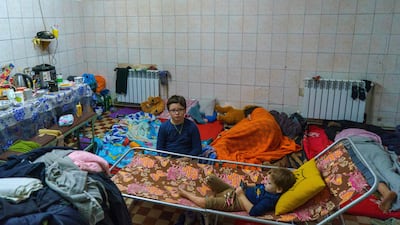
Children shelter in a metro station in Kharkiv. Moscow said on March 10, 2022, that it will open daily humanitarian corridors to allow civilians fleeing fighting in Ukraine to reach Russian territory, despite Kyiv insisting that no evacuation routes should lead to Russia. AFP -
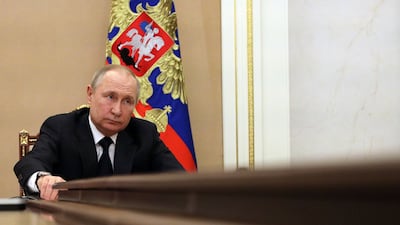
Russian President Vladimir Putin during a videoconference meeting with government members at the Kremlin in Moscow. The meeting focuses on minimising the effects of sanctions on the Russian economy. Russian troops entered Ukraine on February 24, prompting the country's president to declare martial law and triggering a series of severe economic sanctions imposed by western countries. EPA -
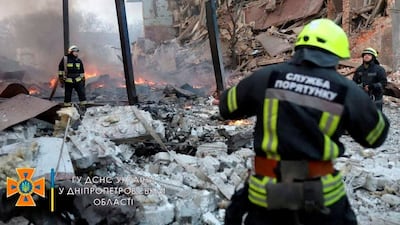
Rescuers work among remains of buildings damaged by an air strike in Dnipro, Ukraine, as Russia's attack on the country continues. Reuters -

Members of the National Guard of Ukraine, Oleksandr and Olena, listen to a priest at their wedding in Ukraine. Reuters -

People fleeing Russia's invasion of Ukraine warm up by a fire near the train station in Lviv, Ukraine. Reuters -
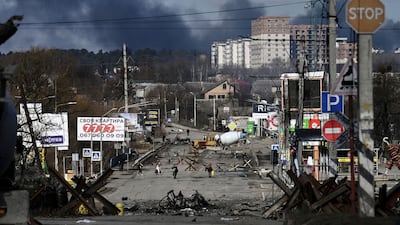
Russian forces rolled their armoured vehicles up to the northeastern edge of Kyiv, edging closer in their attempts to encircle the Ukrainian capital. AFP -
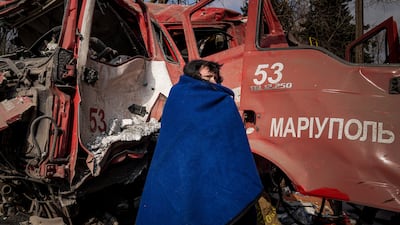
A woman covers herself with a blanket near a damaged fire truck after shelling in Mariupol, Ukraine. AP Photo -

A Ukrainian soldier hides from a helicopter air strike near Demydiv, Ukraine. Reuters -
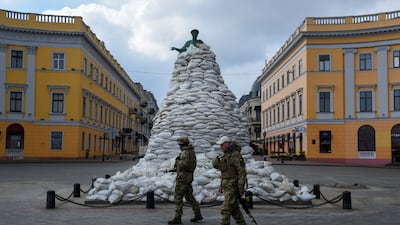
Ukrainian soldiers walk past a monument of the city founder Duke de Richelieu, covered with sand bags for protection, in Odessa, Ukraine. Reuters -
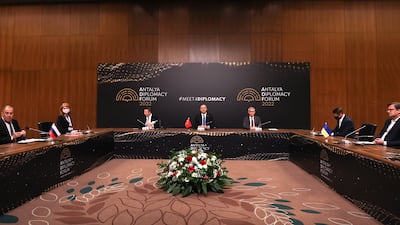
Russian Foreign Minister Sergey Lavrov, left, Turkish Foreign Minister Mevlut Cavusoglu, centre, and Ukranian Foreign Minister Dmytro Kuleba. EPA -
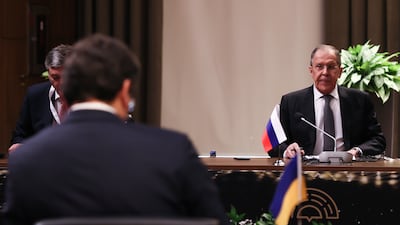
Russian Foreign Minister Sergey Lavrov in talks with Ukrainian counterpart Dmytro Kuleba during a tripartite meeting chaired by Turkish Foreign Minister Mevlut Cavusoglu, in Antalya, Turkey. AP -
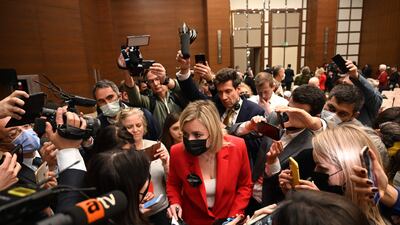
Russian Foreign Ministry spokeswoman Maria Zakharova speaks to the media as the foreign ministers of Ukraine, Russia and Turkey hold talks in Antalya, 15 days after Russia launched a military invasion on Ukraine. AFP -
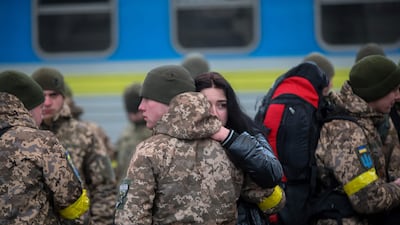
A Ukrainian serviceman says goodbye to his girlfriend before departing in the direction of Kyiv at the central train station in the western Ukrainian city of Lviv. AFP -
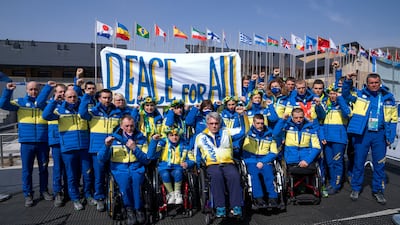
Valerii Sushkevych, president of the Ukraine National Paralympic Committee, and the Ukraine delegation raise their fists and pose with a banner at the Beijing 2022 Winter Paralympic Games. Reuters -

A member of the Ukrainian team cries during a moment of silence at the Zhangjiakou athletes village during the Beijing 2022 Winter Paralympic Games. AFP -
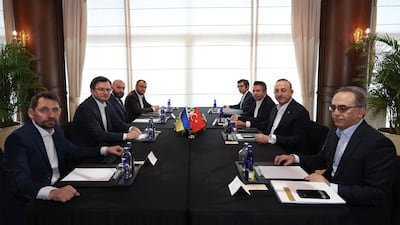
Turkish Foreign Minister Mevlut Cavusoglu, right, and Ukraine Foreign Minister Dmytro Kubela, second left, in Antalya, Turkey. AFP -
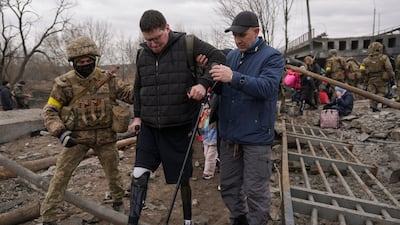
A man is supported after crossing the Irpin river while fleeing the town of Irpin, Ukraine. AP -
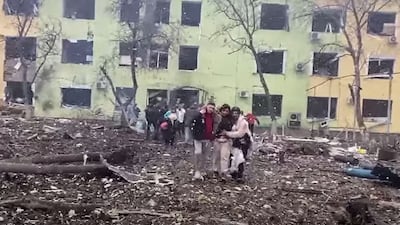
People are helped out of a damaged children's hospital following a Russian air strike in the southeastern city of Mariupol, Ukraine. AFP -

A man rides a bicycle in front of an apartment building that was damaged by shelling in Mariupol. AP -
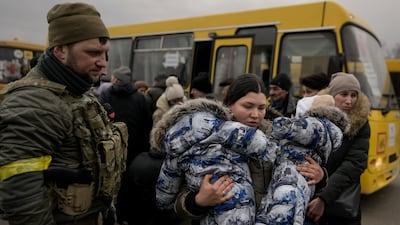
A woman carries two babies after arriving at a triage point in Kyiv, Ukraine. AP -
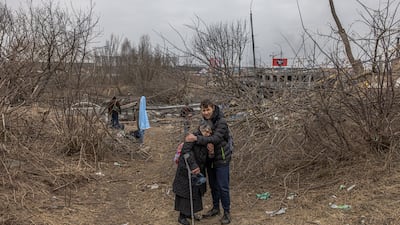
A man hugs an elderly woman after crossing a damaged bridge as they flee from the frontline town of Irpin, near the Ukrainian capital of Kyiv. EPA -
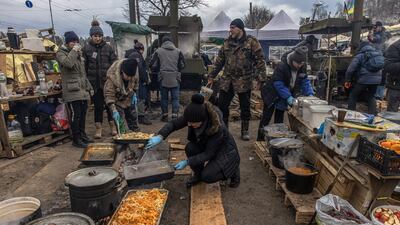
Local residents cook at a makeshift camp next to a checkpoint in Kyiv. EPA -
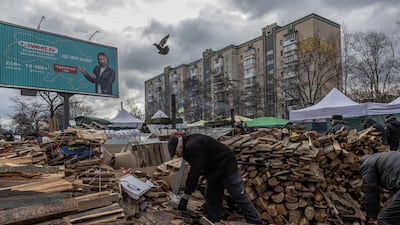
Ukrainian men chop wood at a makeshift camp next to a checkpoint in Kyiv. EPA -

A member of the Territorial Defence Forces learns how to use a Javelin missile during a training session in Kyiv. EPA -
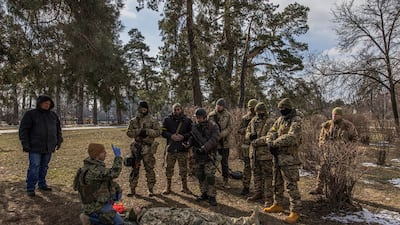
Members of the Territorial Defence Forces learn how to give first aid during the training session. EPA -
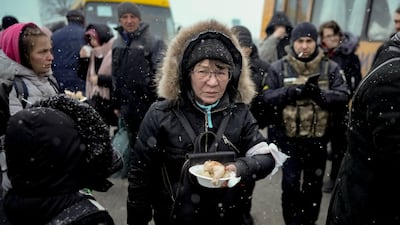
A woman rescued from the outskirts of Kyiv holds a plate of food after arriving at a triage point in the Ukrainian capital. AP -
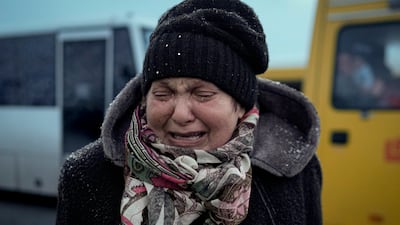
A woman cries after arriving at the triage point in Kyiv. AP -
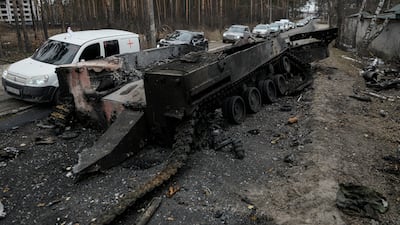
Civilian vehicles drive past a destroyed Russian tank as they leave Irpin. AP -
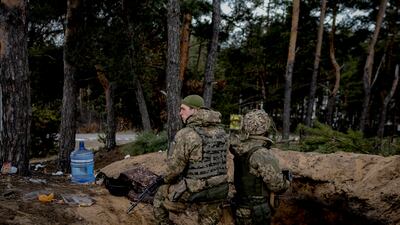
Ukrainian servicemen stand in a foxhole in Irpin. AP -
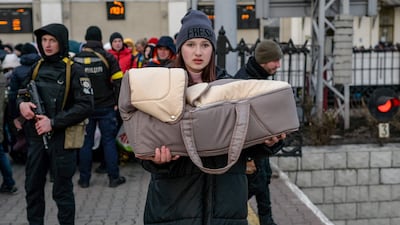
People gather on a platform to board a train leaving Odesa after the US said Russian troops are making preparations to attack the city. AFP -
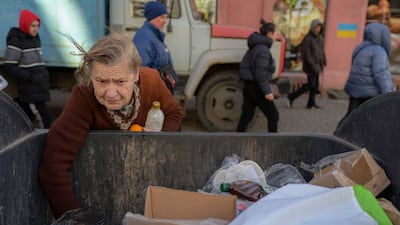
A Ukrainian woman looks for food in a bin in Odesa's city centre. AFP -
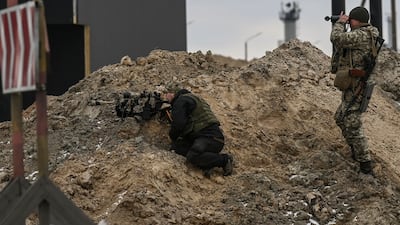
Ukrainian servicemen look towards Russian positions outside the city of Brovary, east of Kyiv. AFP -
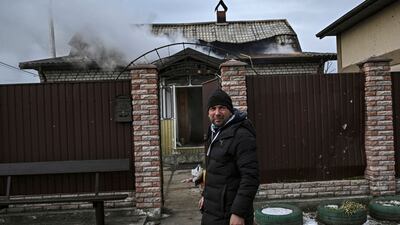
A man walks past a shelled house at the village of Velyka Dymerka, east of Kyiv. AFP -
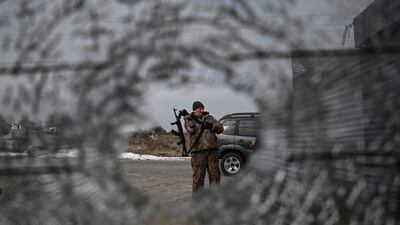
A Ukrainian serviceman stands at a check point in the vilage of Velyka Dymerka east of Kyiv. AFP -
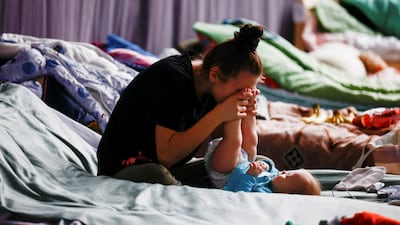
A Ukrainian woman plays with her child in a temporary refugee shelter in Przemysl, Poland. Reuters -

A woman waits outside a maternity and children's hospital damaged by shelling in Mariupol, Ukraine. AP -
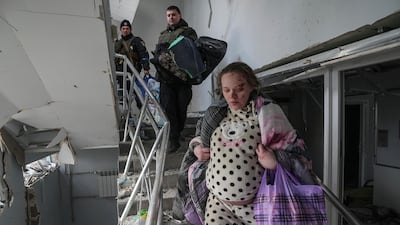
A pregnant woman leaves the hospital after she was wounded when it was bombed. AP -
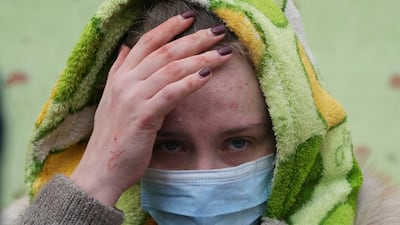
A woman waits outside the damaged hospital in Mariupol. AP -

A man wounded by shelling in Mariupol. AP -
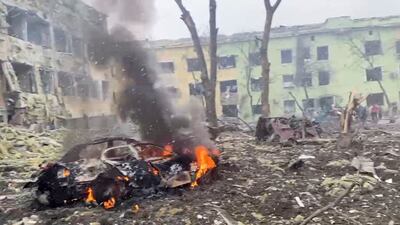
A car burns after the destruction of the children's hospital in Mariupol. Reuters -
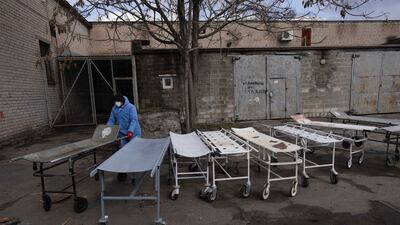
A mortuary worker wheels a stretcher used to move dead bodies before they are buried on the outskirts of Mariupol. AP


Brent, the global benchmark for two thirds of the world's oil, fell 13.20 per cent to $112 a barrel at the close of trading on Wednesday while West Texas Intermediate, the gauge that tracks US crude, retreated 12.15 per cent to $109.60 a barrel,
Both benchmarks remained above $100 a barrel on Thursday. Brent was up 2.6 per cent, trading at $114.4 a barrel at 8.25pm UAE time, while WTI was up 1.7 per cent at $110.6.
“The size of the moves, on relatively modest headlines, highlights the inherent volatility of oil markets at this time,” said Edward Bell, senior director of market economics at Emirates NBD.
“While the announcement from the UAE would help to alleviate pressure in oil markets, time spreads still show the perception of an enormously tight market. In Brent one to six-month spreads, the backwardation fell to only $15.59 a barrel overnight, still among its widest levels on record.”
Backwardation is where prices for immediate delivery are higher than those for future supply.
Oil prices are up by about 100 per cent since last year and have rallied more than 25 per cent since the start of this year, driven by a faster-than-expected economic recovery and also years of underinvestment in the energy industry after prices collapsed in 2014, which restricted the output capacity of some producers.
The outbreak of the Russia-Ukraine conflict has shaken markets further and the surge in energy prices could send the global economy into a recession.
Prices rallied further this week after the announcement of a British and American ban on Russian oil imports. Additional sanctions from western countries on Russia, the world's second-largest energy exporter, would lead to a 4.3 million bpd gap in the market, which cannot be quickly replaced by other supply sources.
That would create the largest potential oil supply shortage since the First Gulf War, when oil prices doubled, and lead to oil prices rising to $240 a barrel by this summer, said Bjornar Tonhaugen, head of oil markets at Rystad Energy.
The foreign ministers of Russia and Ukraine will hold talks in Turkey on Thursday, the first high-level contact between Kyiv and Moscow since Russia's military offensive in Ukraine began two weeks ago.
If a perceived breakthrough in the Ukraine-Russia meeting happens in Turkey today, both benchmarks will be back below $100 a barrel, said Jeffrey Halley, a senior market analyst at Oanda.
“However, the risks are skewed towards disappointment and evolving negative headlines from the Ukraine situation and/or Iran and/or Opec+, in which case, Brent crude will be back above $120 in the blink of an eye,” Mr Halley said.
Should EU-brokered indirect talks in Vienna revive the 2015 Iran nuclear accord, which the US unilaterally withdrew from, Iranian oil could come to the market and potentially boost exports by about a million bpd within a matter of months, once sanctions are lifted.
Iran has been exempt from production cuts under the Opec+ agreement because its crude output remains limited by US sanctions.
The US Energy Information Administration estimates that Iran’s production could return to full capacity, at 3.8 million bpd, if Washington lifts the sanctions.

