


China is building the world's largest wind turbine that can power up to 20,000 households annually as it seeks to tap into the potential of offshore wind to lower its emissions.
The turbine, when assembled, will have a total swept area equivalent to more than six football fields, according to the manufacturer MingYang Smart Energy.
Developer MingYang is perhaps one of the lesser-known wind turbine makers in an industry dominated by established companies such as GE, Siemens Gamesa and Vestas.
However, the Chinese company is making a big bet on the growing offshore wind market, through the introduction of its new MySE 16.0-242 turbine, which has a nameplate capacity of 16 megawatts.
“The launch of our new largest wind turbine ... is an apt illustration of the three essential drivers to technology evolution – demand, combination and iteration,” said Qiying Zhang, president and chief technology officer of Ming Yang.
The turbine has gigantic proportions, sufficient to withstand typhoons and handle offshore wind speeds, with a 242-metre diameter rotor and 118-metre long blades.
MingYang's turbine stands tall and has the capacity to generate 45 per cent more power than its previous model.
-
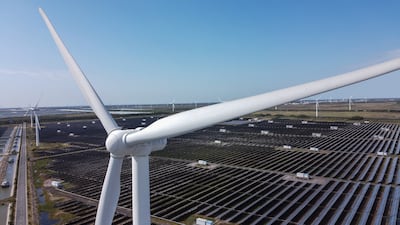
Solar panels and wind turbines work in an integrated power station in Yancheng city in Jiangsu province, China. AFP -
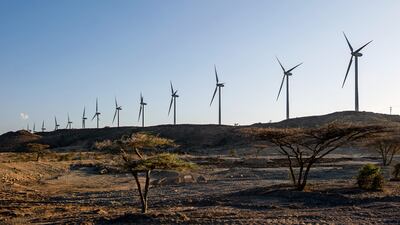
V52-850 kW wind turbines in Lake Turkana, Kenya. Courtesy Vestas Wind Systems A/S -

The Dabancheng wind power plant in Urumqi in China's western Xinjiang region. AFP -
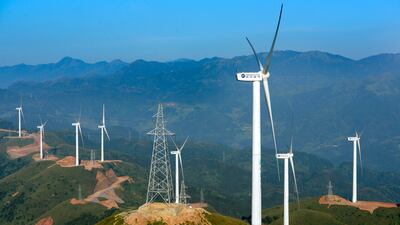
Wind turbines manufactured by Mingyang Electric whirl to generate electricity at a wind farm on the outskirts of Xinyi city, south China's Guangdong province. AP -
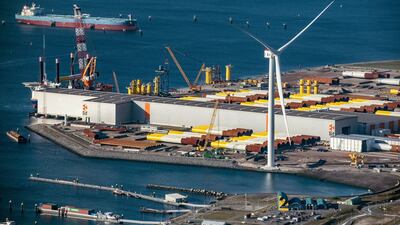
GE's Haliade-X offshore turbine prototype. Courtesy GE Renewable Energy -

Rotor-blades are pictured at Siemens Wind Power's port of export in Esbjerg. Reuters -

An aerial view shows power-generating windmill turbines in a wind farm in Graincourt-les-Havrincourt, France. Reuters -

A model of a wind turbine with the Siemens Gamesa logo is displayed outside the annual general shareholders meeting in Zamudio, Spain. Reuters -
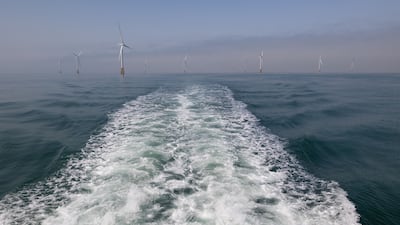
Wind turbines at an offshore wind farm in China. Bloomberg -
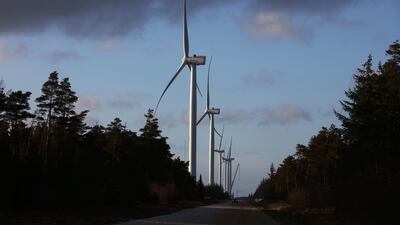
Prototype wind turbines made by different manufacturers operate during testing at the Danish National Test Centre for Large Wind Turbines in Osterild, Denmark. Bloomberg


"I think it's definitely an incredible size for a Chinese company to come on to the market and make such a big bold move. Because today, just to put things in perspective, more than 80 per cent of the turbines in China are sub six-megawatts [capacity]," said Shashi Barla, principal analyst - wind at Wood Mackenzie.
The announcement of the massive wind turbine is in line with the expansion of capacity of the offshore wind market.
The industry is expected to grow to $121.54 billion by 2027, at a compound annual growth rate of 19.85 per cent, according to Market Research Future.
The consultancy valued the size of the industry at $39.1bn in 2020.
The Chinese model could cater to the growing demand for wind turbines as European markets accelerate the deployment of wind capacities offshore.
The major centre for offshore wind is the US, followed by European countries, particularly Denmark, the UK, France, Germany and the Netherlands.
In Asia, China and Taiwan are big growth drivers, Mr Barla said.
MingYang's prototype is expected to become fully commercial by 2024, he added.
Siemens Gamesa and GE are the key players in the development of offshore wind turbines with capacities exceeding 10 megawatts.
"You're going to see these 10-plus megawatt turbines reaching commercial production in the next two to three years," said Mr Barla.
China, which is looking to rapidly decarbonise its economy and reduce its dependence on polluting coal, will continue to make huge bets on technological developments that will produce economical and clean energy.
Offshore wind is earmarked for future growth in China and around the world.
"The industry, in terms of annual installations, is going to grow by six to seven fold in the next two decades," said Mr Barla.
"In the last 30 years, we built 30 gigawatts of capacity, but in the next 10 years we're going to build more than 220 gigawatts of capacity in offshore wind."

