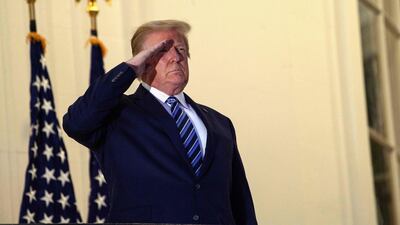
Stocks tumbled and bonds soared after US President Donald Trump said he was ending stimulus talks until after the election.
The call came hours after Federal Reserve Chairman Jerome Powell renewed his warning that the economy would stumble without more fiscal support.
In a sombre day for the US economy, its trade deficit also hit a 14-year high, an unwanted marker before the election for a president whose mission has to been to wean America off foreign goods.
The benchmark S&P 500 slumped 1.4 per cent after Mr Trump tweeted his comments late in the trading session, erasing a gain of as much as 0.7 per cent.
Over the past few trading sessions the market had rallied around stimulus talks and now it's almost a slap in the face
The Dow Jones Industrial Average and Nasdaq Composite indexes also ended lower.
"It was certainly a surprise to the market that had started to price in another stimulus," Ed Clissold, chief US equity strategist at Ned Davis Research, told Bloomberg.
“It’s going to be difficult for the economy to gain much traction until there is another round of stimulus.”
US House Speaker Nancy Pelosi had called on Republicans to get on board with a version of the stimulus bill the House passed last week with only Democratic votes.
But significant gaps remained between the Democrats’ $2.2 trillion proposal and a $1.6tn offer backed by the White House.
“Over the past few trading sessions the market had rallied around stimulus talks and now it’s almost a slap in the face,” said Gene Goldman, chief investment officer at Cetera Financial Group.
Deepening deficit could dent Trump's electoral hopes
There are also lingering concerns about the trajectory of the pandemic and its effect on the economy.
The US Commerce Department said the deficit grew 5.9 per cent in August, from $63.4 million to $67.1 billion, the largest gap since August 2006.
Exports increased by 2.2 per cent to $171.9bn but imports rose by 3.2 per cent to $239bn.
In the year to date, the trade deficit is up 5.7 per cent above last year’s levels.
Mr Trump does have the mitigating factor of Covid-19 to explain the wider deficit.
The economic chaos from the pandemic has affected global trade and the performances of countries around the world.
Compared to other major economies, the US is placing greater emphasis on imports than exports.
Greg Daco, the chief US economist at Oxford Economics, told Barron's that the "stronger pull for imports" was for several reasons.
Mr Daco pointed to the US federal stimulus bill putting money into American pockets and boosting consumer spending, a disproportionate amount of which is being spent on foreign goods.
Conversely, other countries have not injected such liquidity into their economies, suppressing the appetite for US-made products.
There was some good news for the Trump team with a rebound in manufacturing bolstering imports.
Inventory-depleted businesses have also started to stock up on vital supplies again.

UAE%20FIXTURES
%3Cp%3EWednesday%2019%20April%20%E2%80%93%20UAE%20v%20Kuwait%3Cbr%3EFriday%2021%20April%20%E2%80%93%20UAE%20v%20Hong%20Kong%3Cbr%3ESunday%2023%20April%20%E2%80%93%20UAE%20v%20Singapore%3Cbr%3EWednesday%2026%20April%20%E2%80%93%20UAE%20v%20Bahrain%3Cbr%3ESaturday%2029%20April%20%E2%80%93%20Semi-finals%3Cbr%3ESunday%2030%20April%20%E2%80%93%20Third%20position%20match%3Cbr%3EMonday%201%20May%20%E2%80%93%20Final%3C%2Fp%3E%0A
Mercer, the investment consulting arm of US services company Marsh & McLennan, expects its wealth division to at least double its assets under management (AUM) in the Middle East as wealth in the region continues to grow despite economic headwinds, a company official said.
Mercer Wealth, which globally has $160 billion in AUM, plans to boost its AUM in the region to $2-$3bn in the next 2-3 years from the present $1bn, said Yasir AbuShaban, a Dubai-based principal with Mercer Wealth.
“Within the next two to three years, we are looking at reaching $2 to $3 billion as a conservative estimate and we do see an opportunity to do so,” said Mr AbuShaban.
Mercer does not directly make investments, but allocates clients’ money they have discretion to, to professional asset managers. They also provide advice to clients.
“We have buying power. We can negotiate on their (client’s) behalf with asset managers to provide them lower fees than they otherwise would have to get on their own,” he added.
Mercer Wealth’s clients include sovereign wealth funds, family offices, and insurance companies among others.
From its office in Dubai, Mercer also looks after Africa, India and Turkey, where they also see opportunity for growth.
Wealth creation in Middle East and Africa (MEA) grew 8.5 per cent to $8.1 trillion last year from $7.5tn in 2015, higher than last year’s global average of 6 per cent and the second-highest growth in a region after Asia-Pacific which grew 9.9 per cent, according to consultancy Boston Consulting Group (BCG). In the region, where wealth grew just 1.9 per cent in 2015 compared with 2014, a pickup in oil prices has helped in wealth generation.
BCG is forecasting MEA wealth will rise to $12tn by 2021, growing at an annual average of 8 per cent.
Drivers of wealth generation in the region will be split evenly between new wealth creation and growth of performance of existing assets, according to BCG.
Another general trend in the region is clients’ looking for a comprehensive approach to investing, according to Mr AbuShaban.
“Institutional investors or some of the families are seeing a slowdown in the available capital they have to invest and in that sense they are looking at optimizing the way they manage their portfolios and making sure they are not investing haphazardly and different parts of their investment are working together,” said Mr AbuShaban.
Some clients also have a higher appetite for risk, given the low interest-rate environment that does not provide enough yield for some institutional investors. These clients are keen to invest in illiquid assets, such as private equity and infrastructure.
“What we have seen is a desire for higher returns in what has been a low-return environment specifically in various fixed income or bonds,” he said.
“In this environment, we have seen a de facto increase in the risk that clients are taking in things like illiquid investments, private equity investments, infrastructure and private debt, those kind of investments were higher illiquidity results in incrementally higher returns.”
The Abu Dhabi Investment Authority, one of the largest sovereign wealth funds, said in its 2016 report that has gradually increased its exposure in direct private equity and private credit transactions, mainly in Asian markets and especially in China and India. The authority’s private equity department focused on structured equities owing to “their defensive characteristics.”
