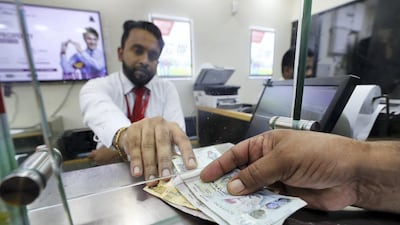
With global growth expected to rebound further in 2021, the World Bank estimates remittance flows to low- and middle-income countries to increase 2.6 per cent this year. Photo: Pawan Singh / The National
With global growth expected to rebound further in 2021, the World Bank estimates remittance flows to low- and middle-income countries to increase 2.6 per cent this year. Photo: Pawan Singh / The Natio

Remittances declined less in 2020 than the drop following the global financial crisis, World Bank says


Deepthi Nair
  • English
  • Arabic

Remittance flows to low- and middle-income countries reached $540 billion in 2020, 1.6 per cent less than the 2019 total, and are set to rise as the global economy recovers, the World Bank said.

Despite the impact of Covd-19, the decline in remittance flows in 2020 was smaller than the 4.8 per cent drop recorded during the 2009 global financial crisis, the Washington-based lender said in its migration and development brief.

“As Covid-19 still devastates families around the world, remittances continue to provide a critical lifeline for the poor and vulnerable,” Michal Rutkowski, global director of the social protection and jobs global practice at the World Bank, said.

“Supportive policy responses, together with national social protection systems, should continue to be inclusive of all communities, including migrants.”

.
.

In October, the lender estimated remittances would fall 14 per cent by the end of this year compared with pre-Covid-19 levels in 2019. It projected global remittances would decline 7 per cent to $508bn in 2020 and 7.5 per cent to $470bn in 2021.

The pandemic and lockdown measures tipped the world economy into its worst recession since the 1930s. However, the rapid vaccine rollout and substantial fiscal stimulus and monetary support from governments and central banks led the International Monetary Fund to raise its forecast in April for global economic growth to 6 per cent for this year, from an earlier 5.5 per cent estimate.

With the global economy expected to recover further in 2021 and 2022, remittance flows to low- and middle-income countries are expected to increase 2.6 per cent to $553bn this year and 2.2 per cent to $565bn in 2022, according to the World Bank.

The main drivers for the steady flow of global remittances included fiscal stimulus that resulted in better-than-expected economic conditions in host countries, a shift in flows from cash to digital and from informal to formal channels, and cyclical movements in oil prices and currency exchange rates.

“The resilience of remittance flows is remarkable. Remittances are helping to meet families’ increased need for livelihood support,” Dilip Ratha, lead author of the report on migration and remittances and head of the Global Knowledge Partnership on Migration and Development, said. “They can no longer be treated as small change.”

The global decline in remittances in 2020 was also far lower than the fall in foreign direct investment flows to low- and middle-income countries, which, excluding flows to China, fell by more than 30 per cent last year, the World Bank said.

Remittance flows to low- and middle-income countries surpassed the sum of FDI ($259bn) and overseas development assistance ($179bn) in 2020, according to the report.

The bank said remittance inflows rose 6.5 per cent in Latin America and the Caribbean, 5.2 per cent in South Asia and 2.3 per cent in the Middle East and North Africa. However, remittance flows fell 7.9 per cent for East Asia and the Pacific, 9.7 per cent for Europe and Central Asia, and 12.5 per cent for Sub-Saharan Africa.

The increase in remittance volumes to the Mena region to about $56bn in 2020 was largely because of strong remittance flows to Egypt and Morocco, the World Bank said.

Remittance inflows to Egypt increased 11 per cent to a record of about $30bn in 2020, while flows to Morocco rose 6.5 per cent and Tunisia increased 2.5 per cent.

In contrast, other regional economies such as Djibouti, Lebanon, Iraq and Jordan posted double-digit declines in remittance inflows last year, the report said.

.
.

Remittances to the Mena region are likely to grow 2.6 per cent in 2021 due to moderate growth in the euro area and weak outflows from GCC countries.

The World Bank has been working with G20 countries and the global community to reduce remittance costs and improve financial inclusion for the poor.

The global average cost of sending $200 remained high at 6.5 per cent in the fourth quarter of 2020, the World Bank said. This is more than double the Sustainable Development Goal target of 3 per cent.

Average remittance costs were the lowest in South Asia at 4.9 per cent, while Sub-Saharan Africa continued to have the highest average cost at 8.2 per cent, the report added.


THE BIO

Favourite car: Koenigsegg Agera RS or Renault Trezor concept car.

Favourite book: I Am Pilgrim by Terry Hayes or Red Notice by Bill Browder.

Biggest inspiration: My husband Nik. He really got me through a lot with his positivity.

Favourite holiday destination: Being at home in Australia, as I travel all over the world for work. It’s great to just hang out with my husband and family.


Living in...

This article is part of a guide on where to live in the UAE. Our reporters will profile some of the country’s most desirable districts, provide an estimate of rental prices and introduce you to some of the residents who call each area home.

India cancels school-leaving examinations
Ten tax points to be aware of in 2026

1. Domestic VAT refund amendments: request your refund within five years

If a business does not apply for the refund on time, they lose their credit.

2. E-invoicing in the UAE

Businesses should continue preparing for the implementation of e-invoicing in the UAE, with 2026 a preparation and transition period ahead of phased mandatory adoption. 

3. More tax audits

Tax authorities are increasingly using data already available across multiple filings to identify audit risks. 

4. More beneficial VAT and excise tax penalty regime

Tax disputes are expected to become more frequent and more structured, with clearer administrative objection and appeal processes. The UAE has adopted a new penalty regime for VAT and excise disputes, which now mirrors the penalty regime for corporate tax.

5. Greater emphasis on statutory audit

There is a greater need for the accuracy of financial statements. The International Financial Reporting Standards standards need to be strictly adhered to and, as a result, the quality of the audits will need to increase.

6. Further transfer pricing enforcement

Transfer pricing enforcement, which refers to the practice of establishing prices for internal transactions between related entities, is expected to broaden in scope. The UAE will shortly open the possibility to negotiate advance pricing agreements, or essentially rulings for transfer pricing purposes. 

7. Limited time periods for audits

Recent amendments also introduce a default five-year limitation period for tax audits and assessments, subject to specific statutory exceptions. While the standard audit and assessment period is five years, this may be extended to up to 15 years in cases involving fraud or tax evasion. 

8. Pillar 2 implementation 

Many multinational groups will begin to feel the practical effect of the Domestic Minimum Top-Up Tax (DMTT), the UAE's implementation of the OECD’s global minimum tax under Pillar 2. While the rules apply for financial years starting on or after January 1, 2025, it is 2026 that marks the transition to an operational phase.

9. Reduced compliance obligations for imported goods and services

Businesses that apply the reverse-charge mechanism for VAT purposes in the UAE may benefit from reduced compliance obligations. 

10. Substance and CbC reporting focus

Tax authorities are expected to continue strengthening the enforcement of economic substance and Country-by-Country (CbC) reporting frameworks. In the UAE, these regimes are increasingly being used as risk-assessment tools, providing tax authorities with a comprehensive view of multinational groups’ global footprints and enabling them to assess whether profits are aligned with real economic activity. 

Contributed by Thomas Vanhee and Hend Rashwan, Aurifer

Kill%20
%3Cp%3E%3Cstrong%3EDirector%3A%3C%2Fstrong%3E%20Nikhil%20Nagesh%20Bhat%3C%2Fp%3E%0A%3Cp%3E%3Cstrong%3EStarring%3C%2Fstrong%3E%3A%20Lakshya%2C%20Tanya%20Maniktala%2C%20Ashish%20Vidyarthi%2C%20Harsh%20Chhaya%2C%20Raghav%20Juyal%3C%2Fp%3E%0A%3Cp%3E%3Cstrong%3ERating%3A%3C%2Fstrong%3E%204.5%2F5%3Cbr%3E%3C%2Fp%3E%0A
Dubai World Cup Carnival card

6.30pm: UAE 1000 Guineas Trial Conditions (TB) US$100,000 (Dirt) 1,400m

7.05pm: Handicap (TB) $135,000 (Turf) 1,000m

7.40pm: Handicap (TB) $175,000 (D) 1,900m

8.15pm: Meydan Challenge Listed Handicap (TB) $175,000 (T) 1,400m

8.50pm: Dubai Stakes Group 3 (TB) $200,000 (D) 1,200m

9.25pm: Dubai Racing Club Classic Listed Handicap (TB) $175,000 (T) 2,410m

The National selections

6.30pm: Final Song

7.05pm: Pocket Dynamo

7.40pm: Dubai Icon

8.15pm: Dubai Legacy

8.50pm: Drafted

9.25pm: Lucius Tiberius

COMPANY PROFILE
Name: Kumulus Water
 
Started: 2021
 
Founders: Iheb Triki and Mohamed Ali Abid
 
Based: Tunisia 
 
Sector: Water technology 
 
Number of staff: 22 
 
Investment raised: $4 million 
The biog

Fast facts on Neil Armstrong’s personal life:

  • Armstrong was born on August 5, 1930, in Wapakoneta, Ohio
  • He earned his private pilot’s license when he was 16 – he could fly before he could drive
  • There was tragedy in his married life: Neil and Janet Armstrong’s daughter Karen died at the age of two in 1962 after suffering a brain tumour. She was the couple’s only daughter. Their two sons, Rick and Mark, consulted on the film
  • After Armstrong departed Nasa, he bought a farm in the town of Lebanon, Ohio, in 1971 – its airstrip allowed him to tap back into his love of flying
  • In 1994, Janet divorced Neil after 38 years of marriage. Two years earlier, Neil met Carol Knight, who became his second wife in 1994 
The specs: 2018 Nissan Patrol Nismo

Price: base / as tested: Dh382,000

Engine: 5.6-litre V8

Gearbox: Seven-speed automatic

Power: 428hp @ 5,800rpm

Torque: 560Nm @ 3,600rpm

Fuel economy, combined: 12.7L / 100km