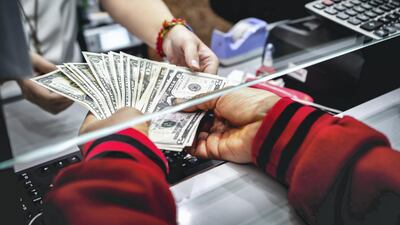
Countries like Georgia, Jordan, Pakistan and Morocco recorded a notable acceleration in remittances growth in the first quarter of 2021 compared to the fourth quarter last year, according to Tellimer Research.
There has been a nearly 30 per cent growth in remittances in the first quarter of 2021 to some countries, with money flowing from very different source regions, according to the research note.
“The growth in remittances in 2021 helped provide partial relief from higher commodity import bills and shortfalls in tourism revenues in emerging and frontier markets,” Hasnain Malik, emerging and frontier markets strategy analyst at Tellimer in Dubai and author of the research, said.
In October, the World Bank said remittances would fall 14 per cent by the end of 2021 compared with pre-Covid-19 levels in 2019. The Washington-based lender projected global remittances would decline 7 per cent to $508 billion in 2020 and 7.5 per cent to $470bn in 2021
The World Bank's estimate of a 14 per cent decline in global remittances this year "looks too pessimistic after what we have seen in the first quarter", Mr Malik told The National.
“The drivers [of higher remittances] have been greater use of official remittance channels, with FinTech development and less physical travel, and the tendency of the diaspora to provide help in difficult times to their home communities. But it is surprising that remittance growth has persisted beyond what might have been an initial bump from job losses and repatriation,” he said.
However, remittance flows to certain markets from the same source countries differed in 2021. For instance, growth in remittances to Jordan substantially underperform those to Bangladesh or Pakistan, even though the GCC is the largest source region for all three, according to the research note.
“The sharpest contrast has been between very high growth in remittances to South Asian countries like Bangladesh and Pakistan, compared to the Philippines,” Mr Malik said.
“The GCC is a major source region for both, although North America is even more important for the Philippines."
Nigeria is an outlier, with remittances collapsing by 75 per cent in the first quarter of 2021, 88 per cent in the prior quarter and 71 per cent in full-year 2020, according to Tellimer Research.
The “very large discount” in the parallel rate versus the official one encourages remitters to use undocumented, unofficial channels to transfer money to Nigeria, the Telimer note said.
“It appears that the one-third of Nigerian remitters who hail from the US and Canada and are no longer so easily able to use Bitcoin transfers, because of a regulatory crackdown by the central bank in Nigeria, may have modestly shifted to more official channels, explaining the moderation in year-on-year decline seen in Q1 2021 – while the one-quarter of remitters from neighbouring countries are likely still easily accessing unofficial routes,” Mr Malik said.
Meanwhile, outward personal remittances from the UAE dropped by 5 per cent or Dh8.3bn year on year in 2020, according to the Central Bank of UAE's annual report.
The top three countries for outward personal remittances in 2020 were India, Pakistan and the Philippines, accounting for 33.6 per cent, 11.9 per cent and 6.7 per cent of the total, respectively, the Central Bank said.
Personal remittances declined by 15.6 per cent and 15.3 per cent for India and the Philippines respectively, while increasing by 5.3 per cent for Pakistan, the report added.

Mercer, the investment consulting arm of US services company Marsh & McLennan, expects its wealth division to at least double its assets under management (AUM) in the Middle East as wealth in the region continues to grow despite economic headwinds, a company official said.
Mercer Wealth, which globally has $160 billion in AUM, plans to boost its AUM in the region to $2-$3bn in the next 2-3 years from the present $1bn, said Yasir AbuShaban, a Dubai-based principal with Mercer Wealth.
“Within the next two to three years, we are looking at reaching $2 to $3 billion as a conservative estimate and we do see an opportunity to do so,” said Mr AbuShaban.
Mercer does not directly make investments, but allocates clients’ money they have discretion to, to professional asset managers. They also provide advice to clients.
“We have buying power. We can negotiate on their (client’s) behalf with asset managers to provide them lower fees than they otherwise would have to get on their own,” he added.
Mercer Wealth’s clients include sovereign wealth funds, family offices, and insurance companies among others.
From its office in Dubai, Mercer also looks after Africa, India and Turkey, where they also see opportunity for growth.
Wealth creation in Middle East and Africa (MEA) grew 8.5 per cent to $8.1 trillion last year from $7.5tn in 2015, higher than last year’s global average of 6 per cent and the second-highest growth in a region after Asia-Pacific which grew 9.9 per cent, according to consultancy Boston Consulting Group (BCG). In the region, where wealth grew just 1.9 per cent in 2015 compared with 2014, a pickup in oil prices has helped in wealth generation.
BCG is forecasting MEA wealth will rise to $12tn by 2021, growing at an annual average of 8 per cent.
Drivers of wealth generation in the region will be split evenly between new wealth creation and growth of performance of existing assets, according to BCG.
Another general trend in the region is clients’ looking for a comprehensive approach to investing, according to Mr AbuShaban.
“Institutional investors or some of the families are seeing a slowdown in the available capital they have to invest and in that sense they are looking at optimizing the way they manage their portfolios and making sure they are not investing haphazardly and different parts of their investment are working together,” said Mr AbuShaban.
Some clients also have a higher appetite for risk, given the low interest-rate environment that does not provide enough yield for some institutional investors. These clients are keen to invest in illiquid assets, such as private equity and infrastructure.
“What we have seen is a desire for higher returns in what has been a low-return environment specifically in various fixed income or bonds,” he said.
“In this environment, we have seen a de facto increase in the risk that clients are taking in things like illiquid investments, private equity investments, infrastructure and private debt, those kind of investments were higher illiquidity results in incrementally higher returns.”
The Abu Dhabi Investment Authority, one of the largest sovereign wealth funds, said in its 2016 report that has gradually increased its exposure in direct private equity and private credit transactions, mainly in Asian markets and especially in China and India. The authority’s private equity department focused on structured equities owing to “their defensive characteristics.”
Four-day collections of TOH
Day Indian Rs (Dh)
Thursday 500.75 million (25.23m)
Friday 280.25m (14.12m)
Saturday 220.75m (11.21m)
Sunday 170.25m (8.58m)
Total 1.19bn (59.15m)
(Figures in millions, approximate)
The details
Heard It in a Past Life
Maggie Rogers
(Capital Records)
3/5
2019 Asian Cup final
Japan v Qatar
Friday, 6pm
Zayed Sports City Stadium, Abu Dhabi
Who's who in Yemen conflict
Houthis: Iran-backed rebels who occupy Sanaa and run unrecognised government
Yemeni government: Exiled government in Aden led by eight-member Presidential Leadership Council
Southern Transitional Council: Faction in Yemeni government that seeks autonomy for the south
Habrish 'rebels': Tribal-backed forces feuding with STC over control of oil in government territory
WRESTLING HIGHLIGHTS
Racecard
6.30pm: Mazrat Al Ruwayah Group Two (PA) US$55,000 (Dirt) 1,600m
7.05pm: Meydan Trophy (TB) $100,000 (Turf) 1,900m
7.40pm: Handicap (TB) $135,000 (D) 1,200m
8.15pm: Balanchine Group Two (TB) $250,000 (T) 1,800m
8.50pm: Handicap (TB) $135,000 (T) 1,000m
9.25pm: Firebreak Stakes Group Three (TB) $200,000 (D) 1,600m
10pm: Handicap (TB) $175,000 (T) 2,410m
The National selections: 6.30pm: RM Lam Tara, 7.05pm: Al Mukhtar Star, 7.40pm: Bochart, 8.15pm: Magic Lily, 8.50pm: Roulston Scar, 9.25pm: Quip, 10pm: Jalmoud
