

Lebanon will need an $8.5 billion (Dh31bn) bailout package from the International Monetary Fund to break its economic impasse, meet future financing needs and restore growth, the Institute of International Finance said.
Even with the $11bn in pledges Lebanon received at the Cedar donor conference in 2018, which are tied to reforms that need to be undertaken by the country, the new government should seek an IMF programme, enforce uniform capital controls to avoid money going abroad and maintain its exchange rate peg to the dollar in the short term, wrote Garbis Iradian, IIF’s chief economist for the Mena region.
“An IMF programme could … provide a framework for the needed fiscal consolidation and structural reforms to address deficiencies in the economy,” he wrote in a new report.
“While the scale of the IMF financing will depend on the financing needs, we estimate that the IMF would need to provide exceptional access to Lebanon … in line with other recent IMF programmes, such as Argentina and Iceland and spread over three years," Mr Iradian said.
An IMF-supported programme could help pave the way for $3bn of additional funds from multilateral and bilateral sources, he added.
The country needs to implement a set of reforms and take additional measures to meet its $24bn of financing needs over the next five years, according to the Washington-based IIF.
Lebanon, which is experiencing its worst economic crisis since the end of a 15-year civil war in 1990, needs to implement reforms and take additional measures to meet $24bn of financing needs over the next five years, the organisation said.
The country’s economy deteriorated rapidly with gross domestic product estimated to have contracted 3.8 per cent 2019 and is set to shrink 4.7 per cent this year, according the IIF.
The fiscal deficit widened last year and the country’s debt-to-GDP ratio surged to 166 per cent, one of the highest in the world.
Lebanon’s public debt, most of it held by Lebanese banks, reached $89.5bn at the end of November 2019.
The country's new government needs to press on with fiscal reforms that address structural imbalances and reduce the sapping of funds by the main power company, Electricite du Liban, which drains about $2bn a year.
Along with fighting tax evasion, the government needs to increase revenues while minimising the effect on the poor, the IIF said.
A reduction of interest rates implemented by the Central Bank of Lebanon and commercial banks on deposits, loans and public debt is positive, the organisation said.
Continued action on this front can improve liquidity of banks and boost confidence, encouraging investment and easing the impact of fiscal adjustment, it said.
The health of Lebanese banks can be strengthened through their recapitalisation, while privatisation of state assets needs to be an integral part of the government’s economic plan, the IIF said.
Aside from the country’s main power company, Lebanon’s central bank owns the state-carrier Middle East Airlines, the privatisation of which has been postponed repeatedly.
The central bank also owns the Casino du Liban. Other assets that could be privatised include Beirut Airport, the Beirut port, the National Lottery and telecoms operators.
-

Hundreds of Lebanese gathered outside the central government building to reject the newly formed Cabinet, while some protesters breached tight security erected around it, removing a metal gate and barbed wire prompting a stream of water cannons from security forces. AP -
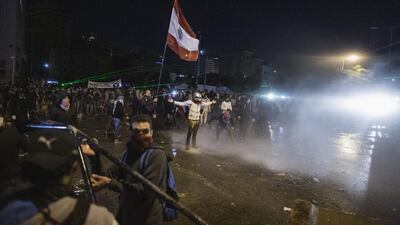
Security forces fire a water cannon at anti-government protester near the Grand Serail on January 25, 2020 in Beirut, Lebanon. Getty Images -
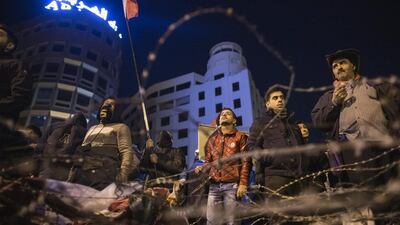
Anti-government protesters stand behind a razor wire barricade near the Grand Serail on January 25, 2020 in Beirut, Lebanon. Getty Images -
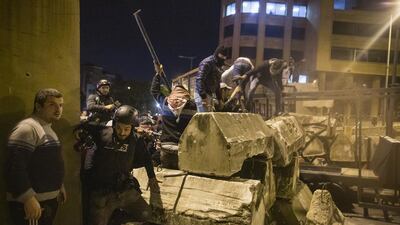
A number of marches were planned to convene on Parliament and the Union of Banks on what is the 101st day of unrest in the country. Getty Images -
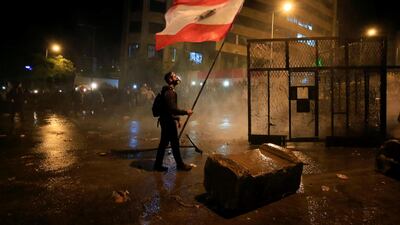
A demonstrator holds the Lebanese flag during a protest against the newly formed government outside the prime minister’s office in downtown Beirut. Reuters -
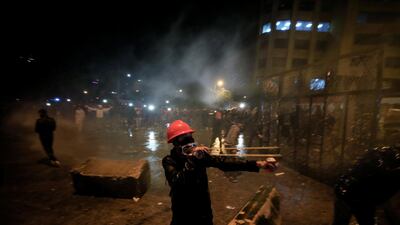
A demonstrator uses a slingshot to throw a stone during a protest against the newly formed government. Reuters -
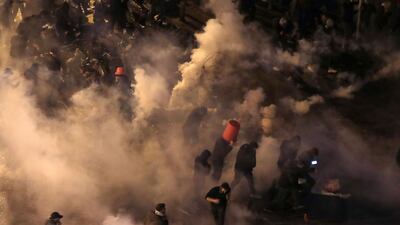
Lebanese anti-government protesters run to avoid tear gas. AFP -
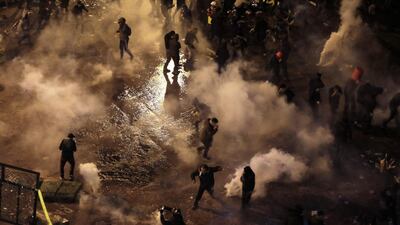
Lebanese anti-government protesters run to avoid tear gas as security forces attempt to disperse their rally near the Grand Serail in downtown Beirut. AFP -
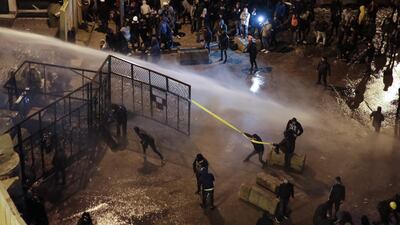
Lebanese anti-government protesters attempt to break through a barricade as security forces uses a water canon to disperse their rally near the government headquarters at the Grand Serail. AFP -
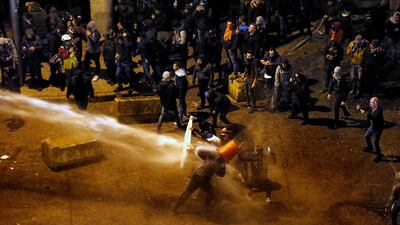
Riot police sprayed anti-government protesters with water cannons as they try to cross to the central government building during ongoing protests in Beirut, Lebanon, Saturday, Jan. 25, 2020. AP -

Anti-government demonstrators fire slingshots toward the Lebanese riot police during ongoing protests in Beirut. AP -
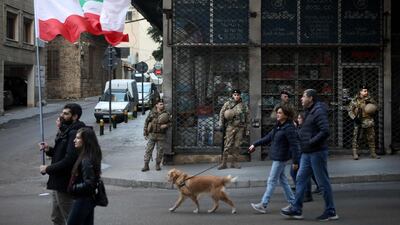
Army soldiers look on as Lebanese anti-government protesters march toward the capital Beirut's downtown district. AFP -
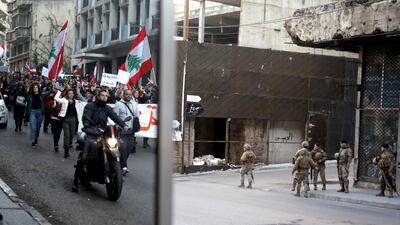
An image reflected in a shop window shows Lebanese anti-government protesters marching down a road on Beirut’s civil war demarcation line between the city's east and west as army soldiers look on from across the road. AFP -
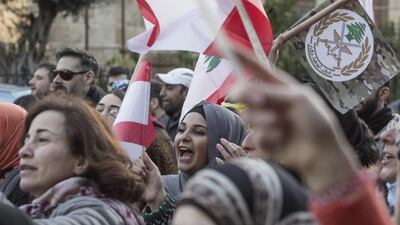
Anti-government protesters chant as they march toward the Parliament on January 25, 2020. Getty Images -
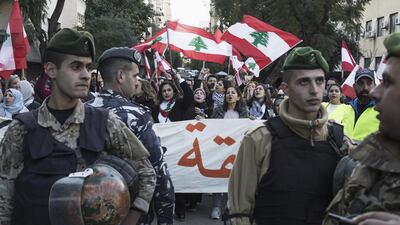
Lebanese security forces walk in front of anti-government protesters as they march toward the Parliament on January 25, 2020 in Beirut. Getty Images -
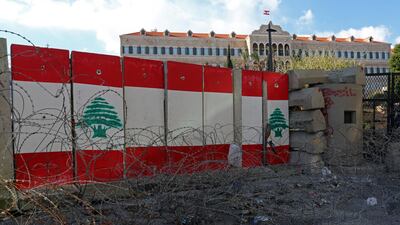
A view shows concrete barriers erected by authorities near the government palace, during ongoing protests in Beirut. Reuters -
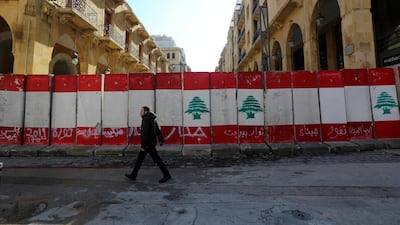
A man walks past concrete barriers erected by authorities to block a street leading to the parliament building in Beirut, Lebanon January 24, 2020. Reuters -
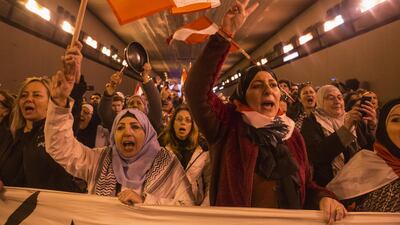
A number of marches were planned to convene on Parliament and the Union of Banks on what is the 101st day of unrest in the country. Getty Images -
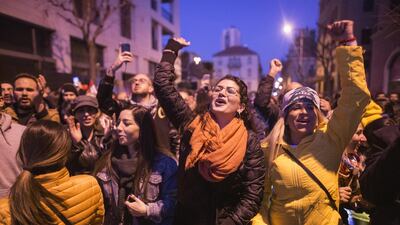
Anti-government protesters chant as they march toward the Parliament on January 25, 2020. Getty Images -

A view shows damaged tiles of a store facade in Beirut, Lebanon January 23, 2020. Reuters -
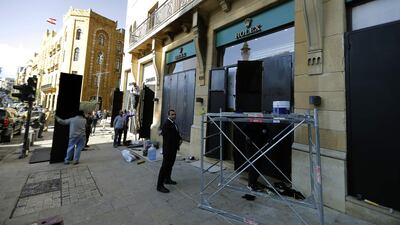
Workers fix iron shields on the windows of shops to protect them from damage during anti-government riots in the Lebanese capital Beirut's downtown district, on January 24, 2020. AFP


Proceeds from privatisation could help the government raise billions of dollars and reduce the size of public debt, which would lower debt-servicing payments and create fiscal space.
The government also needs to fight “rampant corruption” and improve the business environment, the IIF said.
With rising poverty and the imbalance between the rich and poor, the government should consider creating a "social fund" that is financed by foreign grants and recovery of stolen public funds.
To address its debt overhang, the IIF said, the government should consider measures that include rolling over and extending the maturity of the domestic currency part of the debt, which accounted for about 62 per cent of total debt at the end of 2019.
Maturing bonds, it said, could be exchanged for new longer-dated sovereign bonds, possibly at lower yields in the context of an IMF programme.
Lebanon needs to pay $1.2bn due in March when a Eurobond hits maturity. Another $700 million is due in April and $600m in June.
The crisis increased the yield on the country’s bonds threefold.
Lebanon was able to escape the 2008 global credit crisis relatively unscathed due to a high interest rate regime, which lured more than $1bn a month in capital flows that financed its fiscal and current account deficits.
The current economic crisis, which accelerated following the outbreak of war in neighbouring Syria in 2011, slowed the flow funds and led to negative deposit growth at Lebanese lenders.
The Lebanese pound has lost a third of its value against the dollar in the black market and is now trading at about 2,000 pounds or lira to the dollar, above the 1,500 peg.
Lebanon's newly appointed Finance Minister, Ghazi Wazni, met World Bank and IMF officials over the weekend.
Although the country sought technical assistance from the IMF and World Bank, it has not formally requested a bailout package to date.

