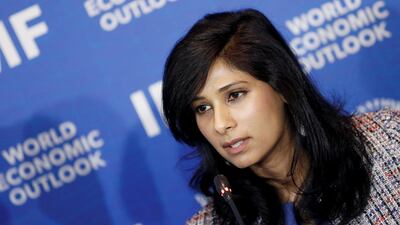
Gita Gopinath, chief economist at the IMF says the fund is "worried about the complacency in financial markets" amid stretched asset price. Reuters

IMF calls for action to address concerns over asset price bubble


Sarmad Khan
  • English
  • Arabic

The International Monetary Fund is "worried" about ballooning asset valuations in financial markets, urging policymakers to minimise the build-up of risk in the system while maintaining accommodative monetary policies to support economies, its chief economist said.

“In our opinion, we do believe that there are stretched asset valuations and over-valuations in risky assets,” Gita Gopinath said on Wednesday evening. “We are worried about the complacency in financial markets that there will somehow always be policy interventions that are needed to [push] stock prices up. So we are flagging that [to policymakers]”.

Given the current situation, where economies have yet to recover from the impact of Covid-19, central banks need to keep accommodative policies in place. However, the IMF is putting “a lot of emphasis” on saying that whatever measures that are necessary to avoid a further build-up of financial risks should be taken.

“It is a difficult trade-off,” she said.

“If anything goes wrong there [in financial markets], it’s a problem for advanced economies, but there will be very large spillovers to emerging and developing economies,” she told students at a webinar hosted by the American University in Cairo's School of Business.

Governments and central banks have provided more than $12 trillion in monetary and fiscal support to economies since the outbreak of the pandemic. Interest rates have been cut and liquidity injections and asset purchases by central banks have helped to prevent a financial meltdown. Global equity markets plunged in March last year but subsequently rallied and the US S&P 500 Index closed close to its all-time high on Wednesday. The index gained in value by about 15 per cent over the course of last year and is up a further 4 per cent this year.

The crisis needed an aggressive reaction, both on fiscal and monetary fronts and that is what was seen, especially in advanced economies. While these measures shielded financial markets, strengthened banks and protected lives and livelihoods, they also helped to make asset prices “almost exuberant”, she said.

“Markets are quite reliant on the best-case scenario for the pandemic ... that we will have a vaccine and things will get better … and interest rates will remain very low for a long time,” she said.

However, the world is entering 2021 in a “tricky situation in which we have this divergence in recovery, and [yet] you have to worry about building financial risks”.

There is a divergence in the global economic recovery and it is important to maintain stable financial conditions, Ms Gopinath said. While developed economies have managed to maintain spending to keep their economies stable, many emerging and developing countries, burdened by debts, have been unable to afford that.

Priority should be given to improve the capacity of healthcare systems and increase spending on economic recovery and providing lifelines to people who are unable to work.

The IMF expects the global economy to grow 5.5 per cent this year – 0.3 per cent more than its previous estimate in October – after contracting 3.5 per cent 2020, according to its latest World Economic Outlook released last month.

However, “it doesn’t look like it is a won-and-done affair” with the effects of the pandemic likely to last for some time as more virulent strains take hold, Ms Gopinath said.

Although the world is experiencing a second wave and the number of infections is much higher than in the first – which triggered widespread lockdowns, upending global travel and trade and making millions unemployed – the hit to economic activity is “significantly smaller” this time

“It tells you that the world has adapted [in terms of] living with social distancing and the virus,” she said.

“Keep in mind that we could have been in a much worse place. There is a hope that the world will be able to exit this crisis with less scars than we thought possible in 2020.”


The specs

Engine: 2.0-litre 4cyl turbo

Power: 261hp at 5,500rpm

Torque: 405Nm at 1,750-3,500rpm

Transmission: 9-speed auto

Fuel consumption: 6.9L/100km

On sale: Now

Price: From Dh117,059

The specs

Price, base / as tested Dh1,470,000 (est)
Engine 6.9-litre twin-turbo W12
Gearbox eight-speed automatic
Power 626bhp @ 6,000rpm
Torque: 900Nm @ 1,350rpm
Fuel economy, combined 14.0L / 100km

COMPANY PROFILE

Company name: Blah

Started: 2018

Founder: Aliyah Al Abbar and Hend Al Marri

Based: Dubai

Industry: Technology and talent management

Initial investment: Dh20,000

Investors: Self-funded

Total customers: 40

UAE%20v%20West%20Indies
%3Cp%3EFirst%20ODI%20-%20Sunday%2C%20June%204%20%0D%3Cbr%3ESecond%20ODI%20-%20Tuesday%2C%20June%206%20%0D%3Cbr%3EThird%20ODI%20-%20Friday%2C%20June%209%26nbsp%3B%3C%2Fp%3E%0A%3Cp%3EMatches%20at%20Sharjah%20Cricket%20Stadium.%20All%20games%20start%20at%204.30pm%0D%3Cbr%3E%0D%3Cbr%3E%3Cstrong%3EUAE%20squad%3C%2Fstrong%3E%0D%3Cbr%3EMuhammad%20Waseem%20(captain)%2C%20Aayan%20Khan%2C%20Adithya%20Shetty%2C%20Ali%20Naseer%2C%20Ansh%20Tandon%2C%20Aryansh%20Sharma%2C%20Asif%20Khan%2C%20Basil%20Hameed%2C%20Ethan%20D%E2%80%99Souza%2C%20Fahad%20Nawaz%2C%20Jonathan%20Figy%2C%20Junaid%20Siddique%2C%20Karthik%20Meiyappan%2C%20Lovepreet%20Singh%2C%20Matiullah%2C%20Mohammed%20Faraazuddin%2C%20Muhammad%20Jawadullah%2C%20Rameez%20Shahzad%2C%20Rohan%20Mustafa%2C%20Sanchit%20Sharma%2C%20Vriitya%20Aravind%2C%20Zahoor%20Khan%0D%3C%2Fp%3E%0A
RESULTS

5pm: Maiden (PA) Dh80,000 1,600m
Winner: Raghida, Szczepan Mazur (jockey), Ibrahim Al Hadhrami (trainer)
5.30pm: Maiden (PA) Dh80,000 1,600m
Winner: AF Alareeq, Connor Beasley, Ahmed Al Mehairbi
6pm: Arabian Triple Crown Round-2 Group 3 (PA) Dh300,000 2,200m 
Winner: Basmah, Fabrice Veron, Eric Lemartinel
6.30pm: Liwa Oasis Group 2 (PA) Dh300,000 1,400m
Winner: AF Alwajel, Tadhg O’Shea, Ernst Oertel
7pm: Wathba Stallions Cup Handicap (PA) Dh70,000 1,600m
Winner: SS Jalmod, Richard Mullen, Satish Seemar
7.30pm: Handicap (TB) Dh100,000 1,600m
Winner: Trolius, Ryan Powell, Simon Crisford

Who was Alfred Nobel?

The Nobel Prize was created by wealthy Swedish chemist and entrepreneur Alfred Nobel.

  • In his will he dictated that the bulk of his estate should be used to fund "prizes to those who, during the preceding year, have conferred the greatest benefit to humankind".
  • Nobel is best known as the inventor of dynamite, but also wrote poetry and drama and could speak Russian, French, English and German by the age of 17. The five original prize categories reflect the interests closest to his heart.
  • Nobel died in 1896 but it took until 1901, following a legal battle over his will, before the first prizes were awarded.
Company%20Profile
%3Cp%3E%3Cstrong%3ECompany%20name%3A%3C%2Fstrong%3E%20Hoopla%3Cbr%3E%3Cstrong%3EDate%20started%3A%20%3C%2Fstrong%3EMarch%202023%3Cbr%3E%3Cstrong%3EFounder%3A%3C%2Fstrong%3E%20Jacqueline%20Perrottet%3Cbr%3E%3Cstrong%3EBased%3A%3C%2Fstrong%3E%20Dubai%3Cbr%3E%3Cstrong%3ENumber%20of%20staff%3A%3C%2Fstrong%3E%2010%3Cbr%3E%3Cstrong%3EInvestment%20stage%3A%20%3C%2Fstrong%3EPre-seed%3Cbr%3E%3Cstrong%3EInvestment%20required%3A%3C%2Fstrong%3E%20%24500%2C000%3C%2Fp%3E%0A
ITU Abu Dhabi World Triathlon

For more information go to www.abudhabi.triathlon.org.

Squads

Pakistan: Sarfaraz Ahmed (c), Babar Azam (vc), Abid Ali, Asif Ali, Fakhar Zaman, Haris Sohail, Mohammad Hasnain, Iftikhar Ahmed, Imad Wasim, Mohammad Amir, Mohammad Nawaz, Mohammad Rizwan, Shadab Khan, Usman Shinwari, Wahab Riaz

Sri Lanka: Lahiru Thirimanne (c), Danushka Gunathilaka, Sadeera Samarawickrama, Avishka Fernando, Oshada Fernando, Shehan Jayasuriya, Dasun Shanaka, Minod Bhanuka, Angelo Perera, Wanindu Hasaranga, Lakshan Sandakan, Nuwan Pradeep, Isuru Udana, Kasun Rajitha, Lahiru Kumara

The five pillars of Islam

1. Fasting 

2. Prayer 

3. Hajj 

4. Shahada 

5. Zakat 

Indoor cricket in a nutshell

Indoor Cricket World Cup – Sep 16-20, Insportz, Dubai

16 Indoor cricket matches are 16 overs per side

8 There are eight players per team

There have been nine Indoor Cricket World Cups for men. Australia have won every one.

5 Five runs are deducted from the score when a wickets falls

Batsmen bat in pairs, facing four overs per partnership

Scoring In indoor cricket, runs are scored by way of both physical and bonus runs. Physical runs are scored by both batsmen completing a run from one crease to the other. Bonus runs are scored when the ball hits a net in different zones, but only when at least one physical run is score.

Zones

A Front net, behind the striker and wicketkeeper: 0 runs

B Side nets, between the striker and halfway down the pitch: 1 run

Side nets between halfway and the bowlers end: 2 runs

Back net: 4 runs on the bounce, 6 runs on the full

The National in Davos

We are bringing you the inside story from the World Economic Forum's Annual Meeting in Davos, a gathering of hundreds of world leaders, top executives and billionaires.

The Outsider

Stephen King, Penguin

COMPANY PROFILE
Name: Almnssa
Started: August 2020
Founder: Areej Selmi
Based: Gaza
Sectors: Internet, e-commerce
Investments: Grants/private funding
UAE currency: the story behind the money in your pockets