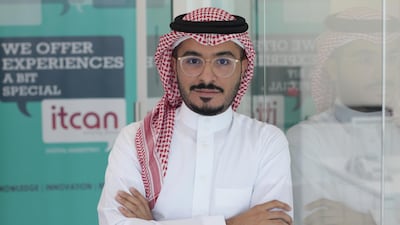
Itcan profile
Founders: Mansour Althani and Abdullah Althani
Based: Business Bay, with offices in Saudi Arabia, Egypt and India
Sector: Technology, digital marketing and e-commerce
Size: 70 employees
Revenue: On track to make Dh100 million in revenue this year since its 2015 launch
Funding: Self-funded to date
For e-commerce businesses finding it hard to survive during the Covid-19 pandemic, digital marketing specialist Mansour Althani of Itcan has one message: "You shouldn’t be struggling at this time.”
“If you are,” adds the chief executive and cofounder of the technology and digital marketing start-up, “then there is something wrong".
With people across the world staying at home as they follow government directives to help curb the spread of the virus, this is a perfect time for e-commerce ventures to flourish, says Mr Althani, from Saudi Arabia.
We are a start-up that started from Dubai without any funding and all the years we have been operating we have been profitable and bringing in a high revenue.
“It’s not only e-commerce; on the internet there are education businesses, gaming and lots of opportunities, so if your business is based online, you shouldn't be struggling. If an e-commerce venture is not doing well, they can pivot, they can be more dynamic and shift their business model a little bit,” he says.
This is why Itcan, which Mr Althani set up with his co-founder and cousin, Abdullah Althani, in 2015, has not only survived over the past few weeks but actually thrived.
The digital marketing specialist works with more than 25 big clients in the UAE and Saudi Arabia, such as Al Tayer owned Ounass and Nisnass, offering services such as digital marketing, performance marketing and app development to help large e-commerce ventures grow their business.
While the company started out with just the Althani cousins, today it has 70 employees spread across four offices – Dubai in the UAE, Damman in Saudi Arabia, Cairo in Egypt and Bangalore in India.
Since launching, the company is now on track to make Dh100 million in revenue this year and Mr Althani says the current economic challenges will not prevent Itcan meeting the target.
Some contracts were paused at the start of the crisis as e-commerce ventures looked to resolve issues related to the sourcing of goods and management of their warehouses. These problems are now resolved and the companies are now operating normally, he says.
“We saw a high demand on the business development side with new clients asking us to help them move to e-commerce faster or those seeking performance marketing,” Mr Althani adds.
The e-commerce market in the Middle East and North Africa is expected to reach $28.5 billion (Dh104.68bn) by 2022, according to a March 2019 report from Bain & Company.
However, the recent growth in demand for e-commerce amid Covid-19 could accelerate the industry's growth. Majid Al Futtaim Retail's online orders, for example, increased 301 per cent year-on-year in March as the coronavirus outbreak limited people’s movement, according to chief executive Hani Weiss. Majid Al Futtaim Retail holds the exclusive franchise rights to operate Carrefour in more than 31 countries across the Middle East, Africa and Asia.
Separately, orders of skincare products soared by 144 per cent in the UAE in a month through to March 26, according to Itcan data, with the rise dominated by demand from new users. Make-up brands also saw order numbers increase by 275 per cent over the same period as consumers seek alternative ways to secure goods.
Itcan's revenue has been steady during the pandemic and despite all of its staff working remotely they have not had to cut salaries or let any employees go – something they do not expect to happen in the future either.
“We actually need to hire more people,” says Mr Althani.
One element that helped the company stay nimble was its ability to switch its workforce to remote working without any hiccups, using new tech tools to enhance efficiency.
Before the crisis even started, the company had already stopped using email to communicate internally. Instead it uses Slack to communicate or task management tools such as Trello, Jira, Zoho projects and Asana to monitor productivity.
“When we started working from home our performance actually became much stronger and our productivity higher,” says Mr Althani. “People were online and we started to put some new rules in place. With our focus on innovation and knowledge, it was very easy to adapt to any kind of change.”
Itan's achievements are quite a feat for a company that started just five years ago when Mr Althani was only 25. The idea for the venture came while he was studying computer science at Sharjah University. He and his cousin then entered a government entrepreneurship contest with an online clothing store, making it to a shortlist of 100 entrants and winning Dh20,000 to set up.
After graduating, the duo then decided to build a marketing company for the e-commerce sector but Mr Althani says it did not work out because they lacked experience.
“I still needed time to understand everything,” he says. “We started and we failed. The biggest challenge was our lack of experience in the business in general – I had just graduated and did not know how it all worked.”
Instead the pair put their business plans on hold and Mr Althani joined Namshi in 2014, an e-commerce venture that Emaar Malls acquired last year. Working in the company’s affiliate marketing channel, Mr Althani says he later applied the invaluable experience he gained to relaunch Itcan in 2015.
The venture started with the founders working from coffee shops and later co-working spaces as the team grew. What is particularly unique about their start-up, however, is that they are entirely self-funded and have been profitable from the outset.
“The company funded itself from the first mile,” says Mr Althani. “I even paid myself from the first month, a small salary at the beginning, but by the third or fourth month I was earning a salary."
While half of the company’s business comes from the UAE and the other half from Saudi Arabia, Itcan plans to expand further into the GCC and North Africa. It is also set to launch products, such as an affiliate network that connects brands with publishers, by the end of the second quarter.
“We are a start-up that started from Dubai without any funding and all the years we have been operating we have been profitable and bringing in a high revenue,” says Mr Althani. "I do not hear of many start-ups that succeeded financially from the outset."
Q&A: Mansour Althani, chief executive and cofounder of Itcan
How does your business model work?
We have three ways to make money: the first is services such as offering performance marketing for an e-commerce, mobile and app development or digital marketing. The second way is offering solutions, such as SEO for a company that needs it or a fix for a mobile app. The third is the products, which we are launching this year.
Will you consider funding in the future?
We will consider funding but it has to be right. We have two plans, one to launch products, and then going forward with funding for the business itself. We will explore funding for the company this year.
How many countries would you like to have a presence in?
Ultimately, we don't have a limit. We want to dominate more in the markets we are already in, then we can move to the next stage.
What new skills have you learnt from setting up Itcan?
I have gained leadership skills. I was 25 when we set up and had never hired someone before I started, so it was very difficult at the beginning. I'd think 'how can I count on people? How can I hire the right people?' So leadership skills are something I have learnt over the years, 100 per cent, and choosing the right people was key as well.
What other successful start-ups do you admire?
Snapchat is a strong start-up. It changed the way social media works by introducing instant videos or images that are deleted within a day. It helped us at the start of the company because Snapchat is quite popular in Saudi Arabia.

Pharaoh's curse
British aristocrat Lord Carnarvon, who funded the expedition to find the Tutankhamun tomb, died in a Cairo hotel four months after the crypt was opened.
He had been in poor health for many years after a car crash, and a mosquito bite made worse by a shaving cut led to blood poisoning and pneumonia.
Reports at the time said Lord Carnarvon suffered from “pain as the inflammation affected the nasal passages and eyes”.
Decades later, scientists contended he had died of aspergillosis after inhaling spores of the fungus aspergillus in the tomb, which can lie dormant for months. The fact several others who entered were also found dead withiin a short time led to the myth of the curse.
The specs
Engine: 2.0-litre four-cylinder turbo
Power: 178hp at 5,500rpm
Torque: 280Nm at 1,350-4,200rpm
Transmission: seven-speed dual-clutch auto
Price: from Dh209,000
On sale: now
Switching%20sides
%3Cp%3EMahika%20Gaur%20is%20the%20latest%20Dubai-raised%20athlete%20to%20attain%20top%20honours%20with%20another%20country.%0D%3C%2Fp%3E%0A%3Cp%3E%3Cstrong%3EVelimir%20Stjepanovic%20(Serbia%2C%20swimming)%20%3C%2Fstrong%3E%0D%3Cbr%3EBorn%20in%20Abu%20Dhabi%20and%20raised%20in%20Dubai%2C%20he%20finished%20sixth%20in%20the%20final%20of%20the%202012%20Olympic%20Games%20in%20London%20in%20the%20200m%20butterfly%20final.%20%0D%3C%2Fp%3E%0A%3Cp%3E%3Cstrong%3EJonny%20Macdonald%20(Scotland%2C%20rugby%20union)%20%3C%2Fstrong%3E%0D%3Cbr%3EBrought%20up%20in%20Abu%20Dhabi%20and%20represented%20the%20region%20in%20international%20rugby.%20When%20the%20Arabian%20Gulf%20team%20was%20broken%20up%20into%20its%20constituent%20nations%2C%20he%20opted%20to%20play%20for%20Scotland%20instead%2C%20and%20went%20to%20the%20Hong%20Kong%20Sevens.%20%0D%3C%2Fp%3E%0A%3Cp%3E%3Cstrong%3ESophie%20Shams%20(England%2C%20rugby%20union)%20%3C%2Fstrong%3E%0D%3Cbr%3EThe%20daughter%20of%20an%20English%20mother%20and%20Emirati%20father%2C%20Shams%20excelled%20at%20rugby%20in%20Dubai%2C%20then%20after%20attending%20university%20in%20the%20UK%20played%20for%20England%20at%20sevens.%20%0D%3C%2Fp%3E%0A
ULTRA PROCESSED FOODS
- Carbonated drinks, sweet or savoury packaged snacks, confectionery, mass-produced packaged breads and buns
- Margarines and spreads; cookies, biscuits, pastries, cakes, and cake mixes, breakfast cereals, cereal and energy bars
- Energy drinks, milk drinks, fruit yoghurts and fruit drinks, cocoa drinks, meat and chicken extracts and instant sauces
- Infant formulas and follow-on milks, health and slimming products such as powdered or fortified meal and dish substitutes
- Many ready-to-heat products including pre-prepared pies and pasta and pizza dishes, poultry and fish nuggets and sticks, sausages, burgers, hot dogs, and other reconstituted meat products, powdered and packaged instant soups, noodles and desserts
Brief scoreline:
Liverpool 2
Keita 5', Firmino 26'
Porto 0
Mercer, the investment consulting arm of US services company Marsh & McLennan, expects its wealth division to at least double its assets under management (AUM) in the Middle East as wealth in the region continues to grow despite economic headwinds, a company official said.
Mercer Wealth, which globally has $160 billion in AUM, plans to boost its AUM in the region to $2-$3bn in the next 2-3 years from the present $1bn, said Yasir AbuShaban, a Dubai-based principal with Mercer Wealth.
“Within the next two to three years, we are looking at reaching $2 to $3 billion as a conservative estimate and we do see an opportunity to do so,” said Mr AbuShaban.
Mercer does not directly make investments, but allocates clients’ money they have discretion to, to professional asset managers. They also provide advice to clients.
“We have buying power. We can negotiate on their (client’s) behalf with asset managers to provide them lower fees than they otherwise would have to get on their own,” he added.
Mercer Wealth’s clients include sovereign wealth funds, family offices, and insurance companies among others.
From its office in Dubai, Mercer also looks after Africa, India and Turkey, where they also see opportunity for growth.
Wealth creation in Middle East and Africa (MEA) grew 8.5 per cent to $8.1 trillion last year from $7.5tn in 2015, higher than last year’s global average of 6 per cent and the second-highest growth in a region after Asia-Pacific which grew 9.9 per cent, according to consultancy Boston Consulting Group (BCG). In the region, where wealth grew just 1.9 per cent in 2015 compared with 2014, a pickup in oil prices has helped in wealth generation.
BCG is forecasting MEA wealth will rise to $12tn by 2021, growing at an annual average of 8 per cent.
Drivers of wealth generation in the region will be split evenly between new wealth creation and growth of performance of existing assets, according to BCG.
Another general trend in the region is clients’ looking for a comprehensive approach to investing, according to Mr AbuShaban.
“Institutional investors or some of the families are seeing a slowdown in the available capital they have to invest and in that sense they are looking at optimizing the way they manage their portfolios and making sure they are not investing haphazardly and different parts of their investment are working together,” said Mr AbuShaban.
Some clients also have a higher appetite for risk, given the low interest-rate environment that does not provide enough yield for some institutional investors. These clients are keen to invest in illiquid assets, such as private equity and infrastructure.
“What we have seen is a desire for higher returns in what has been a low-return environment specifically in various fixed income or bonds,” he said.
“In this environment, we have seen a de facto increase in the risk that clients are taking in things like illiquid investments, private equity investments, infrastructure and private debt, those kind of investments were higher illiquidity results in incrementally higher returns.”
The Abu Dhabi Investment Authority, one of the largest sovereign wealth funds, said in its 2016 report that has gradually increased its exposure in direct private equity and private credit transactions, mainly in Asian markets and especially in China and India. The authority’s private equity department focused on structured equities owing to “their defensive characteristics.”
Dust and sand storms compared
Sand storm
- Particle size: Larger, heavier sand grains
- Visibility: Often dramatic with thick "walls" of sand
- Duration: Short-lived, typically localised
- Travel distance: Limited
- Source: Open desert areas with strong winds
Dust storm
- Particle size: Much finer, lightweight particles
- Visibility: Hazy skies but less intense
- Duration: Can linger for days
- Travel distance: Long-range, up to thousands of kilometres
- Source: Can be carried from distant regions
First Person
Richard Flanagan
Chatto & Windus
Scoreline
Al Wasl 1 (Caio Canedo 90 1')
Al Ain 2 (Ismail Ahmed 3', Marcus Berg 50')
Red cards: Ismail Ahmed (Al Ain) 77'
Islamophobia definition
A widely accepted definition was made by the All Party Parliamentary Group on British Muslims in 2019: “Islamophobia is rooted in racism and is a type of racism that targets expressions of Muslimness or perceived Muslimness.” It further defines it as “inciting hatred or violence against Muslims”.
How%20I%20connect%20with%20my%20kids%20when%20working%20or%20travelling
%3Cp%3E%0D%3Cstrong%3ELittle%20notes%3A%20%3C%2Fstrong%3EMy%20girls%20often%20find%20a%20letter%20from%20me%2C%20with%20a%20joke%2C%20task%20or%20some%20instructions%20for%20the%20afternoon%2C%20and%20saying%20what%20I%E2%80%99m%20excited%20for%20when%20I%20get%20home.%0D%3Cbr%3E%3Cstrong%3EPhone%20call%20check-in%3A%20%3C%2Fstrong%3EMy%20kids%20know%20that%20at%203.30pm%20I%E2%80%99ll%20be%20free%20for%20a%20quick%20chat.%0D%3Cbr%3E%3Cstrong%3EHighs%20and%20lows%3A%20%3C%2Fstrong%3EInstead%20of%20a%20%E2%80%9Chow%20was%20your%20day%3F%E2%80%9D%2C%20at%20dinner%20or%20at%20bathtime%20we%20share%20three%20highlights%3B%20one%20thing%20that%20didn%E2%80%99t%20go%20so%20well%3B%20and%20something%20we%E2%80%99re%20looking%20forward%20to.%0D%3Cbr%3E%3Cstrong%3EI%20start%2C%20you%20next%3A%20%3C%2Fstrong%3EIn%20the%20morning%2C%20I%20often%20start%20a%20little%20Lego%20project%20or%20drawing%2C%20and%20ask%20them%20to%20work%20on%20it%20while%20I%E2%80%99m%20gone%2C%20then%20we%E2%80%99ll%20finish%20it%20together.%0D%3Cbr%3E%3Cstrong%3EBedtime%20connection%3A%20%3C%2Fstrong%3EWake%20up%20and%20sleep%20time%20are%20important%20moments.%20A%20snuggle%2C%20some%20proud%20words%2C%20listening%2C%20a%20story.%20I%20can%E2%80%99t%20be%20there%20every%20night%2C%20but%20I%20can%20start%20the%20day%20with%20them.%0D%3Cbr%3E%3Cstrong%3EUndivided%20attention%3A%20%3C%2Fstrong%3EPutting%20the%20phone%20away%20when%20I%20get%20home%20often%20means%20sitting%20in%20the%20car%20to%20send%20a%20last%20email%2C%20but%20leaving%20it%20out%20of%20sight%20between%20home%20time%20and%20bedtime%20means%20you%20can%20connect%20properly.%0D%3Cbr%3E%3Cstrong%3EDemystify%2C%20don%E2%80%99t%20demonise%20your%20job%3A%20%3C%2Fstrong%3EHelp%20them%20understand%20what%20you%20do%2C%20where%20and%20why.%20Show%20them%20your%20workplace%20if%20you%20can%2C%20then%20it%E2%80%99s%20not%20so%20abstract%20when%20you%E2%80%99re%20away%20-%20they%E2%80%99ll%20picture%20you%20there.%20Invite%20them%20into%20your%20%E2%80%9Cother%E2%80%9D%20world%20so%20they%20know%20more%20about%20the%20different%20roles%20you%20have.%3C%2Fp%3E%0A
COMPANY%20PROFILE
%3Cp%3E%3Cstrong%3EName%3A%20%3C%2Fstrong%3ESmartCrowd%0D%3Cbr%3E%3Cstrong%3EStarted%3A%20%3C%2Fstrong%3E2018%0D%3Cbr%3E%3Cstrong%3EFounder%3A%20%3C%2Fstrong%3ESiddiq%20Farid%20and%20Musfique%20Ahmed%0D%3Cbr%3E%3Cstrong%3EBased%3A%20%3C%2Fstrong%3EDubai%0D%3Cbr%3E%3Cstrong%3ESector%3A%20%3C%2Fstrong%3EFinTech%20%2F%20PropTech%0D%3Cbr%3E%3Cstrong%3EInitial%20investment%3A%20%3C%2Fstrong%3E%24650%2C000%0D%3Cbr%3E%3Cstrong%3ECurrent%20number%20of%20staff%3A%3C%2Fstrong%3E%2035%0D%3Cbr%3E%3Cstrong%3EInvestment%20stage%3A%20%3C%2Fstrong%3ESeries%20A%0D%3Cbr%3E%3Cstrong%3EInvestors%3A%20%3C%2Fstrong%3EVarious%20institutional%20investors%20and%20notable%20angel%20investors%20(500%20MENA%2C%20Shurooq%2C%20Mada%2C%20Seedstar%2C%20Tricap)%3C%2Fp%3E%0A
Itcan profile
Founders: Mansour Althani and Abdullah Althani
Based: Business Bay, with offices in Saudi Arabia, Egypt and India
Sector: Technology, digital marketing and e-commerce
Size: 70 employees
Revenue: On track to make Dh100 million in revenue this year since its 2015 launch
Funding: Self-funded to date
