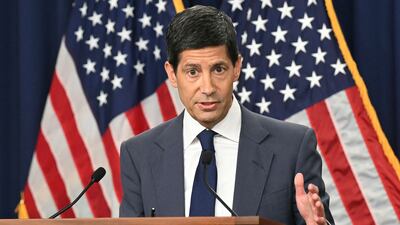

The US Federal Reserve held interest rates steady on Wednesday in a 10-2 vote, as officials opted for patience amid lingering inflation concerns.
“The committee believes that the accumulation of more information will help it determine the policy stance appropriate to ensure a timely return of inflation to the 2 per cent goal. The committee will achieve price stability,” Fed chairman Kevin Warsh told reporters.
Fed governor Lisa Cook and Cleveland Fed president Beth Hammack voted against the decision, preferring to raise rates by 25 basis points.

Wednesday’s decision was expected to be a short reprieve from raising short-term interest rates after the Fed lifted the target range to between 3.75 and 4.00 per cent last month.
The UAE Central Bank, which follows Fed decisions because of the dirham's peg to the dollar, also kept its benchmark interest rate unchanged at 3.9 per cent.
Investors still anticipate a quarter-point increase when Fed officials meet for the final time this year in December, according to CME Group data. Most officials indicated in September they would be in favour of another rate increase this year, although some have said in public remarks since that they are in no rush to do so.
"The two hawkish dissents, the wording of the policy statement and prior comments from officials all suggest the central bank will hike rates in December," Michael Pearce, chief US economist at Oxford Economics, wrote in a note.
Asked why rates were held steady, Mr Warsh said ensuring price stability is not about "some fixed individual date in the calendar" or "some isolated data point". He also said he has noticed financial and credit conditions have tightened since the Fed met last month.
The yield on the 10-year Treasury held steady at about 5 per cent after Mr Warsh's news conference. The Dow Jones Industrial Average, S&P 500 and Nasdaq Composite all saw minor gains to end the trading session in the green.
Ahmed Azzam, head of financial market research at Equiti Group, said his remarks were less hawkish than the post-meeting statement indicated, although his base case remains a quarter-point increase in December.
"But the bigger question is whether the Fed is overestimating the economy's ability to absorb inflationary pressures through productivity gains, potentially leaving it facing a more persistent inflation problem and a longer 'higher for longer' cycle in 2027," Mr Azzam said.
Partly contributing to the inflation outlook is the Iran war's effect on energy prices. The Fed typically looks through energy costs because rate decisions cannot directly affect a loss of supply such as the one being experienced in the Middle East, although the prolonged conflict is testing this ability.
Petrol prices jumped 9.1 per cent in September on a monthly basis, representing more than half of the all-items monthly increase for the Consumer Price Index. For the past 12 months, petrol prices are up 34.2 per cent, while fuel oil is up 74.2 per cent. Overall, energy is up 20.4 per cent over the last year.
“Energy and related prices have moved higher again in recent weeks, and our job is to ensure that relative price changes in some sectors do not broaden out across the economy,” Mr Warsh said.
"I'm just telling you when I look out the window over the last several months, that is what we've seen. To the extent that oil prices were to move lower, again probably due to geopolitical events, that's something that we're going to have to interrogate.
"But that's just a hypothetical."
The labour market also appears to remain stuck. The economy added 29,000 jobs last month while the unemployment rate remained fixed at 4.2 per cent. This suggests economic activity is being fuelled by AI-driven investment instead of broad-based employment growth.
Fed officials have also acknowledged the artificial intelligence building as another inflation driver as Amazon, Meta and other so-called hyperscalers continue to spend billions on AI infrastructure.
Mr Warsh said in Thailand earlier this month that central bankers have to recognise this AI investment as a “shock”, even as he sees it contributing to long-term wealth and productivity gains.
However, raising interest rates could have a muted impact on the hyperscalers, who are considered to be key drivers of the economy.
Morgan Stanley analysts said Alphabet, Amazon, Meta and Microsoft are expected to raise their total capital expenditure by more than 50 per cent in 2027, compared with 2026, and will probably be able to withstand higher funding costs.
Mr Warsh rejected that suggestion, saying he does not believe advanced technologies are “divorced from the rest of the economy".
Changes to meetings
Mr Warsh also laid out a new schedule for the regularly scheduled policy meetings. The Federal Reserve typically meets eight times a year to consider monetary policy decisions.
Mr Warsh on Wednesday said it will keep the number of meetings unchanged for next year, although one meeting starting in autumn will exclusively focus on monetary policy strategy and not include a policy statement. He said this will grow to two meetings in 2028.

