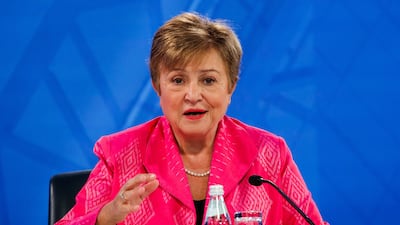

The head of the International Monetary Fund has said the energy price shock driven by the US-Iran war has so far been “large but contained”, but warned that energy demand could lead to further pressure.
“Even if the war in the Gulf were to end soon, the problem of high energy prices would likely persist for some time,” managing director Kristalina Georgieva said in prepared remarks in Singapore ahead of the IMF and World Bank annual meetings.
This year's gathering, held in Bangkok, comes as supply disruptions from the war in the Middle East pile on to inflationary pressures, potentially leading to higher interest rates for advanced economies. The Federal Reserve and European Central Bank have already begun to raise their key rates, with the Bank of England expected to join them next month.

Higher energy prices and rising debt levels have also driven global borrowing costs to their highest levels in decades. The yield on the 10-year US Treasury, a benchmark for global borrowing costs, traded at 5.307 per cent as recently on Monday, its highest level since 2002.
That pressure has also spread to markets in other advanced economies including in Japan, France, Germany and the UK.
Oil producers in the Middle East are racing to establish alternative routes to bring their exports to the markets. The UAE is fast-tracking construction of its West-East Pipeline, which is expected to double export capacity through Fujairah by the time its expansion is completed in 2027. Saudi Arabia has rerouted its crude through the East-West Pipeline.
The seven-day moving average for crude exports from the Gulf was 18.3 million barrels per day on September 30, compared to the average 18 million bpd that passed through the region in the 12 months before the Iran war began, according to ship tracking firm Kpler. The latest figures included transits via the Strait of Hormuz, the Red Sea and exports from terminals and ship-to-ship transfers in the Gulf of Oman.
Ms Georgieva had credited the Gulf Co-operation Council's efforts to reroute energy supplies for preventing a larger shock to the global economy during a meeting with the bloc's finance ministers and central bankers in Bahrain last week.
She also said the IMF anticipates the GCC economy will contract this year, adding that the region is expected to face a strong recovery next year, conditional on the normalisation of shipping.
A separate report from the World Bank released on Tuesday said GCC economies will contract by an average of 4.3 per cent this year, a downward revision of 5.7 percentage points from its April forecast.
Meanwhile, continued supply disruptions in liquefied natural gas will hit buyers in Europe and Asia particularly hard, Ms Georgieva said, noting price pressures could further build with winter approaching and reserves dwindling.
AI revolution is here
In her address, the IMF chief also used her address to urge governments to embark on policies to unlock the productive gains under artificial intelligence.
Ms Georgieva described the global economy as one being pulled in two directions, with the positive demand shock from AI partially offsetting the economic fallout from the US-Iran conflict.
“Love it, hate it, or fear it, AI is here, rapidly becoming a key driver of countries’ relative fortunes in the world economy,” she said.
In the US, the AI buildout is shaping up to become the largest investment drive in the country's history. Analysts at Brookings anticipate AI investment in data centres, infrastructure, chips and other equipment will total $10.3 trillion from 2025 to 2032, or an average of 3.63 per cent of US GDP per year.
The broad S&P 500 hit a fresh record-high of 7,800 on Tuesday driven by renewed AI enthusiasm. But with fears of an AI bubble also fomenting, Ms Georgieva said countries should adopt regulation and supervision as a “first line of defence” to prevent a far-reaching shock if AI earnings fall short.
The Trump administration has recently adopted a defensive posture of AI amid a growing domestic backlash against the data centre buildout ahead of November’s midterm elections. US President Donald Trump has taken a light regulatory touch on AI advancement and repeatedly expressed his desire to beat China in the global AI race.
Countries in the Gulf are seeking to advance large-scale acceleration of AI. The UAE targets to have AI contribute 20 per cent of its non-oil GDP by 2031.
Ms Georgieva said AI could deliver up to a half percentage point of additional world growth – or “adding an economy the size of ASEAN to the world economy” – annually.
“Yet as this drives forward today’s AI economies, it largely bypasses most others, increasing the risk of widening economic inequality across the globe,” she said.