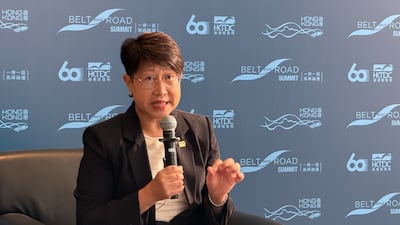

Hong Kong is positioning a “pipeline of non-stop investments” towards the Middle East and North Africa as part of its long-term commitment to the region, the top executive of the territory's trade body has said.
The plan encompasses six clusters comprising priority sectors that are part of the China-led Belt and Road Initiative's push to tap into high-growth industries in the region, Hong Kong Trade Development Council executive director Sophia Chong said.
“We are planning some new projects to reinforce the [existing] investments in different sectors,” she told The National on the sidelines of the 11th Belt and Road Summit in Hong Kong on Wednesday.

Those clusters – which were unveiled in July as part of the HKTDC's 60th anniversary – are finance and professional services, global network and supply chains, technology and digital innovation, wellness and creative industries, consumer goods and lifestyle, and corporate development.
“These efforts with the Middle East are non-stop because this is an expression of mutual sincerity of doing trade,” she said.
Ms Chong, however, did not provide a timetable for when the HKTDC's projects will materialise, given the ongoing war in Iran. She hinted that its plans will accelerate once the war ends, without providing specifics.
“The Middle East has contributed a lot of initiatives [in terms of trade]. It's a very promising market, but I have to say there is some pullback because of the conflict … [so] I can't tell the exact date,” Ms Chong said. Trade missions targeting key Mena cities are also on the table, she added.

She acknowledged that the war has deterred the growth of trade and the HKTDC's plans “by a little bit”, especially as air travel from Hong Kong remains restricted. Flights of Cathay Pacific, Hong Kong's flag carrier, to Dubai and Riyadh remain suspended until November 30.
“But [the HKTDC's plans] are a long term one … I always say [especially to the] media that we should consider and continue our efforts in the Middle East,” Ms Chong said.
Making its presence felt
Hong Kong's increasing role in Mena is underpinned by the Belt and Road Initiative, the Beijing-led initiative that aims to connect Asia with Africa and Europe, improve regional integration, increase trade and stimulate economic growth.
The push comes as China and the UAE deepen investment links. On Thursday, the UAE Ministry of Investment and the China Council for the Promotion of International Trade signed an agreement in Beijing to establish a China–UAE Business Advisory Committee, a business-led platform aimed at connecting companies in both countries to identify investment opportunities and develop partnerships.
China is the UAE's largest global trading partner and accounted for 4.8 per cent of the country's total inward foreign direct investment stock in 2025, according to the UAE Ministry of Investment.
The HKTDC, which organises the annual Belt and Road Summit, has 51 offices globally, including five in the Middle East and Africa – Dubai, Riyadh, Johannesburg, Nairobi and Tel Aviv.
A new office in Cairo is being planned and is expected to open in 2027, with Qatar, Oman, Kuwait and North African cities also on the HKTDC's radar, Ms Chong said.
Trade between Hong Kong and the Middle East grew by nearly a third from 2019 to 2025, according to HKTDC figures. This is half of the 60 per cent growth Hong Kong recorded with Asean countries, it is still “a big increase and a very high growth number”, she said.
“We are seriously looking into these … all these developments point to the fact that we're diversifying our markets,” which is key to the present trade environment that is unpredictable, Ms Chong said.
In the past three years, the commission has sent several trade delegations to Abu Dhabi, Dubai, Riyadh, Doha and Kuwait, seeking to pave more avenues to boost trade. The HKTDC's chairman, Frederick Ma, is “contemplating” another mission to the Gulf, she said.
This year's Belt and Road Summit also debuted a dedicated Middle East zone and panels focused on the region, as “the Hong Kong government is placing a lot of importance in Middle Eastern countries”, Ms Chong said.
“You see the interactions and exchanges have become more frequent and being exemplified in a lot of different initiatives. And even after these high-level missions, there are a lot of follow-ups.”