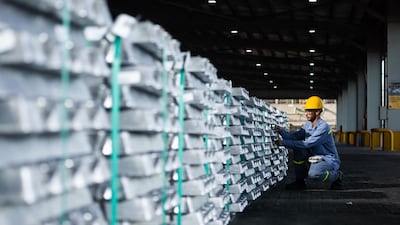

Emirates Global Aluminium has made significant progress in restarting production at its Al Taweelah plant in Abu Dhabi, three months after it sustained extensive damage in an Iranian drone attack.
EGA, among the largest UAE non-oil industrial conglomerates, has achieved key milestones ahead of its internal restoration schedule to restart operations at the multibillion-dollar production facility, it said in a statement on Thursday.
The company had initially estimated the repairs would take up to a year to finish.

“We are rapidly and safely actioning a clear, disciplined plan to restore production at Al Taweelah, which is one of the most important aluminium production complexes in the world,” Abdulnasser bin Kalban, chief executive of EGA, said.
The production unit at the Khalifa Economic Zones Abu Dhabi, hit on March 28, had sustained “significant damage”. The site, including the smelter and cast house, power plant, alumina refinery and recycling plant, was fully evacuated and its centres entered emergency shutdown, the company said in an April 3 statement. Two people were injured in the attack.
On April 12, the company declared force majeure for certain products due to the shutdown and said it is doing everything it can to support its customers “during this difficult period”. Force majeure clauses allow suppliers to suspend contractual obligations without penalty when events beyond their control prevent delivery.

Progress
EGA said its dedicated team for restoration and restart of the Al Taweelah facilities had already made significant progress in terms of repairs to the damaged infrastructure.
Basic utilities have been restored across the site, with natural gas and electricity availability projected to increase in line with the needs of the restart programme.
The company is progressively restoring each of the 1,262 reduction cells where pure aluminium is produced. The process of removing anodes that deliver electricity has been completed at all the reduction cells, and frozen metal has been removed from more than 20 per cent of the reduction cells, EGA said.
The company has restored 89 of its 1,262 reduction cells so far, and hot metal production will ramp up as the remaining cells are restored.
The entire process still “could take up to a year to reach pre-incident levels”; however, EGA is working to speed up the process. The company has not changed its overall estimate for a full recovery despite the faster-than-expected progress.
“All opportunities to accelerate the timeline further are being explored, and we will achieve our goal of emerging stronger than ever before,” Mr bin Kalban said.

Financial impact
EGA, which "entered this crisis with a very robust balance sheet", does not need additional external financing to fund the repairs at Al Taweelah, chief financial officer Pal Kildemo told The National on Thursday.
The company has enough cash on the balance sheet as it had already refinanced its credit facilities.
"So, in general, we're managing restart and repair activities based on own balance sheet and cash flow," Mr Kildemo said.
He declined to give an estimated total cost for repairs and said further financial details would be revealed with the first-half earnings report in August.
Although the company has lost production at one plant, the margins for aluminum producers rose significantly due to a sharp increase in global aluminium prices amid supply disruptions driven by the Iran war. A drop in the rate for alumina, the feedstock, has also helped margins, he said.
Capital expenditure this year will be higher than estimated, but EGA does not expect a significant impact on earnings.
"Not having a plant is being offset by the fact that markets are better," Mr Kildemo said.
With the shutdown of Taweelah facilities, EGA lost nearly 60 per cent of its production capacity. However, the steps it took even before the crisis began helped it to navigate the disruption and to serve its clients.
"As the geopolitical tension in the region had risen, we did several measures to mitigate any potential risk. One of them was to ensure that we had more metal sitting outside the UAE," he said.
"We had a lot of stock on the ground in the US, particularly, and also, to some extent, a lot of metal on ship in Europe."
During the initial phases of the conflict customers were not "materially impacted [and] we were able to continue to supply", Mr Kildemo added.
"But as the situation continued, we had to declare force majeure for some customers, and we are now working to restore the production and supply to every extent possible."