

The US issued an advisory last Monday to American-flagged ships, asking them to avoid Iranian territory when passing through the Strait of Hormuz.
The warning has led to intensified scrutiny throughout the global shipping industry, though markets have yet to react sharply.
The US accounts for only a small fraction of global commercial shipping – particularly in container trades – but analysts say the move has wider implications for non-US operators that dominate Gulf trade flows, as most vessels transiting Hormuz are owned or operated by foreign firms.

Iran poses a “credible threat” to shipping if hostilities break out, says Jakob Larsen, chief safety and security officer at shipping association Bimco. With advanced weapons systems across nearby waters, the risk to commercial vessels is real, he says.
chief safety and security officer, Bimco
“As demonstrated by Iran in the past, any shipping operation with business or personal links to Israel or US risks being targeted,” he tells The National. "Add to that the omnipresent risk of being targeted due to misidentification and it becomes clear that all ships will be at risk if hostilities break out."
“There is no alternative route to the Strait of Hormuz," he adds. "We have seen around a 50 per cent drop in numbers of ships going through the Bab Al Mandeb strait and the Red Sea due to Houthi attacks in connection with the Israeli military operation in Gaza. These ships have indeed rerouted south of Cape of Good Hope.”
Risk ‘always there’
For credit analysts, the strategic importance of Hormuz has never diminished. Alexander Perjessy, vice president and senior credit officer at Moody’s Ratings, says risk is “always there”. The advisory does not materially change the underlying risk environment, he says.
“In our view, the risk has not changed, it’s always been there,” Mr Perjessy says, describing the Strait of Hormuz as one of the key transmission channels through which geopolitical tension can affect credit fundamentals across the region.
Disruption to shipping traffic through the strait remains a low-probability but high-impact event.
Mr Perjessy adds that the strait represents one of the few strategic levers Iran could use in response to escalating pressure from the US and its allies, including over Tehran’s nuclear programme.
Tension is simmering between the US and Iran. Washington sent an "armada" to the Middle East in response to a government crackdown on protests in Iran. Concerns are high that the US might launch another attack on Tehran.
Earlier this month, US forces shot down an Iranian drone it said had ventured too close to the USS Abraham Lincoln aircraft carrier in the Arabian Sea.
Amid the tension, Iran and the US have held talks on the future of Tehran's nuclear programme. US President Donald Trump, who ordered strikes on Iran's nuclear infrastructure in June last year, described the negotiations in Oman as "very good".
The Strait of Hormuz is a major route for shipping in the Middle East, particularly for tankers carrying oil around the world. Iran has threatened to close the waterway during times of high geopolitical tension.
Structurally, the Strait of Hormuz remains one of the world’s most critical chokepoints. If tension between the US and Iran heightens, non-US shipping companies could be directly affected – through security threats, potential sanctions or sharp swings in freight rates.
The US Department of Transportation has advised vessels to assert their rights under international law and decline Iranian forces permission to board, but to avoid resisting should they be boarded. To avoid such issues, it warned vessels to steer clear of Iranian waters "without compromising navigational safety".
Iranian forces used small boats and helicopters during boarding operations and have attempted to force commercial vessels in the country's territorial waters, the US Department of Transportation said on February 9.
Using hybrid routes
As a result of the advisory, ship operators are also using hybrid routes, with a combination of sea and air routes, to avoid sensitive regions. “Some supertanker operators, nervous about rising US-Iran tensions and potential risks to shipping in the waterway, are speeding their vessels through the chokepoint,” Junaid Ansari, director of Investment Strategy and Research at Kamco Invest, tells The National.
“In addition, shipping companies are increasing the use of AI-driven, real-time analytics to monitor threats and predict risks to container ships, allowing for rapid, proactive route changes."
Operationally, companies have already adapted to years of geopolitical friction – adjusting insurance premiums, factoring higher freight rates into contracts and investing in real-time analytics to monitor threats, Mr Ansari says.
For non-US shipping firms, he argues, the greater concern may not be physical security but sanctions exposure.
“Worry comes more from a sanctions perspective rather than from a security perspective,” Mr Ansari says. “We believe that shipping firms would be cautious in taking any step that would risk a sanction from the US … [and that] oil shipments will not be impacted as this will escalate to include even other producers in the region.”
Container flows steady ... for now
In the container sector, meanwhile, there has been no immediate operational shift.
Peter Sand, chief analyst at freight pricing platform Xeneta, says geopolitical risks are “ever present” for shippers, carriers and forwarders, “these days more than ever before”.
“A risk like this should not be ignored,” he points out. “But all maritime businesses working in the Middle East region are used to operating under elevated levels of risk.”
Data from Xeneta shows container shipping services and capacity into the Arabian Gulf and upper Indian Ocean remain unaffected so far. Capacity from China to the UAE – a trade route that transits the Strait of Hormuz – has been rising since November 2025. Since early this year, supply has outpaced demand, pushing short-term average freight rates down from $2,700 to $1,540 per 12-metre equivalent unit.
Mr Sand, however, warns that the situation could change quickly if uncertainty escalates.
Importantly, the vast majority of container shipowners and operators are non-US entities, meaning any material shift in capacity or pricing would be driven largely by European and Asian shipowners, rather than Americans. For now, they are holding course. But that could change quickly if tension escalates, warns Mr Sand.
What of shipping costs?
With non-US operators rerouting around alternative paths such as the wider Gulf of Oman routes or the Cape of Good Hope, shipping costs are set to soar, Mr Ansari says.
“This will definitely increase shipping costs, but this issue has been there since the start of the geopolitical conflicts in the region,” he tells The National. "And shipping companies have adjusted costs, insurance premiums and vessel capacity expansions to deal with the situation."
According to Mr Larsen of Bimco, during the war between Iran and Iraq in the 1980s, oil kept flowing out of the Arabian Gulf despite several attacks on tankers … and with that in mind, the most likely scenario is “probably that some shipowners will opt out of the trade” in and out of the Arabian Gulf. “And when this happens, the usual supply and demand dynamics will kick in and drive up the freight rates,” he says.
Meanwhile, amid all the tension, the International Chamber of Shipping (ICS) says its priority is ensuring seafarers’ lives are not affected by regional instability.
-

US President Jimmy Carter toasts Shah Mohammad Reza Pahlavi of Iran during a New Year's Eve dinner at Niavaran Palace in Tehran in 1977. AP -
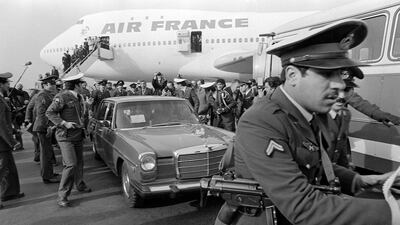
An armed escort surrounds Ayatollah Ruhollah Khomeini's car at Tehran airport on February 1979, as he returns to Iran from exile. AP -

People jostle to see Khomeini, who blessed the crowd, in a schoolyard in Tehran on February 4, 1979. AP -
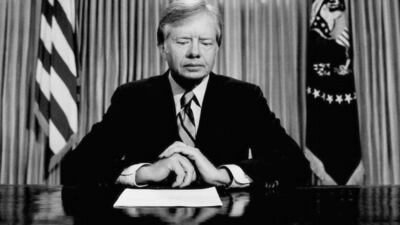
President Carter prepares to make a national television address from the White House, on April 25, 1980, about the failed US mission to rescue hostages held in Iran. AP -
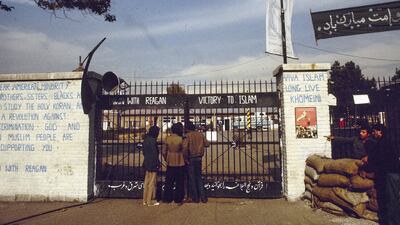
The entrance to the US Embassy in Tehran where 63 people were held hostage, in 1980. Graffiti on the wall urges minority communities in America to start a 'revolution against US discrimination'. AP -
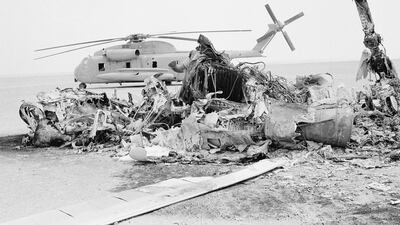
Remains of a burned-out American helicopter in the eastern desert region of Iran, in April 1980, after the failed attempt to free the US Embassy hostages. AP -
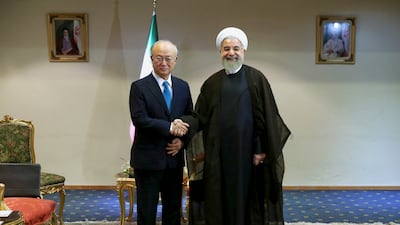
Iran's President Hassan Rouhani, right, shakes hands with Yukiya Amano, director general of the International Atomic Energy Agency (IAEA), in July 2015, before talks in Tehran on Iran's nuclear programme. AP -
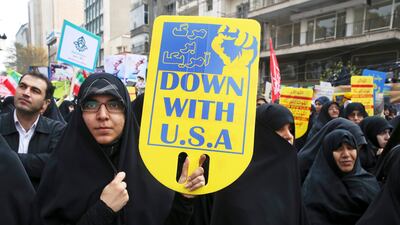
A rally in front of the former US Embassy in Tehran in 2015 marks the 36th anniversary of the seizure of the embassy by militant Iranian students. AP -

President Rouhani attends an event to mark National Nuclear Day in Tehran on April 9, 2018. AP -

The coffins of Iranian Quds Force general Qassem Suleimani and others who were killed by a US drone strike are carried on a lorry during their funeral procession in Kerman, Iran, in January 2020. AP -

Demonstrators walk over Israeli and US flags at a rally commemorating Iran's 1979 Islamic Revolution, in Tehran in February 2024. AP -
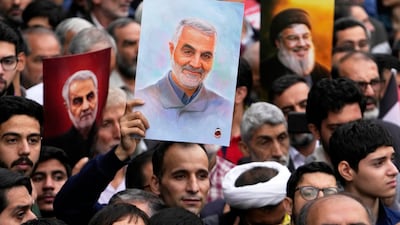
Iranian demonstrators hold up posters of Qassem Suleimani and Hezbollah leader Hassan Nasrallah, who was killed in an Israeli air strike in Beirut in September 2024, at a rally outside the former US Embassy in Tehran, in November 2024. AP -
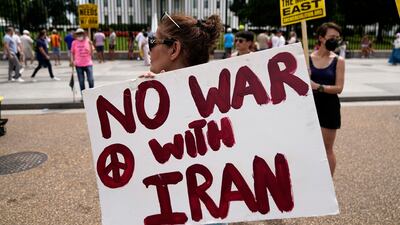
Demonstrators protest outside the White House in Washington on June 22, 2025, following US military strikes on Iran. AP


The body acknowledged the US advisory and urged ships sailing in the region to conduct thorough risk assessments and maintain vigilance in line with established maritime security guidelines, while monitoring updates from official channels.
For now, global shipping appears to be maintaining course, balancing caution with commercial necessity. But with about a fifth of the world’s oil passing through the Strait of Hormuz, even a remote threat commands attention.
“As a global industry, shipping depends on the continued safety and stability of this vital maritime corridor,” says John Stawpert, principal director of marine at ICS, which is “closely monitoring the situation” while ensuring the secure flow of international trade.

