
India’s annual budget will focus on accelerating and sustaining strong economic growth, Finance Minister Nirmala Sitharaman said on Sunday, raising infrastructure spending to a record as New Delhi pushes structural reforms in a volatile global environment.
Infrastructure outlays will rise to 12.2 trillion rupees ($133.08 billion) for the 2026–2027 financial year, above the 11.21 trillion rupees budgeted for the current fiscal year, which was previously the highest on record. Ms Sitharaman said the budget prioritises long-term competitiveness, a stronger financial sector and investment in cutting-edge technologies including artificial intelligence.
The spending plan comes as India seeks to maintain momentum in one of the world’s fastest-growing major economies while managing fiscal pressures and external risks.

The Indian economy is forecast to grow 7.4 per cent in the current financial year, with inflation expected near 2 per cent, according to Reuters. The government’s fiscal deficit is forecast at 4.4 per cent of gross domestic product.
To spur private investment and domestic demand, New Delhi has rolled out a series of reforms in recent months, including consumption and income tax cuts, an overhaul of labour laws and steps to open the tightly controlled nuclear power sector. More policy changes are expected in the budget.
A central theme of the budget presentation was boosting domestic manufacturing to create jobs and reduce vulnerability to global supply shocks. The government said it would expand incentives for priority sectors and strengthen industrial capacity as part of a broader strategy to build economic resilience.
The budget signals continuity in Prime Minister Narendra Modi’s growth model, which relies heavily on public capital expenditure to crowd in private investment while gradually narrowing the fiscal deficit.
-
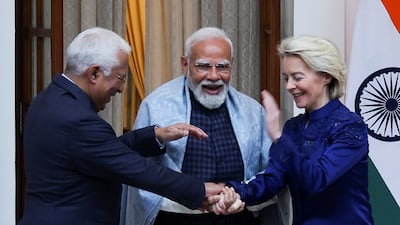
Indian Prime Minister Narendra Modi, centre, with European Council President Antonio Costa and European Commission President Ursula von der Leyen in New Delhi as Mr Modi announced the finalisation of a trade deal between his country and the EU. Reuters -

Ahmad Rohimat, 30, collects belongings from the ruins of his house following a landslide due to heavy rain in Pasir Langu village, West Java, Indonesia. Reuters -

A model wears a creation from Rahul Mishra's spring/summer 2026 couture collection at Paris Fashion Week. AFP -

French skipper Alexia Barrier and members of her crew hold lit flares to celebrate completing the Jules Verne Trophy, at Brest harbour, Brittany, France. The Famous Project team became the first all-female crew to complete the non-stop round-the-world voyage in a maxi-trimaran, her team announced. AFP -

A decoration for the Lunar New Year of the Horse in the Chinatown district of Singapore. AFP -

A boatman steers a traditional shikara after snow at Srinagar's Dal Lake in Kashmir, India. AFP -

A gunshot hole in a window near a memorial for nurse Alex Pretti, 37, who was shot dead by US federal immigration (ICE) agents in Minneapolis, Minnesota, on January 24. AFP -

Youths leap from St Kilda Pier in Melbourne, Australia, as Victoria state swelters in a heatwave. EPA


Manufacturing and strategic sectors
A central theme of the speech was the push to boost domestic manufacturing, which remains below 20 per cent of GDP, to create jobs for millions entering the workforce. The government outlined plans to scale up capacity across seven priority sectors, including pharmaceuticals, semiconductors, chemicals, textiles and capital goods. It also outlined targeted incentives for rare earth magnets and electronics production. Legacy industrial clusters are set to be revived under new schemes.
Specific allocations include a 100 billion rupee package for biopharmaceuticals over five years and 400 billion rupees for semiconductor manufacturing, underscoring a strategic tilt towards globally competitive high-tech industries.
The budget builds on a string of policy reforms rolled out in recent months to spur investment and demand, including cuts in consumption and income taxes, a major overhaul of labour laws, and opening up tightly regulated sectors such as nuclear power to private participation. Additional policy changes are widely expected as part of the broader effort to improve ease of doing business and attract foreign capital.
While the government signalled no dramatic shifts on the tax front, it seems focused on delivering predictability and stability rather than headline tax cuts. This is aimed at preserving fiscal credibility and shielding the economy from heightened global risks, including punitive US tariffs and supply-chain pressures.

