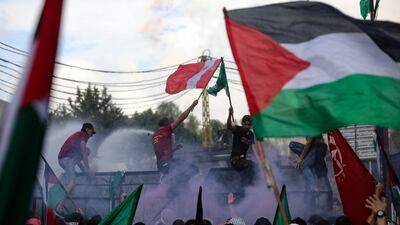
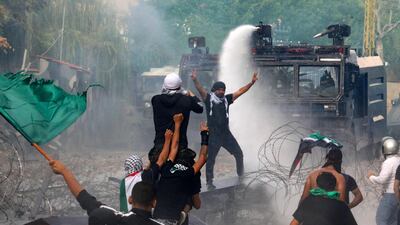
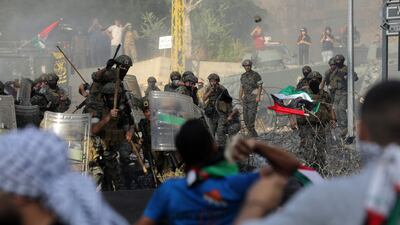
A drop in tourist arrivals to the Middle East due to the Israel-Gaza war will have a significant impact on neighbouring countries, but will deliver the biggest blow to Lebanon's already battered economy with an estimated loss in gross domestic product of up to 23 per cent, ratings firm S&P Global warned.
If tourism revenue falls 10 per cent to 30 per cent due to the war, that would cut Lebanon's GDP by 10 per cent, the agency said on Monday. In the worst-case scenario, a 70 per cent drop in tourism receipts could lead to a 23 per cent hit to the country's GDP.
Lebanon has the highest reliance on tourism among its neighbours, Israel, Egypt and Jordan. Last year, tourism contributed to 26 per cent of Lebanon's current account receipts.
“In the context of ongoing foreign currency shortages, currency depreciation of more than 95 per cent since 2020, hyperinflation, and a political vacuum, Lebanon can ill afford to forego critical foreign currency inflows from tourism,” S&P said.
Global airlines including Lufthansa, Eurowings and Swiss Air suspended flights to Lebanon in mid-October.
The tourism sector is a big employer and an important source of foreign currency in many Mena countries. The UN World Tourism Organisation says the region received 20 per cent more tourists in the first seven months of this year than in the same period in 2019, making it the only region where tourism has exceeded pre-pandemic levels.
This supports the countries' economic growth and current accounts, but the consequences of the war have put the progress at risk, S&P said.
“Lebanon, Egyp, and Jordan could suffer the most, hampering real GDP growth and weakening their external positions” due to their shared borders with Israel and the potential for the conflict to spill over into their borders, it said.
Last year, tourism contributed 21 per cent of Jordan's current account receipts, 12 per cent in Egypt and 3 per cent for Israel.
S&P estimated that a scenario of a 10 per cent to 30 per cent drop in Egypt's tourist revenue would cost the country 4 per cent to 11 per cent of its foreign exchange reserves if the central bank opted to intervene in the FX market.
In a scenario of a 70 per cent drop in tourism revenue, it could cut Egypt's foreign reserves by 26.6 per cent and cut 1.8 per cent of its GDP.
“It is important to emphasise the quite large share of visitors from the region and diaspora in total tourism arrivals, which should help shield the sector from a larger sector shock,” S&P said.
“Such visitors are likely to have somewhat more inelastic demand to regional geopolitical considerations.”
In Jordan, a 70 per cent drop in tourism revenue could cut its foreign exchange reserves by as much as 22.2 per cent and its GDP by 8.5 per cent.
In Israel, foreign tourism has come to a halt, but the economic impact is “likely to be minimal” because the sector makes up less than 3 per cent of current account receipts, S&P said.
If tourism income were to drop by 70 per cent, the loss would be equivalent to about 2 per cent of Israel's official foreign exchange reserves, it said.
However, the Israeli economy will likely face “more severe consequences from logistical disruptions, business interruption, a reduced labour force, suspension of gas production at the Tamar gasfield, and lower investment”, the rating agency said.
S&P expects Israel's GDP to shrink by 5 per cent year on year in the fourth quarter of 2023, bringing down growth for the full year to 1.5 per cent. It forecasts growth at 0.5 per cent for 2024.
Broader Mena region outlook
For the GCC, Turkey and Iraq, the impact on tourism flows is “unlikely to be material”, though much depends on the duration and spillover of the conflict into the broader region, S&P said.
“Within the broader Mena region, higher perceived security risks could dampen the inflow of tourists,” the agency said.
The UAE has a large and diversified tourism industry that “could be affected by cancelled hotel bookings and events to some extent. But we do not currently expect the decline to be significant, for now”, S&P said.
This is because the UAE has “some buffer” as tourist inflows already exceed pre-pandemic levels in the year-to-date and some tourists may divert their travel to the UAE from other parts of the region, it said.
In the other GCC countries, most visitors come from within the Gulf region. For Saudi Arabia and Iraq, a large part of tourism is for religious purposes and would be less susceptible to cancellations, the report said.
The war began on October 7, when Hamas operatives attacked southern Israel, killing about 1,400 people and taking more than 240 hostages.
Israel retaliated with air strikes and a total siege of the enclave, with the Palestinian death toll currently at more than 10,000.
The conflict has sent shock waves throughout the Middle East, triggering new areas of confrontation and risking an escalation that could potentially plunge the region into a broader war.
The war will have a lasting impact on Israel's economy, while economic activity in Gaza has ceased and unemployment is close to 100 per cent.

The five pillars of Islam
How to help
Send “thenational” to the following numbers or call the hotline on: 0502955999
2289 – Dh10
2252 – Dh 50
6025 – Dh20
6027 – Dh 100
6026 – Dh 200
Trump v Khan
2016: Feud begins after Khan criticised Trump’s proposed Muslim travel ban to US
2017: Trump criticises Khan’s ‘no reason to be alarmed’ response to London Bridge terror attacks
2019: Trump calls Khan a “stone cold loser” before first state visit
2019: Trump tweets about “Khan’s Londonistan”, calling him “a national disgrace”
2022: Khan’s office attributes rise in Islamophobic abuse against the major to hostility stoked during Trump’s presidency
July 2025 During a golfing trip to Scotland, Trump calls Khan “a nasty person”
Sept 2025 Trump blames Khan for London’s “stabbings and the dirt and the filth”.
Dec 2025 Trump suggests migrants got Khan elected, calls him a “horrible, vicious, disgusting mayor”
Fines for littering
In Dubai:
Dh200 for littering or spitting in the Dubai Metro
Dh500 for throwing cigarette butts or chewing gum on the floor, or littering from a vehicle.
Dh1,000 for littering on a beach, spitting in public places, throwing a cigarette butt from a vehicle
In Sharjah and other emirates
Dh500 for littering - including cigarette butts and chewing gum - in public places and beaches in Sharjah
Dh2,000 for littering in Sharjah deserts
Dh500 for littering from a vehicle in Ras Al Khaimah
Dh1,000 for littering from a car in Abu Dhabi
Dh1,000 to Dh100,000 for dumping waste in residential or public areas in Al Ain
Dh10,000 for littering at Ajman's beaches
F1 The Movie
Starring: Brad Pitt, Damson Idris, Kerry Condon, Javier Bardem
Director: Joseph Kosinski
Rating: 4/5
The%20specs%3A%202024%20Mercedes%20E200
%3Cp%3E%3Cstrong%3EEngine%3A%20%3C%2Fstrong%3E2.0-litre%20four-cyl%20turbo%20%2B%20mild%20hybrid%0D%3Cbr%3E%3Cstrong%3EPower%3A%20%3C%2Fstrong%3E204hp%20at%205%2C800rpm%20%2B23hp%20hybrid%20boost%0D%3Cbr%3E%3Cstrong%3ETorque%3A%20%3C%2Fstrong%3E320Nm%20at%201%2C800rpm%20%2B205Nm%20hybrid%20boost%0D%3Cbr%3E%3Cstrong%3ETransmission%3A%20%3C%2Fstrong%3E9-speed%20auto%0D%3Cbr%3E%3Cstrong%3EFuel%20consumption%3A%20%3C%2Fstrong%3E7.3L%2F100km%0D%3Cbr%3E%3Cstrong%3EOn%20sale%3A%20%3C%2Fstrong%3ENovember%2FDecember%0D%3Cbr%3E%3Cstrong%3EPrice%3A%20%3C%2Fstrong%3EFrom%20Dh205%2C000%20(estimate)%3C%2Fp%3E%0A
Match info
Uefa Nations League Group B:
England v Spain, Saturday, 11.45pm (UAE)
Expo details
Expo 2020 Dubai will be the first World Expo to be held in the Middle East, Africa and South Asia
The world fair will run for six months from October 20, 2020 to April 10, 2021.
It is expected to attract 25 million visits
Some 70 per cent visitors are projected to come from outside the UAE, the largest proportion of international visitors in the 167-year history of World Expos.
More than 30,000 volunteers are required for Expo 2020
The site covers a total of 4.38 sqkm, including a 2 sqkm gated area
It is located adjacent to Al Maktoum International Airport in Dubai South
Francesco Totti's bio
Born September 27, 1976
Position Attacking midifelder
Clubs played for (1) - Roma
Total seasons 24
First season 1992/93
Last season 2016/17
Appearances 786
Goals 307
Titles (5) - Serie A 1; Italian Cup 2; Italian Supercup 2
How to get there
Emirates (www.emirates.com) flies directly to Hanoi, Vietnam, with fares starting from around Dh2,725 return, while Etihad (www.etihad.com) fares cost about Dh2,213 return with a stop. Chuong is 25 kilometres south of Hanoi.
Various Artists
Habibi Funk: An Eclectic Selection Of Music From The Arab World (Habibi Funk)
VEZEETA PROFILE
Date started: 2012
Founder: Amir Barsoum
Based: Dubai, UAE
Sector: HealthTech / MedTech
Size: 300 employees
Funding: $22.6 million (as of September 2018)
Investors: Technology Development Fund, Silicon Badia, Beco Capital, Vostok New Ventures, Endeavour Catalyst, Crescent Enterprises’ CE-Ventures, Saudi Technology Ventures and IFC
Mercer, the investment consulting arm of US services company Marsh & McLennan, expects its wealth division to at least double its assets under management (AUM) in the Middle East as wealth in the region continues to grow despite economic headwinds, a company official said.
Mercer Wealth, which globally has $160 billion in AUM, plans to boost its AUM in the region to $2-$3bn in the next 2-3 years from the present $1bn, said Yasir AbuShaban, a Dubai-based principal with Mercer Wealth.
“Within the next two to three years, we are looking at reaching $2 to $3 billion as a conservative estimate and we do see an opportunity to do so,” said Mr AbuShaban.
Mercer does not directly make investments, but allocates clients’ money they have discretion to, to professional asset managers. They also provide advice to clients.
“We have buying power. We can negotiate on their (client’s) behalf with asset managers to provide them lower fees than they otherwise would have to get on their own,” he added.
Mercer Wealth’s clients include sovereign wealth funds, family offices, and insurance companies among others.
From its office in Dubai, Mercer also looks after Africa, India and Turkey, where they also see opportunity for growth.
Wealth creation in Middle East and Africa (MEA) grew 8.5 per cent to $8.1 trillion last year from $7.5tn in 2015, higher than last year’s global average of 6 per cent and the second-highest growth in a region after Asia-Pacific which grew 9.9 per cent, according to consultancy Boston Consulting Group (BCG). In the region, where wealth grew just 1.9 per cent in 2015 compared with 2014, a pickup in oil prices has helped in wealth generation.
BCG is forecasting MEA wealth will rise to $12tn by 2021, growing at an annual average of 8 per cent.
Drivers of wealth generation in the region will be split evenly between new wealth creation and growth of performance of existing assets, according to BCG.
Another general trend in the region is clients’ looking for a comprehensive approach to investing, according to Mr AbuShaban.
“Institutional investors or some of the families are seeing a slowdown in the available capital they have to invest and in that sense they are looking at optimizing the way they manage their portfolios and making sure they are not investing haphazardly and different parts of their investment are working together,” said Mr AbuShaban.
Some clients also have a higher appetite for risk, given the low interest-rate environment that does not provide enough yield for some institutional investors. These clients are keen to invest in illiquid assets, such as private equity and infrastructure.
“What we have seen is a desire for higher returns in what has been a low-return environment specifically in various fixed income or bonds,” he said.
“In this environment, we have seen a de facto increase in the risk that clients are taking in things like illiquid investments, private equity investments, infrastructure and private debt, those kind of investments were higher illiquidity results in incrementally higher returns.”
The Abu Dhabi Investment Authority, one of the largest sovereign wealth funds, said in its 2016 report that has gradually increased its exposure in direct private equity and private credit transactions, mainly in Asian markets and especially in China and India. The authority’s private equity department focused on structured equities owing to “their defensive characteristics.”
Ten tax points to be aware of in 2026
1. Domestic VAT refund amendments: request your refund within five years
If a business does not apply for the refund on time, they lose their credit.
2. E-invoicing in the UAE
Businesses should continue preparing for the implementation of e-invoicing in the UAE, with 2026 a preparation and transition period ahead of phased mandatory adoption.
3. More tax audits
Tax authorities are increasingly using data already available across multiple filings to identify audit risks.
4. More beneficial VAT and excise tax penalty regime
Tax disputes are expected to become more frequent and more structured, with clearer administrative objection and appeal processes. The UAE has adopted a new penalty regime for VAT and excise disputes, which now mirrors the penalty regime for corporate tax.
5. Greater emphasis on statutory audit
There is a greater need for the accuracy of financial statements. The International Financial Reporting Standards standards need to be strictly adhered to and, as a result, the quality of the audits will need to increase.
6. Further transfer pricing enforcement
Transfer pricing enforcement, which refers to the practice of establishing prices for internal transactions between related entities, is expected to broaden in scope. The UAE will shortly open the possibility to negotiate advance pricing agreements, or essentially rulings for transfer pricing purposes.
7. Limited time periods for audits
Recent amendments also introduce a default five-year limitation period for tax audits and assessments, subject to specific statutory exceptions. While the standard audit and assessment period is five years, this may be extended to up to 15 years in cases involving fraud or tax evasion.
8. Pillar 2 implementation
Many multinational groups will begin to feel the practical effect of the Domestic Minimum Top-Up Tax (DMTT), the UAE's implementation of the OECD’s global minimum tax under Pillar 2. While the rules apply for financial years starting on or after January 1, 2025, it is 2026 that marks the transition to an operational phase.
9. Reduced compliance obligations for imported goods and services
Businesses that apply the reverse-charge mechanism for VAT purposes in the UAE may benefit from reduced compliance obligations.
10. Substance and CbC reporting focus
Tax authorities are expected to continue strengthening the enforcement of economic substance and Country-by-Country (CbC) reporting frameworks. In the UAE, these regimes are increasingly being used as risk-assessment tools, providing tax authorities with a comprehensive view of multinational groups’ global footprints and enabling them to assess whether profits are aligned with real economic activity.
Contributed by Thomas Vanhee and Hend Rashwan, Aurifer