


The effect of UK supermarkets cutting the price of household staples led to food inflation slowing for a second month, figures have shown.
In June, shop price inflation overall dropped to 8.4 per cent, down from 9 per cent in May and below the three-month average of 8.7 per cent, the BRC-NielsenIQ Shop Price Index showed.
Food inflation decelerated for a second consecutive month to 14.6 per cent in June, a relatively significant drop from May’s 15.4 per cent and below the three-month average of 15.2 per cent.
Fresh food inflation saw a significant slowing from May’s 17.2 per cent to 15.7 per cent as retailers dropped the prices of staples including milk, cheese and eggs.
Prices for clothing and electrical goods also fell, with inflation for items other than food slowing to 5.4 per cent from 5.8 per cent last month, helping customers to pick up a bargain ahead of the summer holidays.
“Households up and down the country will welcome the easing of shop price inflation in June,” British Retail Consortium chief executive Helen Dickinson said.
“If the current situation continues, food inflation should drop to single digits later this year.
“However, it is imperative that government does not hamper this progress by introducing costly new policies.
“Reforms to the packaging levy and a new deposit return scheme could create an additional £4 billion [$5.1 billion] burden on retailers and their customers.
“Along with a rise in business rates, and the introduction of border controls in October, these policies could hinder the government’s efforts to combat inflation.”
Inflation around the world – in pictures
-

People queue to buy wheat flour at government-controlled prices in Islamabad. Pakistan's economy has been hit hard by a political crisis, as well as devastating floods and the global energy crisis, with the rupee plummeting and inflation at decades-high levels. AFP -
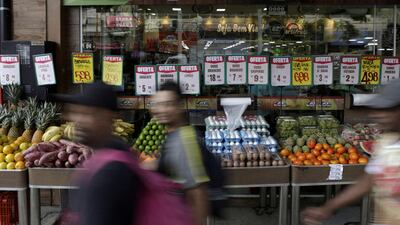
A market in Rio de Janeiro. Brazil's inflation ended 2022 with a sharp slowdown from double-digit peaks seen throughout the year. Reuters -
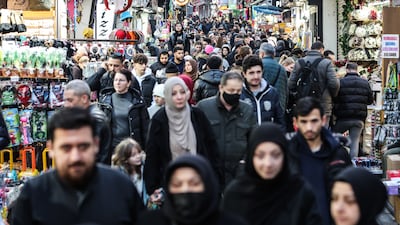
A market in Istanbul. Turkey's inflation at the end of 2022 stood at 64. 27 per cent, the country's Statistical Institute said, while the independent group of inflation researchers ENAG calculated it at 137. 55 per cent. EPA -
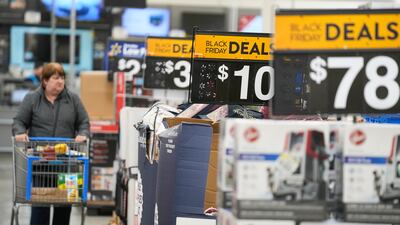
A Walmart in New Jersey. According to a poll, US Republicans and Democrats have distinct views of what’s most important for the government to address amid high inflation. More Republicans name gas and food prices, energy and immigration, while Democrats focus on health care, climate change and poverty. AP -

A used car sales lot in California. US Federal Reserve officials have indicated it’s possibly too early to declare victory over inflation. AFP -
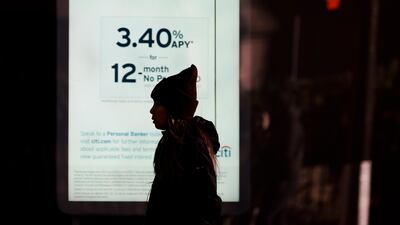
A person walks by a sign showing interest rates at a bank in New York. EPA -
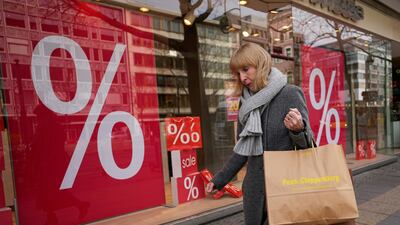
A woman walks with purchases past a store in Berlin. In December, consumer price growth across the Euro zone slowed to 9.2 per cent from 10.1 per cent a month earlier, Eurostat data showed last week. AP -
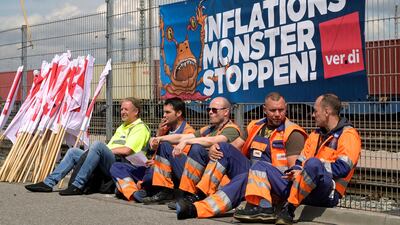
Workers sit in front of a banner reading "Stop the Inflation Monster" at the Burchardkai Container Terminal as they go on strike for higher wages at the harbour in Hamburg, Germany. Reuters -
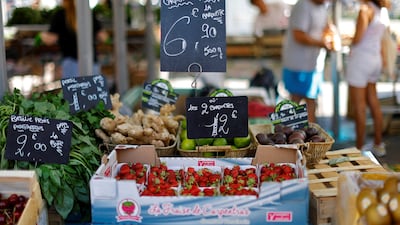
Price tags at a market in Nice, France. Reuters -

Commuters cross Waterloo Bridge in London. The British Retail Consortium said spending in store chains rose by 6.9 per cent in annual terms in December, but this was a long way off consumer price inflation, which hit 10.7 per cent in November. Reuters -

Jobseekers in Johannesburg. South Africa’s governing party wants the central bank’s mandate broadened to shore up the economy and promote employment in addition to its existing task of tackling inflation. Reuters -

Social grant recipients stand in a queue outside a post office, as joblessness takes its toll in Meadowlands, South Africa. Reuters


Mike Watkins, head of retailer and business insight at NielsenIQ, said: “Whilst prices are still higher than a year ago, the slowdown in food inflation is welcome news for shoppers, helped by supermarkets lowering prices of some staple goods.
“And if global supply chain costs continue to fall, we may now be past the peak of price increases.
“However, with most households needing to save money, purchasing behaviour for the rest of this year is still likely to shift towards essential needs with discretionary consumption being de-prioritised or delayed.”

