
A complete decoupling of the US and China would have catastrophic consequences for the global economy and policymakers on both sides are keen to find areas where the world’s two biggest economies can co-operate, the chief executive of money manager Fidelity International said in Davos.
There is a lot of “rhetoric” in terms of what is being said by officials, however, it is really important to “listen very hard to get what is actually being said”, said Anne Richards.
“My take is that the realisation that complete decoupling would be catastrophic for the global economy means that there is a genuine desire on both the US and Chinese sides to find the areas where co-operation can happen,” Ms Richards told a panel at the World Economic Forum on Tuesday.
The fact that these conversations are taking place between the two sides and there is an intent “not to completely fracture the global economy” is really important, added Ms Richards, whose company has $9.6 trillion in assets under administration globally.
The US and China have been at loggerheads since Donald Trump's Republican administration took control of the White House in 2016. The two sides engaged in a tit-for-tat tariff war that has seen the US slapping duties on more than $300 billion worth of Chinese imports.
The US has also imposed embargoes on advanced technology sales to Chinese companies and the US markets regulator has sought more scrutiny of the financial affairs of Chinese enterprises listed on US stock exchanges.
The situation has improved little in terms of a rollback of tariffs or China’s access to advanced technology under the Biden administration, but the rhetoric has toned down considerably.
Last year, China’s President Xi Jinping called for greater global economic integration and warned against decoupling, saying international affairs should be conducted by way of negotiations and discussions.
As Chinese companies seek to develop their own advanced technology industrial base, US enterprises that have relied on China for supplies and manufacturing for decades are now seeking alternatives.
Exports of iPhones made in India crossed the $1 billion mark last year, as Apple tries to cut its reliance on China, where the bulk of its smartphones are manufactured.
Most businesses, however, do not want a complete breakage in global supply chains and want to follow a “China plus one” policy, Ms Richards said.
-
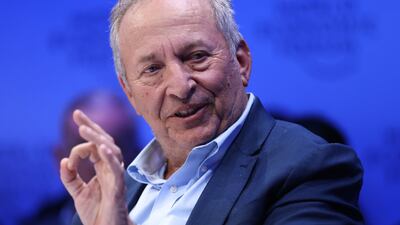
Lawrence Summers, president emeritus and professor at Harvard University, speaks during a panel session on day three of the World Economic Forum's Annual Meeting in Davos, Switzerland. Bloomberg -
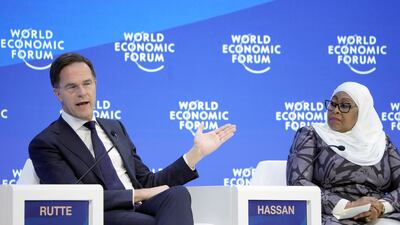
Netherlands Prime Minister Mark Rutte and Tanzanian President Samia Hassan during a panel discussion in Davos. AP -
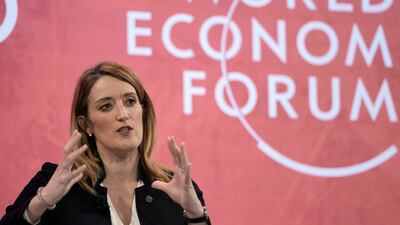
EU Parliament President Roberta Metsola speaks at the forum. AP -

Greek Prime Minister Kyriakos Mitsotakis, left, speaks to CNN journalist Fareed Zakaria at the Congress Centre in Davos. AFP -
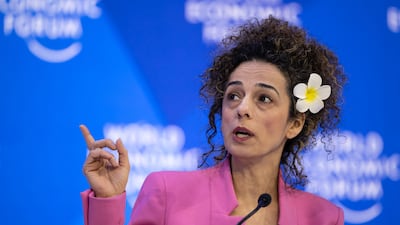
Iranian-American journalist and women's rights activist Masih Alinejad takes part in an interview with a TV news channel in Davos. AFP -
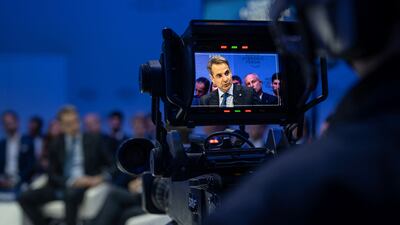
Mr Mitsotakis is seen on a TV camera viewfinder at the Congress Centre in Davos. AFP -
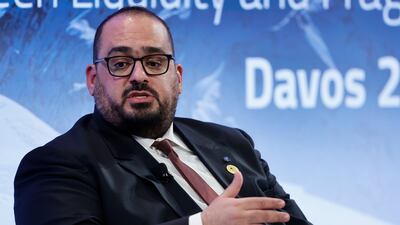
Faisal Alibrahim, Saudi Arabia's Economy and Planning Minister, speaks during a panel session in Davos. Bloomberg -
Climate activist Greta Thunberg addresses journalists in Davos. Reuters -
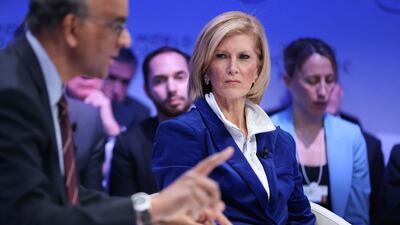
Mary Erdoes, chief executive of JP Morgan Chase's asset wealth management arm, listens during a panel session in Davos. Bloomberg -
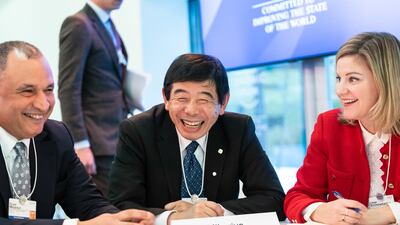
Officials take part in the World Economic Forum's Busting Business Barriers session. Photo: World Economic Forum -
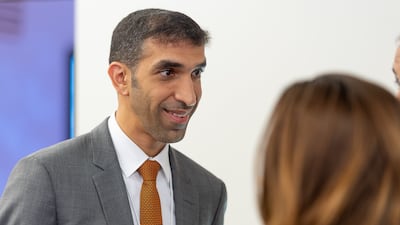
Dr Thani Al Zeyoudi, the UAE Minister of State for Foreign Trade, is among the senior officials in Davos. Photo: WEF -

Former US vice president Al Gore, who is also a member of board of trustees of the forum, at a session titled Leading the Charge through Earth's New Normal. Photo: WEF -

Famed cellist Yo-Yo Ma performs at the event. Photo: WEF -
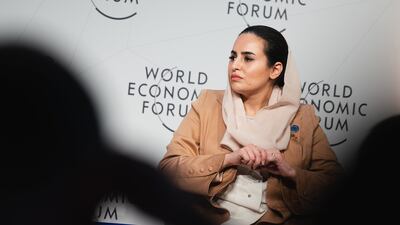
Deemah Al Yahya, secretary general of the Digital Co-operation Organisation in Saudi Arabia, at the forum's Turning Technologies into the Markets of Tomorrow session. Photo: WEF -
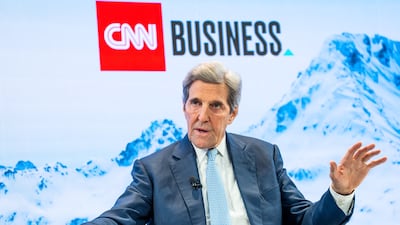
US climate change envoy John Kerry at the Keeping the Pace on Climate session. Photo: WEF -
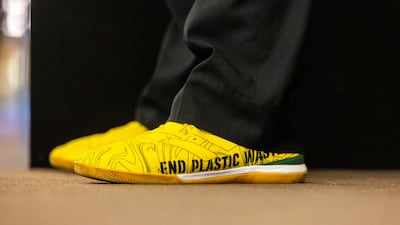
Shoes worn by Rodrigo Oliveira, founder of Brazilian group Green Mining, emphasise support for environmental initiatives. Photo: WEF -
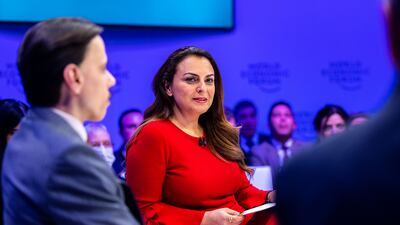
Mina Al-Oraibi, Editor in Chief of The National, moderates a session on the Middle East that featured Prince Faisal bin Farhan, Saudi Arabia's Minister of Foreign Affairs. Photo: WEF -
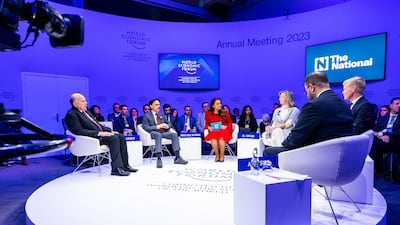
Officials and delegates take part in the Middle East: Meeting Point or Battleground? session. Photo: WEF -
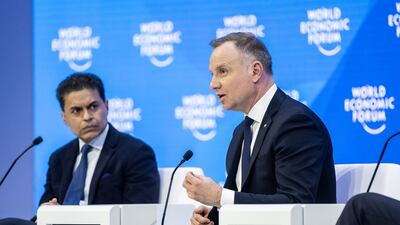
Polish President Andrzej Duda speaks at the Restoring Security and Peace session. Photo: WEF -
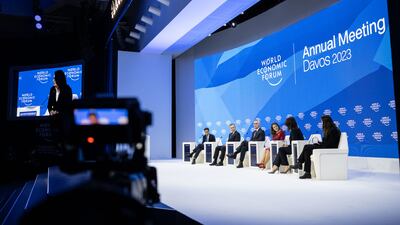
Mr Duda, Nato chief Jens Stoltenberg, Canada's Deputy Prime Minister Chrystia Freeland, Yuliia Svyrydenko, first deputy prime minister in Ukraine, and US Director of National Intelligence Avril Haines attend a session hosted by broadcaster Fareed Zakaria. Photo: WEF -
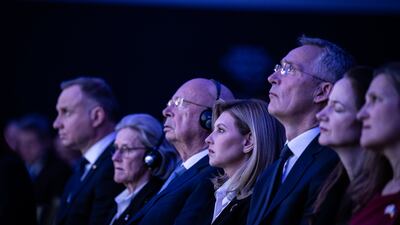
Olena Zelenska, Ukraine's first lady, watches as Ukrainian President Volodymyr Zelenskyy addresses the forum. Photo: WEF -
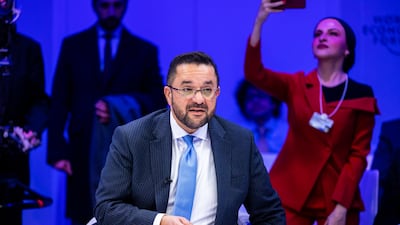
Mohamad Al Ississ, Jordan's Minister of Finance, takes part in the session titled The Middle East: Meeting Point or Battleground? Photo: WEF -
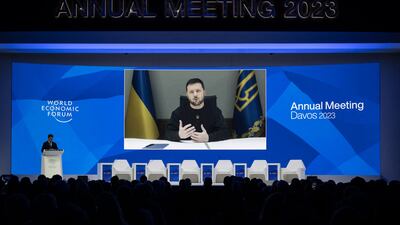
Mr Zelenskyy gives a video address to the forum in Davos. AFP -

Former US secretary of state Henry Kissinger appears on screen during the annual meeting of the World Economic Forum, in Davos. AP -

US governors Brian Kemp and JB Pritzker, senators Chris Coons, Joe Manchin and Kyrsten Sinema and representatives Maria Salazar and Mikie Sherrill take part in a panel discussion at Davos. AP -
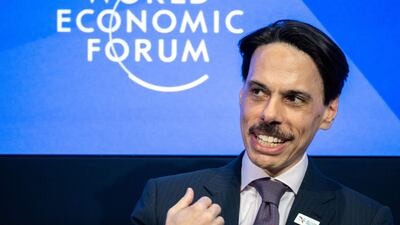
Saudi Foreign Minister Prince Faisal bin Farhan attends a session in Davos. AFP -
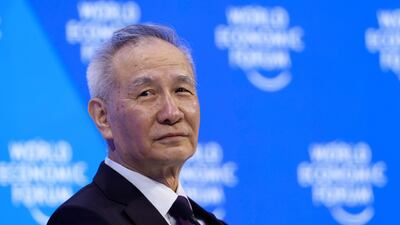
Chinese Vice Premier Liu He on the opening day of the forum. Bloomberg -
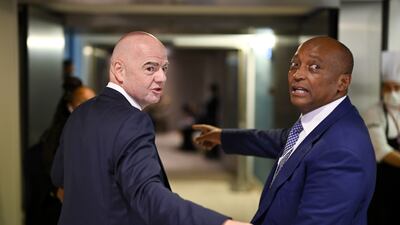
Fifa president Gianni Infantino, left, and Patrice Motsepe, billionaire founder of African Rainbow Minerals, arrive at the forum's venue in Davos. EPA -
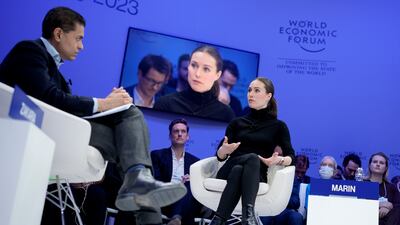
Finland's Prime Minister Sanna Marin, right, is interviewed by Fareed Zakaria in Davos. AP -
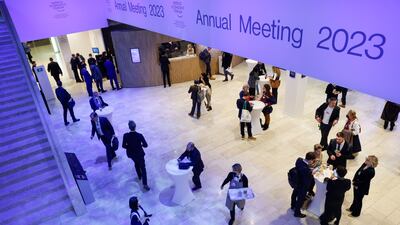
Delegates visit the refreshments area between sessions in Davos. Bloomberg -

Singer Angelique Kidjo performs in Davos. EPA -
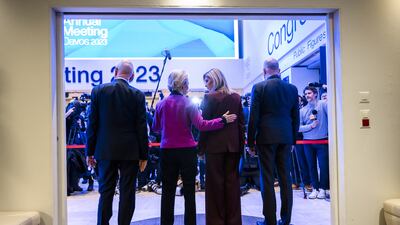
From left, WEF founder Klaus Schwab, European Commission President Ursula von der Leyen, Ukrainian first lady Olena Zelenska and Swiss President Alain Berset pose together during the 53rd annual meeting of the forum in Davos. EPA -
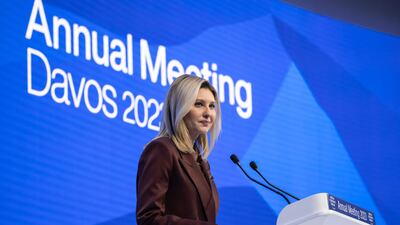
Ms Zelenska hit out at Russia and said 'we cannot allow a new Chernobyl to happen'. AFP -
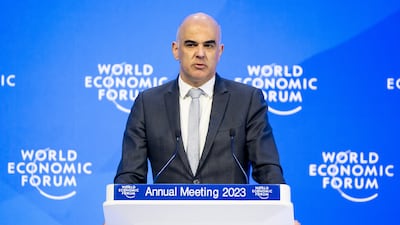
Mr Berset addresses delegates in Davos. EPA -
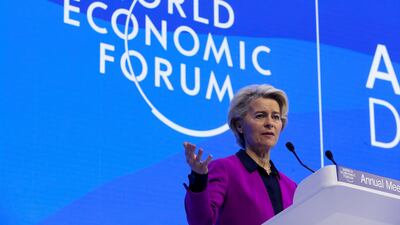
Ms von der Leyen said the 27-nation bloc would become much more forceful in countering unfair trading practices. Reuters -
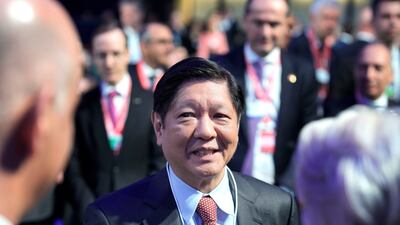
Ferdinand Marcos, President of the Philippines, arrives to attend a session in Davos. AP -
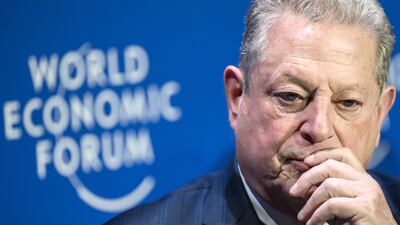
Former US vice president Al Gore is expected to discuss decarbonisation, as well as efforts to build clean energy infrastructure and ensure equitable growth. EPA -

From second left, WEF president Borge Brende, Carbon Direct vice chairwoman Nili Gilbert and US climate envoy John Kerry with other delegates in Davos. EPA -

Credit Suisse chairman Axel Lehmann speaks during the 53rd WEF Annual Meeting. EPA -
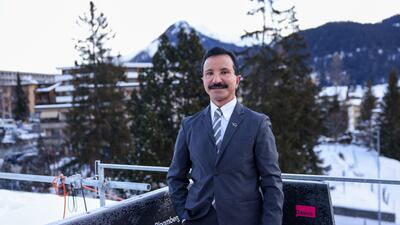
DP World chief executive Sultan bin Sulayem in Davos. Bloomberg -
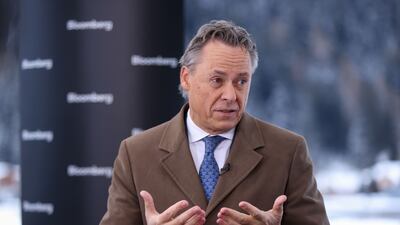
UBS chief executive Ralph Hamers speaks during a television interview on the opening day of the forum. Bloomberg -

From left, Hong Kong Exchanges & Clearing Ltd chairwoman Laura Cha, Banco de Portugal Governor Mario Centeno, Bloomberg TV anchor Francine Lacqua, Credit Suisse chairman Axel Lehmann and S&P Global president and chief executive Douglas Peterson during a panel session on the opening day of the forum. Bloomberg -

Mr Kerry delivers a speech at the Congress Centre in Davos. AFP -
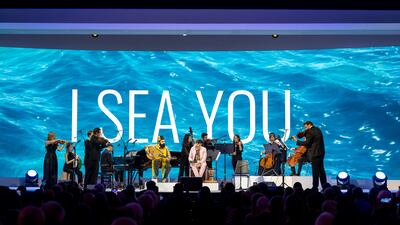
Musicians take part in a concert during the official opening of the forum. Photo: WEF -
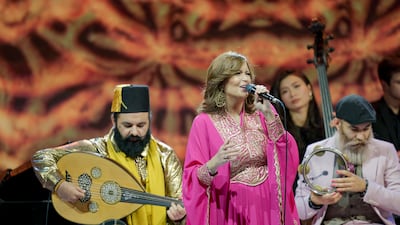
Jordanian vocalist Farah Siraj, centre, and Egyptian-Australian multi-instrumentalist Joseph Tawadros, left, perform during the I Sea You concert. Photo: WEF -

Tawadros is one of the world's leading oud performers and composers. Photo: WEF -
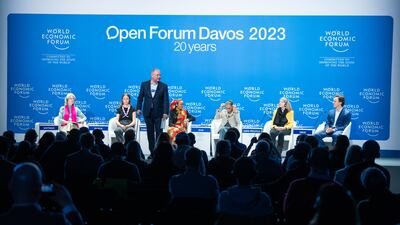
WEF managing director Alois Zwinggi speaks during a session called 'In Harmony with Nature'. Photo: WEF -
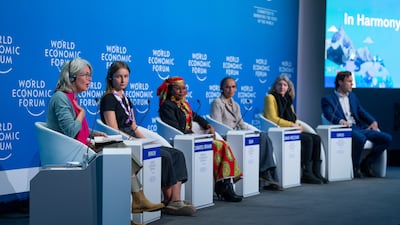
Gail Whiteman, left, a professor of sustainability at the University of Exeter Business School, speaks during the 'In Harmony with Nature' panel discussion. Photo: WEF -

Mr Schwab delivers a speech during the 'Crystal Award' ceremony in Davos. AFP -

Actor Idris Elba, right, and his wife Sabrina Dhowre Elba, left, smile on the podium during the Crystal Award ceremony. AP -

Kyiv Mayor Vitali Klitschko attends the Crystal Award ceremony. EPA -
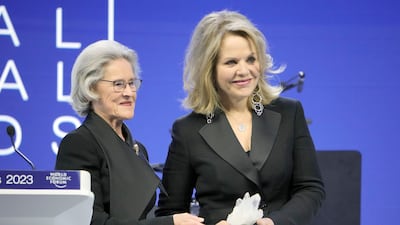
Singer Renee Fleming, right, receives a Crystal Award from Hilde Schwab, wife of WEF founder Klaus Schwab. AP -
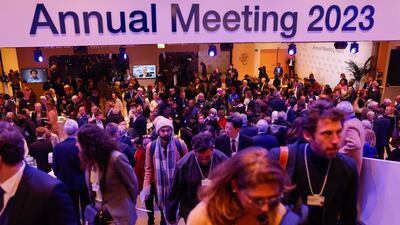
Delegates at the welcome reception before the official start of the forum. Bloomberg -
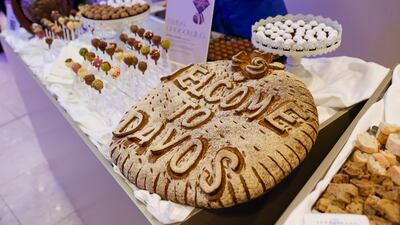
Food for attendees at the welcome reception. Bloomberg -
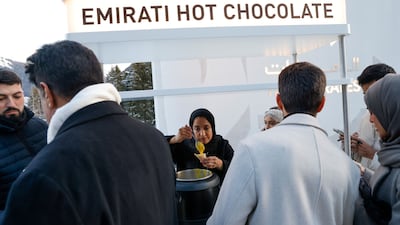
A kiosk serving hot chocolate from the UAE at the forum. Bloomberg -
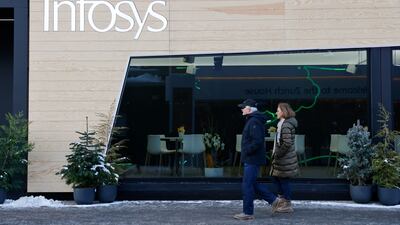
The Infosys pavilion at the forum. Bloomberg -
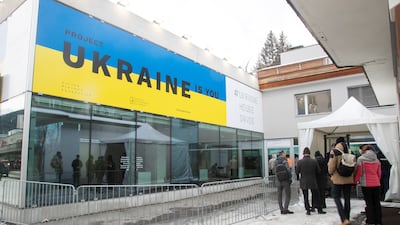
Ukraine's pavilion in Davos. Reuters -
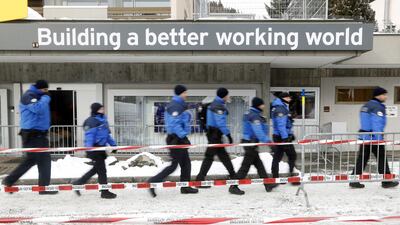
Swiss police officers on patrol in Davos. Reuters -
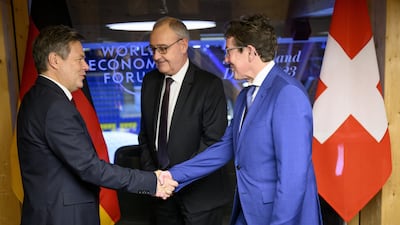
From left, German Vice Chancellor Robert Habeck with Swiss ministers Guy Parmelin and Albert Roesti before the start of a bilateral meeting in Davos. EPA -
A delegate passes a digital display in Davos. Bloomberg
The trend of adding resilience to supply chains by having an alternative is evident from a rise in foreign direct investments into countries such as Indonesia, Mexico, Cambodia and other places, she said.
“I think that's important. It's a realisation,” she added.
For major companies, especially those that are publicly traded, it will be extremely difficult to completely cut off ties with China if sanctions similar to those imposed on Russia were levied against China, Lubna Olayan, chairwoman of Olayan Financing Company’s executive committee, told the panel.
“The pressure on the companies, and especially, [publicly-traded companies] who have major [revenue] contributions from China, I don't think there is going to be that choice [for them],” she said.
Most companies are having a hard time because the bulk of their supply chain is in China, but little by little, they are moving away to alternatives, Carmine Di Sibio, global chairman and chief executive of EY, said.
“China is very different to Russia. I mean, there's just too much revenue, there's too much at stake,” he said.

What vitamins do we know are beneficial for living in the UAE
Vitamin D: Highly relevant in the UAE due to limited sun exposure; supports bone health, immunity and mood.
Vitamin B12: Important for nerve health and energy production, especially for vegetarians, vegans and individuals with absorption issues.
Iron: Useful only when deficiency or anaemia is confirmed; helps reduce fatigue and support immunity.
Omega-3 (EPA/DHA): Supports heart health and reduces inflammation, especially for those who consume little fish.
The specs
Engine: 6.2-litre supercharged V8
Power: 712hp at 6,100rpm
Torque: 881Nm at 4,800rpm
Transmission: 8-speed auto
Fuel consumption: 19.6 l/100km
Price: Dh380,000
On sale: now
SUCCESSION%20SEASON%204%20EPISODE%201
Getting%20there%20
The%C2%A0specs%20
The specs: 2019 Audi A7 Sportback
Price, base: Dh315,000
Engine: 3.0-litre V6
Transmission: Seven-speed automatic
Power: 335hp @ 5,000rpm
Torque: 500Nm @ 1,370rpm
Fuel economy 5.9L / 100km
The specs
Engine: 3.0-litre twin-turbo flat-six
Power: 480hp at 6,500rpm
Torque: 570Nm from 2,300-5,000rpm
Transmission: 8-speed dual-clutch auto
Fuel consumption: 10.4L/100km
Price: from Dh547,600
On sale: now
WHAT IS GRAPHENE?
It was discovered in 2004, when Russian-born Manchester scientists Andrei Geim and Kostya Novoselov were experimenting with sticky tape and graphite, the material used as lead in pencils.
Placing the tape on the graphite and peeling it, they managed to rip off thin flakes of carbon. In the beginning they got flakes consisting of many layers of graphene. But when they repeated the process many times, the flakes got thinner.
By separating the graphite fragments repeatedly, they managed to create flakes that were just one atom thick. Their experiment led to graphene being isolated for the very first time.
In 2010, Geim and Novoselov were awarded the Nobel Prize for Physics.
How The Debt Panel's advice helped readers in 2019
December 11: 'My husband died, so what happens to the Dh240,000 he owes in the UAE?'
JL, a housewife from India, wrote to us about her husband, who died earlier this month. He left behind an outstanding loan of Dh240,000 and she was hoping to pay it off with an insurance policy he had taken out. She also wanted to recover some of her husband’s end-of-service liabilities to help support her and her son.
“I have no words to thank you for helping me out,” she wrote to The Debt Panel after receiving the panellists' comments. “The advice has given me an idea of the present status of the loan and how to take it up further. I will draft a letter and send it to the email ID on the bank’s website along with the death certificate. I hope and pray to find a way out of this.”
November 26: ‘I owe Dh100,000 because my employer has not paid me for a year’
SL, a financial services employee from India, left the UAE in June after quitting his job because his employer had not paid him since November 2018. He owes Dh103,800 on four debts and was told by the panellists he may be able to use the insolvency law to solve his issue.
SL thanked the panellists for their efforts. "Indeed, I have some clarity on the consequence of the case and the next steps to take regarding my situation," he says. "Hopefully, I will be able to provide a positive testimony soon."
October 15: 'I lost my job and left the UAE owing Dh71,000. Can I return?'
MS, an energy sector employee from South Africa, left the UAE in August after losing his Dh12,000 job. He was struggling to meet the repayments while securing a new position in the UAE and feared he would be detained if he returned. He has now secured a new job and will return to the Emirates this month.
“The insolvency law is indeed a relief to hear,” he says. "I will not apply for insolvency at this stage. I have been able to pay something towards my loan and credit card. As it stands, I only have a one-month deficit, which I will be able to recover by the end of December."
Ten tax points to be aware of in 2026
1. Domestic VAT refund amendments: request your refund within five years
If a business does not apply for the refund on time, they lose their credit.
2. E-invoicing in the UAE
Businesses should continue preparing for the implementation of e-invoicing in the UAE, with 2026 a preparation and transition period ahead of phased mandatory adoption.
3. More tax audits
Tax authorities are increasingly using data already available across multiple filings to identify audit risks.
4. More beneficial VAT and excise tax penalty regime
Tax disputes are expected to become more frequent and more structured, with clearer administrative objection and appeal processes. The UAE has adopted a new penalty regime for VAT and excise disputes, which now mirrors the penalty regime for corporate tax.
5. Greater emphasis on statutory audit
There is a greater need for the accuracy of financial statements. The International Financial Reporting Standards standards need to be strictly adhered to and, as a result, the quality of the audits will need to increase.
6. Further transfer pricing enforcement
Transfer pricing enforcement, which refers to the practice of establishing prices for internal transactions between related entities, is expected to broaden in scope. The UAE will shortly open the possibility to negotiate advance pricing agreements, or essentially rulings for transfer pricing purposes.
7. Limited time periods for audits
Recent amendments also introduce a default five-year limitation period for tax audits and assessments, subject to specific statutory exceptions. While the standard audit and assessment period is five years, this may be extended to up to 15 years in cases involving fraud or tax evasion.
8. Pillar 2 implementation
Many multinational groups will begin to feel the practical effect of the Domestic Minimum Top-Up Tax (DMTT), the UAE's implementation of the OECD’s global minimum tax under Pillar 2. While the rules apply for financial years starting on or after January 1, 2025, it is 2026 that marks the transition to an operational phase.
9. Reduced compliance obligations for imported goods and services
Businesses that apply the reverse-charge mechanism for VAT purposes in the UAE may benefit from reduced compliance obligations.
10. Substance and CbC reporting focus
Tax authorities are expected to continue strengthening the enforcement of economic substance and Country-by-Country (CbC) reporting frameworks. In the UAE, these regimes are increasingly being used as risk-assessment tools, providing tax authorities with a comprehensive view of multinational groups’ global footprints and enabling them to assess whether profits are aligned with real economic activity.
Contributed by Thomas Vanhee and Hend Rashwan, Aurifer
Tips for taking the metro
- set out well ahead of time
- make sure you have at least Dh15 on you Nol card, as there could be big queues for top-up machines
- enter the right cabin. The train may be too busy to move between carriages once you're on
- don't carry too much luggage and tuck it under a seat to make room for fellow passengers
Mercer, the investment consulting arm of US services company Marsh & McLennan, expects its wealth division to at least double its assets under management (AUM) in the Middle East as wealth in the region continues to grow despite economic headwinds, a company official said.
Mercer Wealth, which globally has $160 billion in AUM, plans to boost its AUM in the region to $2-$3bn in the next 2-3 years from the present $1bn, said Yasir AbuShaban, a Dubai-based principal with Mercer Wealth.
“Within the next two to three years, we are looking at reaching $2 to $3 billion as a conservative estimate and we do see an opportunity to do so,” said Mr AbuShaban.
Mercer does not directly make investments, but allocates clients’ money they have discretion to, to professional asset managers. They also provide advice to clients.
“We have buying power. We can negotiate on their (client’s) behalf with asset managers to provide them lower fees than they otherwise would have to get on their own,” he added.
Mercer Wealth’s clients include sovereign wealth funds, family offices, and insurance companies among others.
From its office in Dubai, Mercer also looks after Africa, India and Turkey, where they also see opportunity for growth.
Wealth creation in Middle East and Africa (MEA) grew 8.5 per cent to $8.1 trillion last year from $7.5tn in 2015, higher than last year’s global average of 6 per cent and the second-highest growth in a region after Asia-Pacific which grew 9.9 per cent, according to consultancy Boston Consulting Group (BCG). In the region, where wealth grew just 1.9 per cent in 2015 compared with 2014, a pickup in oil prices has helped in wealth generation.
BCG is forecasting MEA wealth will rise to $12tn by 2021, growing at an annual average of 8 per cent.
Drivers of wealth generation in the region will be split evenly between new wealth creation and growth of performance of existing assets, according to BCG.
Another general trend in the region is clients’ looking for a comprehensive approach to investing, according to Mr AbuShaban.
“Institutional investors or some of the families are seeing a slowdown in the available capital they have to invest and in that sense they are looking at optimizing the way they manage their portfolios and making sure they are not investing haphazardly and different parts of their investment are working together,” said Mr AbuShaban.
Some clients also have a higher appetite for risk, given the low interest-rate environment that does not provide enough yield for some institutional investors. These clients are keen to invest in illiquid assets, such as private equity and infrastructure.
“What we have seen is a desire for higher returns in what has been a low-return environment specifically in various fixed income or bonds,” he said.
“In this environment, we have seen a de facto increase in the risk that clients are taking in things like illiquid investments, private equity investments, infrastructure and private debt, those kind of investments were higher illiquidity results in incrementally higher returns.”
The Abu Dhabi Investment Authority, one of the largest sovereign wealth funds, said in its 2016 report that has gradually increased its exposure in direct private equity and private credit transactions, mainly in Asian markets and especially in China and India. The authority’s private equity department focused on structured equities owing to “their defensive characteristics.”
You might also like
While you're here
Benefits of first-time home buyers' scheme
- Priority access to new homes from participating developers
- Discounts on sales price of off-plan units
- Flexible payment plans from developers
- Mortgages with better interest rates, faster approval times and reduced fees
- DLD registration fee can be paid through banks or credit cards at zero interest rates
Electric scooters: some rules to remember
- Riders must be 14-years-old or over
- Wear a protective helmet
- Park the electric scooter in designated parking lots (if any)
- Do not leave electric scooter in locations that obstruct traffic or pedestrians
- Solo riders only, no passengers allowed
- Do not drive outside designated lanes
RACE CARD
6.30pm Maiden (TB) Dh82.500 (Dirt) 1,400m
7.05pm Handicap (TB) Dh87,500 (D) 1,400m
7.40pm Handicap (TB) Dh92,500 (Turf) 2,410m
8.15pm Handicap (TB) Dh105,000 (D) 1,900m
8.50pm UAE 2000 Guineas Trial (TB) Conditions Dh183,650 (D) 1,600m
9.25pm Dubai Trophy (TB) Conditions Dh183,650 (T) 1,200m
10pm Handicap (TB) Dh102,500 (T) 1,400m
Fifa%20World%20Cup%20Qatar%202022%20
Our legal consultant
Name: Dr Hassan Mohsen Elhais
Position: legal consultant with Al Rowaad Advocates and Legal Consultants.
MATCH INFO
Uefa Champions League semi-finals, second leg:
Liverpool (0) v Barcelona (3), Tuesday, 11pm UAE
Game is on BeIN Sports
Globalization and its Discontents Revisited
Joseph E. Stiglitz
W. W. Norton & Company


