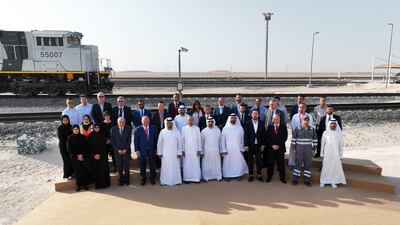
Standing from left, Dr Sultan Al Jaber, Minister of Industry and Advanced Technology; Sheikh Theyab bin Mohamed, member of the Abu Dhabi Executive Council; and Suhail Al Mazrouei, Minister of Energy and Infrastructure, attend the signing ceremony. The agreement was signed by Shadi Malak, chief executive of Etihad Rail, left, and Hazeem Al Suwaidi, chief executive of Borouge. Photo: Abu Dhabi Government Media Office
Standing from left, Dr Sultan Al Jaber, Minister of Industry and Advanced Technology; Sheikh Theyab bin Mohamed, member of the Abu Dhabi Executive Council; and Suhail Al Mazrouei, Minister of Energy a

Etihad Rail joins forces with Borouge for sustainable transport


Alkesh Sharma
  • English
  • Arabic

Etihad Rail, the developer of the UAE railway network, has joined forces with Borouge, the joint venture between Adnoc and Austrian chemicals producer Borealis, to ensure more sustainable transport.

Under the agreement, Etihad Rail will transport 1.3 million tonnes of Borouge’s polyolefins annually from its petrochemical complex in Al Ruways Industrial City for export to customers.

Sheikh Theyab bin Mohamed, member of Abu Dhabi Executive Council, chairman of Emirates Council for Balanced Development and chairman of Etihad Rail, witnessed the signing of the terms sheet for the strategic partnership, Abu Dhabi Government Media Office said in a statement on Tuesday.

“This important collaboration between Borouge and Etihad Rail contributes to the growth of Abu Dhabi’s industrial sector and will support Borouge’s ongoing drive to optimise its logistics platform, lowering both its operating costs and carbon emissions,” said Dr Sultan Al Jaber, Minister of Industry and Advanced Technology, Adnoc managing director and group chief executive, and chief executive and chairman of Borouge.

“The partnership reinforces Borouge’s resilience and accelerates the export of its Made In UAE products using more sustainable modes of transport, while underlining the partners’ commitment to the UAE’s Net Zero by 2050 Strategic Initiative.”

Established in 1998, Borouge is a petrochemical company that employs more than 3,000 people and serves customers in more than 50 countries across Asia, the Middle East and Africa.

It provides polyolefin solutions for the agricultural, infrastructure, energy, advanced packaging, mobility and healthcare industries.

Adnoc owns 54 per cent of the company, while Borealis controls 36 per cent.

Its partnership with Etihad Rail also supports the national In-Country Value programme, with 88 per cent of the value flowing back into the local economy, boosting economic diversification and growth, the statement said.

The agreement also includes the development of a rail freight terminal in Al Ruways Industrial City, extending over an area of more than one million square metres, where the terminal will handle loading and unloading as well as storage and maintenance of shipping containers.

By using rail, the time required to transport Borouge’s products will be reduced to four hours compared with 12 hours through other modes of transport.

“This strategic partnership comes in line with Etihad Rail's efforts to provide logistics solutions to some of the country’s largest companies, where they can transport goods through the rail network at reduced costs and time,” Sheikh Theyab said.

“In doing so, Etihad Rail also contributes to reducing carbon emissions, in line with the objectives of the UAE.”

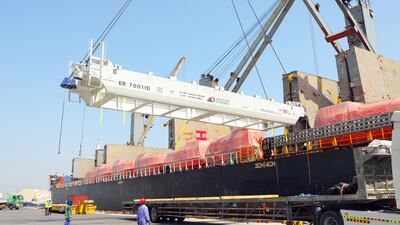
  • Etihad Rail's new locomotive fleet is delivered. Photo: Etihad Rail
    Etihad Rail's new locomotive fleet is delivered. Photo: Etihad Rail
  • The advanced rolling stock will be at the heart of the national rail network. Photo: Etihad Rail
    The advanced rolling stock will be at the heart of the national rail network. Photo: Etihad Rail
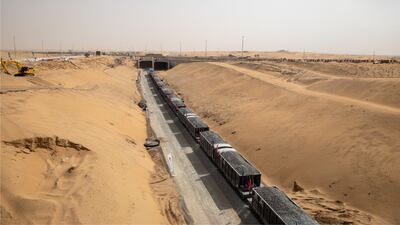
  • New wagons are delivered to support Etihad Rail services. Photo: Etihad Rail
    New wagons are delivered to support Etihad Rail services. Photo: Etihad Rail
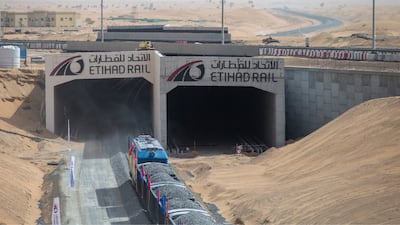
  • Construction of the Etihad Rail railway in Fujairah. Photo: Etihad Rail
    Construction of the Etihad Rail railway in Fujairah. Photo: Etihad Rail
  • The first stage of the Etihad Rail network links gasfields in Shah and Habshan with Ruwais in Abu Dhabi. Photo: Abu Dhabi Media Office
    The first stage of the Etihad Rail network links gasfields in Shah and Habshan with Ruwais in Abu Dhabi. Photo: Abu Dhabi Media Office
  • Sheikh Theyab bin Mohamed visited Etihad Rail project sites in Sharjah and Fujairah, inspecting the latest developments of the final part of the second phase of track construction, which spans 145km. Photo: Abu Dhabi Media office
    Sheikh Theyab bin Mohamed visited Etihad Rail project sites in Sharjah and Fujairah, inspecting the latest developments of the final part of the second phase of track construction, which spans 145km. Photo: Abu Dhabi Media office

Sheikh Theyab also led a meeting with representatives of private rail industry companies to discuss the commercial opportunities provided by the UAE National Rail Network to the private sector.

He announced the formation of an advisory committee for enhancing the private sector’s benefits from the National Rail Network.

Etihad Rail has successfully reserved 60 per cent of the network’s annual transport capacity through the commercial agreements it has signed with key companies.

The Etihad Rail line will span about 1,200km and link 11 cities and areas across the UAE, from the border with Saudi Arabia to Fujairah in the north.

Its new high-tech trains were unveiled in August, with the diesel and electricity-operated locomotives providing 4,600 brake horsepower.


Ten tax points to be aware of in 2026

1. Domestic VAT refund amendments: request your refund within five years

If a business does not apply for the refund on time, they lose their credit.

2. E-invoicing in the UAE

Businesses should continue preparing for the implementation of e-invoicing in the UAE, with 2026 a preparation and transition period ahead of phased mandatory adoption. 

3. More tax audits

Tax authorities are increasingly using data already available across multiple filings to identify audit risks. 

4. More beneficial VAT and excise tax penalty regime

Tax disputes are expected to become more frequent and more structured, with clearer administrative objection and appeal processes. The UAE has adopted a new penalty regime for VAT and excise disputes, which now mirrors the penalty regime for corporate tax.

5. Greater emphasis on statutory audit

There is a greater need for the accuracy of financial statements. The International Financial Reporting Standards standards need to be strictly adhered to and, as a result, the quality of the audits will need to increase.

6. Further transfer pricing enforcement

Transfer pricing enforcement, which refers to the practice of establishing prices for internal transactions between related entities, is expected to broaden in scope. The UAE will shortly open the possibility to negotiate advance pricing agreements, or essentially rulings for transfer pricing purposes. 

7. Limited time periods for audits

Recent amendments also introduce a default five-year limitation period for tax audits and assessments, subject to specific statutory exceptions. While the standard audit and assessment period is five years, this may be extended to up to 15 years in cases involving fraud or tax evasion. 

8. Pillar 2 implementation 

Many multinational groups will begin to feel the practical effect of the Domestic Minimum Top-Up Tax (DMTT), the UAE's implementation of the OECD’s global minimum tax under Pillar 2. While the rules apply for financial years starting on or after January 1, 2025, it is 2026 that marks the transition to an operational phase.

9. Reduced compliance obligations for imported goods and services

Businesses that apply the reverse-charge mechanism for VAT purposes in the UAE may benefit from reduced compliance obligations. 

10. Substance and CbC reporting focus

Tax authorities are expected to continue strengthening the enforcement of economic substance and Country-by-Country (CbC) reporting frameworks. In the UAE, these regimes are increasingly being used as risk-assessment tools, providing tax authorities with a comprehensive view of multinational groups’ global footprints and enabling them to assess whether profits are aligned with real economic activity. 

Contributed by Thomas Vanhee and Hend Rashwan, Aurifer

MATCH INFO

Uefa Champions League semi-final, first leg
Bayern Munich v Real Madrid

When: April 25, 10.45pm kick-off (UAE)
Where: Allianz Arena, Munich
Live: BeIN Sports HD
Second leg: May 1, Santiago Bernabeu, Madrid

The Perfect Couple

Starring: Nicole Kidman, Liev Schreiber, Jack Reynor

Creator: Jenna Lamia

Rating: 3/5

Updated: November 30, 2022, 1:18 PM