


The days of venture capital financing that fuelled the start-up expansion frenzy “at all costs” are over amid changing economic dynamics and rising interest rates that now warrant caution and discipline, panellists told the Future Investment Initiative.
In the past, interest rates were near zero and there was ample liquidity for founders to raise money — whether it was a good company or not. But this was obviously an error, Prince Khaled bin Alwaleed, founder and chief executive of KBW Venturesx, told the FII conference in Riyadh on Thursday.
“I think the model of growth at any cost has definitely been broken. And I think we are thankful for that,” he said.
“I do see a lot of VCs pulling back from that model, a lot of VCs giving advice to founders to start conserving their capital.”
The latest from FII in Riyadh — in pictures
-

Left to right: Bill Winters, chief executive officer of Standard Chartered, Lorenzo Simonelli, chief executive officer of Baker Hughes, Jennifer Holmgren, chief executive officer of Lanzatech NZ, Matthew Harris, founding partner of Global Infrastructure Partners, Henrik Andersen, chief executive officer of Vestas Wind Systems A/S, Abdulaziz bin Salman, the kingdom's Minister of Energy, and Yousef Gamal El-Din, Bloomberg Television anchor, at the 'Science in Action' panel session at the Future Investment Initiative conference in Riyadh. Bloomberg -
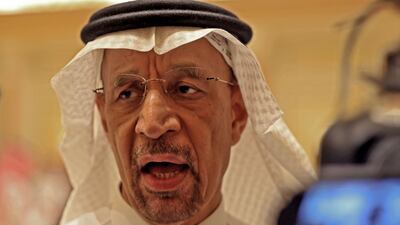
Saudi Arabia's Minister of Investment Khalid Al Faleh is pictured during an interview with AFP TV on the sidelines of the annual FII conference in the Saudi capital Riyadh. AFP -

Tareq Al Sadhan, chief executive of Riyadh Bank, centre, at the FII conference. Rising energy prices are likely to linger for some time, posing one of the most serious challenges to the global economic recovery and raising the potential risk of social unrest, some of the world's top executives said on the first day of the investment forum. Bloomberg -

Joseph Bradley, chief executive of NEOM's Tech and Digital Holding Company, speaks during an interview with AFP on the sidelines of the annual FII conference. AFP -
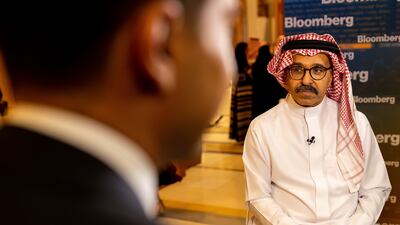
Nadhmi Al Nasr, chief executive officer of NEOM, during a Bloomberg Television interview at the FII conference. Saudi Arabia said global efforts to cut planet-warming emissions must avoid hurting poor countries' economies. Bloomberg -

Steven Mnuchin, former US Treasury secretary, attends a Bloomberg Television interview at the conference. Bloomberg -
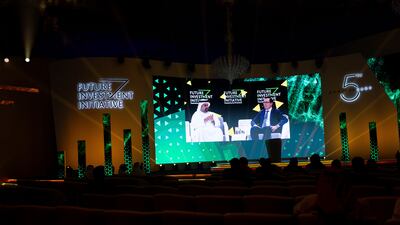
Mr Mnuchin, right, attends a panel session at the conference. Bloomberg -

Saudi Arabia's Minister of Energy Abdulaziz bin Salman at the conference. Saudi Arabia could go carbon neutral before its target of 2060 if technology evolves quickly enough, he said, days before the Cop26 climate summit. AFP -
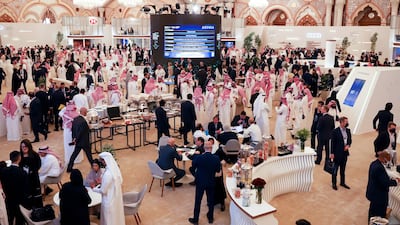
Attendees between panel sessions at the FII conference in Riyadh. Bloomberg -
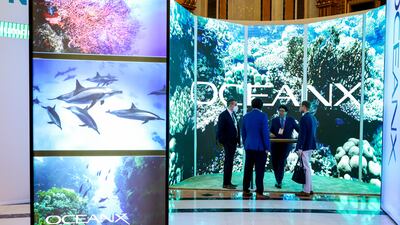
A promotional booth for Oceanx at the conference. Bloomberg -

Attendees during a break between panel sessions. Bloomberg -
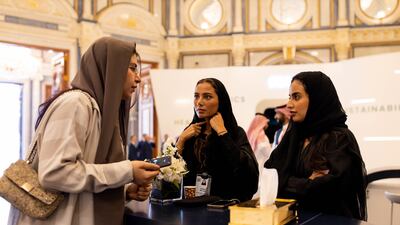
Female employees assist a guest at the conference. Bloomberg


VC companies took advantage of near-zero interest rates for a long period of time as central banks tried to minimise shocks to financial markets and boost economic activity during the Covid-19 pandemic.
This led to investors pouring liquidity into start-ups and growing companies to support their expansions.
In the Middle East and North Africa alone, VC funding for start-ups jumped 20 per cent annually to more than $2.3 billion in the first three quarters of 2022, putting it on track to potentially surpass total investments attracted in 2021, a study carried out by Magnitt has found.
Funding reached $512 million in the third quarter of this year, which was the lowest since the first quarter of 2021, the data intelligence
company said in its quarterly update, citing global economic and geopolitical factors.
However, in recent quarters, central banks around the globe have aggressively raised interest rates to curb rampant inflation that has significantly increased the cost of funding for investors. Elevated energy and food prices, coupled with rising policy rates have slowed economic momentum.
Governments printing money during the pandemic did not help, as this further fuelled the “growth at any at any cost model”, Prince Khaled said.
However, the current slowdown is a “good thing” from the VC industry’s perspective.
Watch: Iraqi city of Mosul establishes start-up scene
“I think there's a lot more money that is being put on the sidelines for the next, let's say … 12 to 18 months. And I think you're going to see a great amount of quality and capital … deployed in quality companies in the near future,” he said.
Meanwhile, the “new paradigm where money is not free any more” is already here and is “the elephant in the room”, said Saleh Romeih, Softbank's managing partner and Europe, Middle East and Africa head of operating group.
Many investors lost discipline in terms of deploying that capital and the companies themselves did not have to work hard to get that funding, Mr Romeih added.
“However, the risk-free rate, depending on what you consider the risk-free rate to be, is about 4 per cent, probably heading to 5 per cent, or maybe even higher,” he said.
“All risk assets as a result getting repriced … venture capital is going to be repriced as well and I think that's something we need to be mindful of.”

