

Russian efforts to rewire trade flows and bypass sanctions imposed because of the war in Ukraine cannot make up for the collapse in imports that is crippling its economy.
One stark result so far: for the first time, Belarus, a neighbouring country, in April leapfrogged Germany — an economy more than 60 times bigger — in terms of the value of imports to Russia, according to a Bloomberg analysis of the latest data.
“The market practically crashed” this spring, said Andrey Pobezhimov, head of international logistics at SDEK, one of Russia’s biggest express delivery companies.
“Today, it is very difficult to bring cargo from Europe; sometimes almost impossible.”
Russia has made it harder to obtain an accurate reading of its economy because it stopped publishing some key statistics, including a detailed breakdown of imports and exports.
However, a picture that emerges from figures made available by Russia’s biggest counterparts is one of a commercial pecking order turned upside down.
Sales to Russia from trading partners that together accounted for about half of its imports in 2021 were down about 40 per cent in April from a year earlier, Bloomberg calculations show.
Even those, such as China, which have not joined the US and its allies in imposing sanctions, are cutting shipments of merchandise.
Russia's military offensive in Ukraine, which began in late February, was a moment of whiplash for an economy so woven into global commerce after three decades that its imports as a share of gross domestic product in the years before the war were notably higher than in such emerging markets as Brazil, India and China.
-
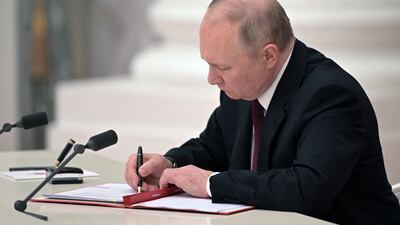
Russian President Vladimir Putin signs documents, including a decree recognising two Russian-backed breakaway regions in eastern Ukraine as independent, during a ceremony at the Kremlin in Moscow. President Vladimir Putin said on February 21, 2022, he would make a decision "today" on recognising the independence of east Ukraine's rebel republics, after Russia's top officials made impassioned speeches in favour of the move. AFP -
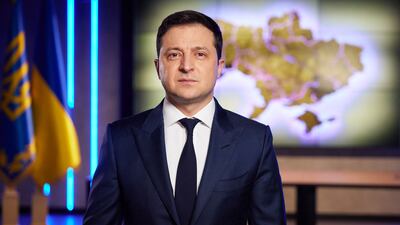
Ukraine President Volodymyr Zelenskyy pictured on February 22 after Russia ordered troops into two Moscow-backed rebel regions of Ukraine. AFP -
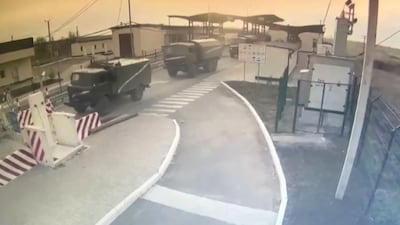
Russian military equipment crosses the Crimea border checkpoint. AFP -
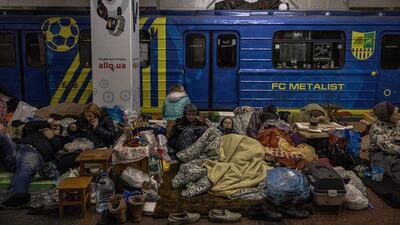
People use a subway station as a bomb shelter in Kharkiv, Ukraine. EPA -
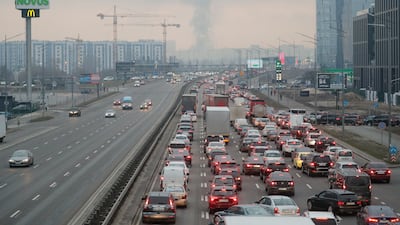
A traffic jam in Kyiv on February 24. Russian troops entered Ukraine while President Zelenskyy addressed the nation to announce the imposition of martial law. EPA -

Emergency services tend to an injured man after bombings hit the town of Chuguiv, Ukraine. AFP -

Firefighters tend to a fire after bombings in Chuguiv on February 24. AFP -

Protesters show support for Ukraine in Times Square, New York, on February 24. EPA -
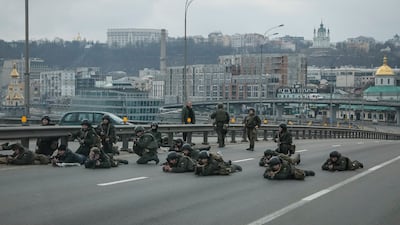
Ukrainian National Guard servicemen take their positions in central Kyiv on February 25. Reuters -
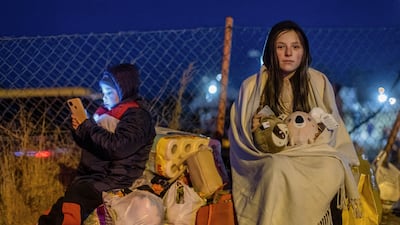
Helena and her brother Bodia from Lviv at the Medyka pedestrian border crossing in eastern Poland on February 26. AFP -
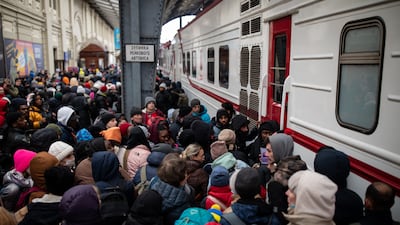
People desperate to leave Ukraine try to board a train at the railway station in Lviv on February 27. Oliver Marsden for The National -
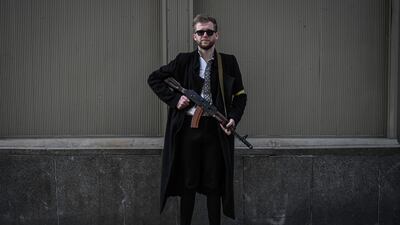
Svyatoslav Yurash, 26, a lawmaker from Zelenskyy's Servant of the People party, poses with his assault rifle as he patrols downtown Kyiv on February 27. AFP -
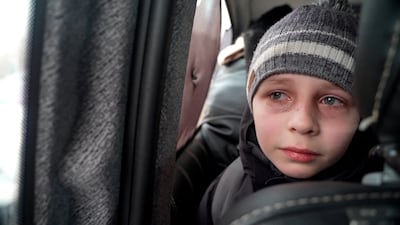
Mark Goncharuk, a young boy from Kyiv, leaves his father behind as he travels with the rest of his family towards the border on February 27. Reuters -
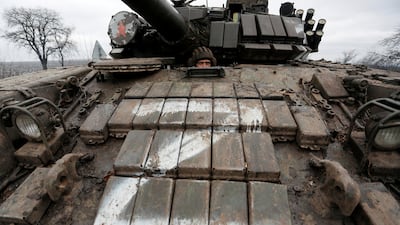
A pro-Russian militia serviceman in the Luhansk region, Ukraine, on February 27. Reuters -
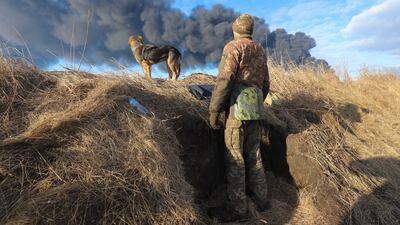
A Ukrainian serviceman and his dog look at smoke from a burned petroleum storage depot after a Russian missile attack near Kiev on February 27. EPA -

Children with cancer are evacuated to the basement of the oncology centre used as a bomb shelter in Kyiv on February 28. AFP -
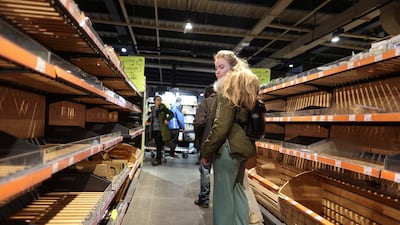
A woman in Kyiv looks at empty supermarket shelves after the curfew was lifted on February 28. Reuters -
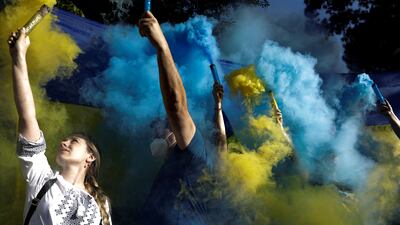
People in support of Ukraine hold an anti-war protest outside the Russian Embassy in Mexico City on February 28. Reuters -

Ukrainian President Zelenskyy in Kyiv on March 1. Reuters -
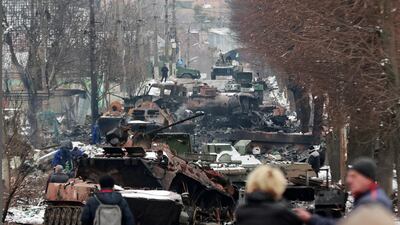
Destroyed military vehicles in the town of Bucha, Ukraine, on March 1. Reuters -
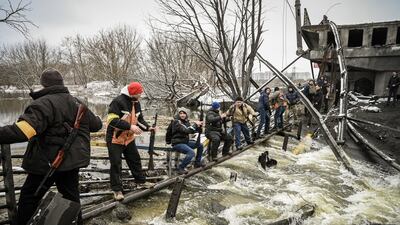
Members of a Ukrainian civil defence unit pass new assault rifles to the opposite side of a blown up bridge on Kyiv's northern front on March 1. AFP -
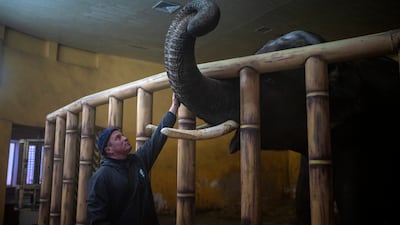
Kirilo Trantin comforts an elephant at Kiev Zoo on March 1. AP -

Stanislav says goodbye to his two-year-old son David and wife Anna after they boarded a train that will take them to Lviv, on March 3. AP -

People take cover on the floor of a hospital during shelling by Russian forces in Mariupol, Ukraine, on March 4. AP -

A flare lands at the Zaporizhzhia nuclear power plant in Ukraine during shelling on March 4. EPA -

Messages are posted by visitors on a board in support of Ukraine, inside the Ukrainian pavilion at Expo 2020 Dubai on March 4. AFP -

Ukrainians try to flee the country by crossing the Irpin River on the outskirts of Kyiv on March 5. AP -

Ukrainian territorial defence fighters Valeriy, right, and Lesya during their wedding ceremony near Kyiv on March 6. EPA -

Russian policemen detain a participant in an unauthorised rally against the Russian special operation in Ukraine, in Saint Petersburg, Russia, on March 6. EPA -

US President Joe Biden announces a ban on US imports of Russian oil and gas on March 8. AFP -
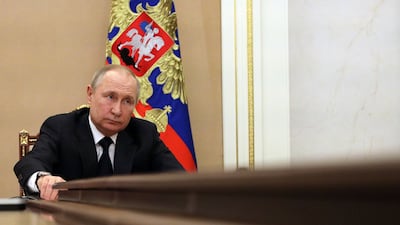
Russian President Vladimir Putin attends a videoconference meeting with government members at the Kremlin in Moscow, Russia, on March 10. EPA -
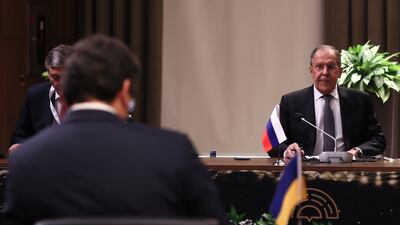
Russian Foreign Minister Sergei Lavrov, right, and Ukranian Foreign Minister Dmytro Kuleba before their meeting during the Antalya Diplomacy Forum in Antalya, Turkey, on March 10. EPA -

An explosion tears a hole in the side of an apartment building after a Russian tank fired a rocket in Mariupol on March 11. AP Photo -
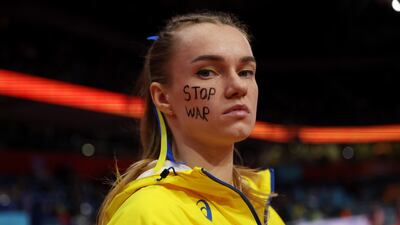
Yana Hladiychuk of Ukraine UKR looks on with a 'Stop War' message on her face after the women's pole vault on day two of the World Athletics Indoor Championships Belgrade 2022 on March 19. Getty Images -

In this picture taken on March 18, 109 empty prams and baby baskets are seen outside the Lviv city council during an action to highlight the number of children killed in Russia's invasion of Ukraine. AFP -

Six-year-old Milana, who is recovering from leg injuries sustained after a Russian rocket hit her house on February 28, killing her mother, reacts to volunteers dressed as clowns at a children's hospital in Kyiv on March 19. Getty Images -

People clean a room in an apartment building destroyed during an air raid in Kyiv on March 21. Reuters -

A firefighter works at a residential district that was damaged by shelling in Kyiv on March 23. Reuters -

Smoke billows from a fire on what Ukrainian Ministry of Defence says is a Russian ship at the port of Berdiansk on March 24. Reuters -

Turkey's President Recep Tayyip Erdogan, Britain's Prime Minister Boris Johnson, US President Joe Biden, Nato Secretary General Jens Stoltenberg, Belgium's Prime Minister Alexander De Croo and leaders of the US-led military alliance pose for a family photo at Nato Headquarters in Brussels, Belgium, on March 24. Reuters -
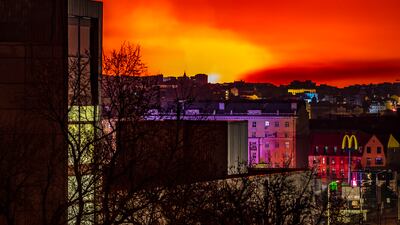
This general view taken on March 30 shows fire and smoke lighting up the night sky, east of Kharkiv. AFP -
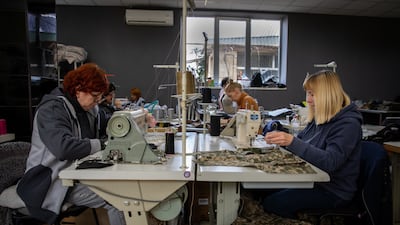
Women sew camouflage fabric for homemade military bullet proof vests and flak jackets in Mykolaiv on March 31. Oliver Marsden for the National -

A theatre destroyed in the southern port city of Mariupol on April 3. Reuters -

Women stand in their robes as smoke rises in the background after shelling in Odesa, Ukraine, on Sunday, April 3. AP -
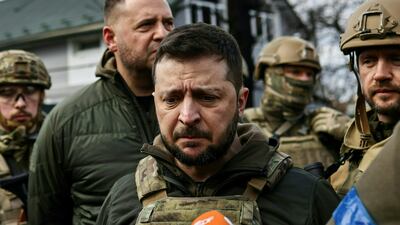
President Zelenskyy in the town of Bucha, northwest of the Ukrainian capital Kyiv, on April 4. AFP -

A woman carries her cat as she walks past buildings destroyed by Russian shelling in Borodyanka, Ukraine, on April 5. Reuters -

Ukrainian servicemen sing a patriotic song amid buildings destroyed during fighting between Ukrainian and Russian forces in Borodyanka on April 5. AP -

A firefighter works at the site of burning fuel storage facilities damaged by an air strike in Dnipropetrovsk region, Ukraine, on April 6. Reuters -
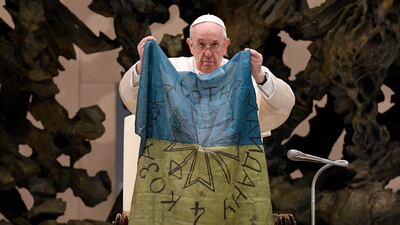
Pope Francis holds a Ukraine flag sent to him from the Ukrainian town of Bucha during the weekly general audience in the Paul VI Audience Hall, Vatican City, on April 6. EPA -
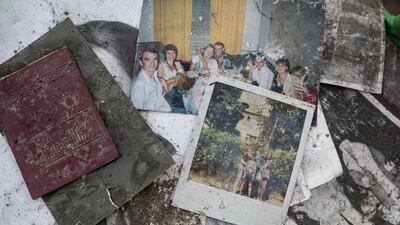
Photos of people are seen next to a destroyed apartment building on April 9 in Borodianka. Getty Images -

Mr Johnson and Mr Zelensky in central Kyiv on April 9. AFP -

A booby trap found by locals near their home in the village of Zalissya village, Ukraine, on April 12. EPA -

Yehor, 7, holds a toy rifle next to destroyed Russian military vehicles near Chernihiv on Sunday, April 17. AP -
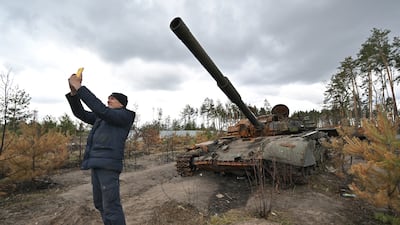
A man takes a selfie in front of a destroyed Russian tank in the village of Andriivka, Ukraine, on April 17. AFP -
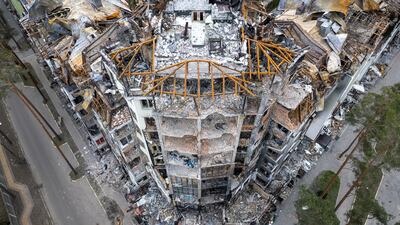
Destroyed structures in Irpin, Ukraine, on April 8. Getty Images -
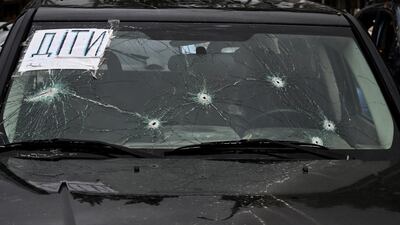
A sign saying 'children' on the windscreen of a car with bullet holes in Irpin on April 19. AFP -

An armoured convoy of pro-Russian troops moves along a road in the southern port city of Mariupol on April 21. Reuters -

Ukraine's President Volodymyr Zelenskyy poses for a picture with US Secretary of State Antony Blinken and US Defence Secretary Lloyd Austin in Kyiv on April 24. Reuters -

A Ukrainian serviceman looks at a Russian ballistic missile's booster stage that fell in a field in Bohodarove, eastern Ukraine, on April 25. AFP -
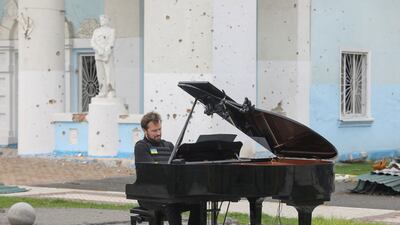
Lithuanian musician Darius Mazintas plays a piano in front of the Central House of Culture, destroyed during Russia's invasion, in the town of Irpin on April 26. Reuters -
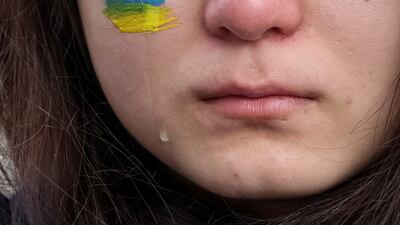
A woman cries as she takes part in a rally in Kyiv on April 27 demanding international leaders organise a humanitarian corridor for the evacuation of Ukrainian military and civilians from Mariupol. Reuters -
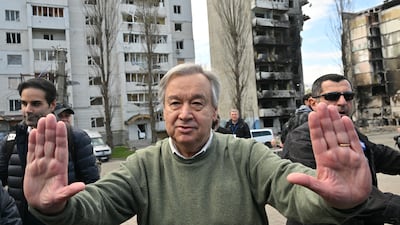
UN Secretary General Antonio Guterres visits Borodianka on April 28. AFP -
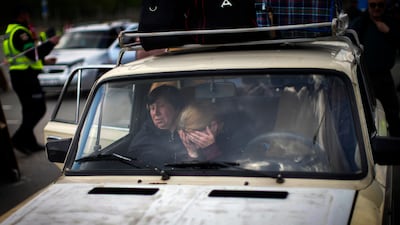
People wait in a car to be processed at a reception centre for displaced people in Zaporizhzhia, Ukraine, on Monday, May 2. AP -

Anton Gladun lies on his bed at the Third City Hospital in Cherkasy, Ukraine, on Thursday, May 5. AP -

Patron, a dog trained to search for explosives, during demining works at the Gostomel airfield near Kyiv on May 5. EPA -
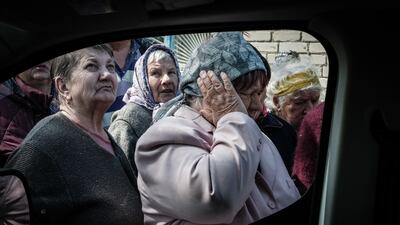
A woman covers her ears from the sound of mortar fire as people queue to collect pensions from a postal delivery van that reached the frontline despite the ongoing conflict in Mayaky, eastern Ukraine, on May 6. AFP -
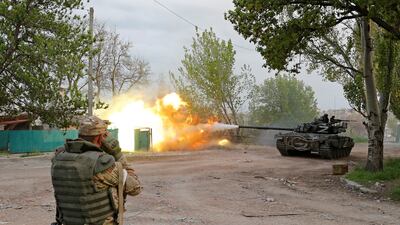
Service members of pro-Russian troops fire from a tank near the Azovstal steel plant in the southern port city of Mariupol on May 5. Reuters -

A Ukrainian soldier inside the ruined Azovstal steel plant in Mariupol on May 7. AP -

The statue of Ukrainian philosopher Hryhoriy Skovoroda stands in the damaged Hryhoriy Skovoroda Literary Memorial Museum in Skovorodynivka, Ukraine, on May 7. EPA -
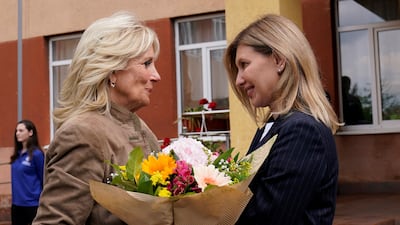
First lady Jill Biden receives flowers from Olena Zelenska, wife of Ukraine's President Zelenskyy, outside a public school in Uzhhorod, Slovakia, on May 8. Reuters -

Bono and The Edge sing during a performance for Ukrainian people inside a subway station in Kyiv on May 8. Reuters -
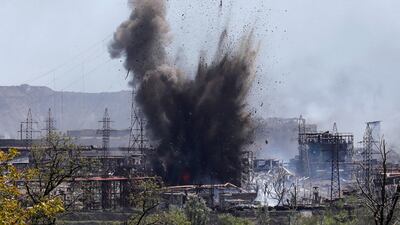
An explosion at the Azovstal Iron and Steel Works in Mariupol on May 11. Reuters -

Russian paratroopers on a BMD-4 infantry fighting vehicle in Kharkiv on May 11. EPA -

Sasha, left, 4, and his sister Ksenia, 8, in a basement shelter in Lysychansk, eastern Ukraine, on May 15. AFP -

A controlled detonation of explosive devices near Borodianka, Ukraine, on May 17. Reuters -

People stand amid newly-made graves at a cemetery in Staryi Krym outside Mariupol on May 22. Reuters -
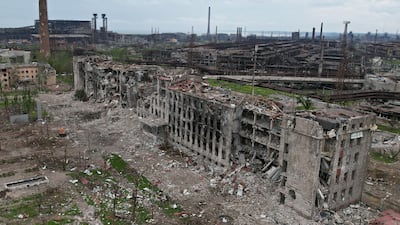
A view shows the destroyed Azovstal Iron and Steel Works in Mariupol on May 22. Reuters -

Russian Sgt Vadim Shishimarin listens to his translator during his court hearing in Kyiv on May 23. The 21-year-old soldier pleaded guilty to killing an unarmed civilian. AP -
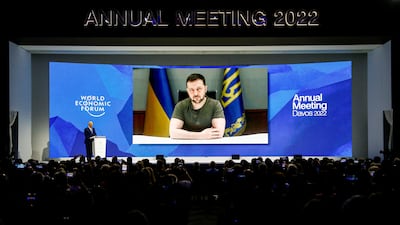
President Zelenskyy on a screen at the opening ceremony of the World Economic Forum in Davos, Switzerland, on May 23. Reuters -
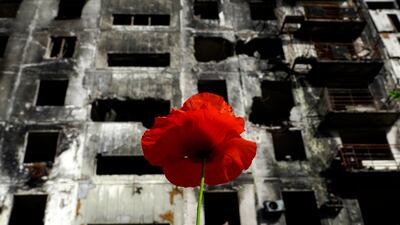
A red poppy in front of a destroyed residential building in Mariupol on May 31. AFP -
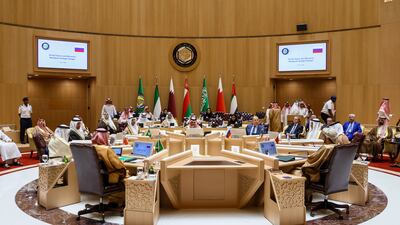
The Russia-Ukraine conflict is discussed during the 152nd session of the Ministerial Council of the Gulf Co-operation Council in Riyadh, Saudi Arabia, on June 1. EPA


But since a global backlash against the war disrupted supply chains and prompted numerous multinationals to pull out, Russians have had to make do or learn how to navigate a new obstacle course — sourcing ingredients from alternative foreign suppliers, scouring the world for new routes or finding other loopholes to haul in the wares.
Otkritie Research estimates the value of imports in April may have plunged to as low as $5 billion, down from about $27bn a year earlier.
As trade with much of Europe dries up, Belarus is emerging as one of the main beneficiaries. Its exports to Russia, of items ranging from construction materials to pet food, surged by more than 100 per cent in April when measured by value.
Boris, who asked to be identified only by first name, owns a large supermarket chain and factories across Russia. He said processing payments was initially an even bigger challenge than the delivery of shipments.
Enough workaround solutions are now available to ensure more shipments trickle through and imports start to recover, he said.
But another major threat looms as the EU’s fifth package of sanctions goes into effect in full next month.
Mr Boris, whose company relies on imports for about half the goods it sells, expects 5 per cent of its products to vanish from store shelves.
“We have dropped a few steps but that doesn’t mean we are at the landing yet,” he said. “The staircase down will be a long one.”
The collapse in imports has been one of the forces warping Russia’s wartime economy and driving it towards what its central bank called “reverse industrialisation”.
Car factories employing tens of thousands ground to a halt for lack of components and simple paper became scarce because manufacturers did not have enough whitening agent.
The Bank of Russia even expects some imports to shift to the “shuttle trade” of the 1990s, when people en masse travelled abroad to bring back goods to sell on open markets.
In the search for new ways to deliver consumer goods from abroad, Fesco, a major Russian cargo company, has launched a new maritime line between Vietnamese ports and its Vladivostok terminal on the Pacific coast.
Its other new initiatives in April included the start of a container service between Istanbul and Novorossiysk on the Black Sea, and rail shipments to western Europe.
Yet, even in the government’s telling, the outlook is bleak. Under the main official forecast, goods imports are set to decline by more than a quarter in real terms in 2022.
Besides cheap credit and subsidies for struggling industries, the government has also responded by cancelling customs duties on numerous products and legalising grey market sales, also known as parallel imports.
Countries such as Turkey may increasingly become conduits for imports, according to Andrej Golubchik, professor at the Russian Foreign Trade Academy. Shipments have restarted to India and the Gulf by way of Iran, he said.

