


The global economy is facing its “biggest test” since the Second World War amid the Russia-Ukraine conflict, coronavirus pandemic and tightening financial conditions, the International Monetary Fund said.
As policymakers and business leaders gather in Davos for the World Economic Forum’s annual meeting, only international co-operation can address some of the world's most urgent issues, which include food shortages and climate change, top officials from the Washington-based lender said in a blog post on Monday.
“Russia’s invasion of Ukraine has compounded the Covid-19 pandemic — a crisis upon a crisis — devastating lives, dragging down growth, and pushing up inflation,” IMF managing director Kristalina Georgieva, first deputy managing director Gita Gopinath, and strategy, policy and review department director Ceyla Pazarbasioglu wrote in the blog post.
“High food and energy prices are weighing heavily on households around the world. Tightening financial conditions are putting further pressure on highly indebted nations, companies and families. And countries and companies are re-evaluating global supply chains amid persistent disruptions.”
Geopolitical and economic uncertainty is mounting around the world after Russia’s military offensive in Ukraine, with inflation also rising due to higher commodity prices and supply chain disruptions.
Last month, the IMF lowered its 2022 global growth forecast to 3.6 per cent, down from its previous estimate of 4.4 per cent in January.
Inflation in the US, the world's largest economy, remains at a 40-year high after hitting 8.3 per cent last month, while prices in Europe increased by 7.5 per cent in April.
Rising prices have prompted central banks to raise interest rates, with some analysts warning of economies sliding into recessions.
Global debt also surged to a record $305 trillion in the first three months of this year as the US and China, the world’s two largest economies, continued to borrow amid slowing economic growth exacerbated by Russia’s war in Ukraine, according to the Institute of International Finance.
“Add to this sharply increased volatility in financial markets and the continuing threat of climate change, and we face a potential confluence of calamities,” the IMF officials said.

“Yet our ability to respond is hampered by another consequence of the war in Ukraine — the sharply increased risk of geoeconomic fragmentation.”
Over the past three decades, flows of capital, goods, services and people, helped by the spread of new technologies and ideas, have transformed the world, boosting productivity and living standards, they added.
“These forces of integration have boosted productivity and living standards, tripling the size of the global economy and lifting 1.3 billion people out of extreme poverty,” they said.
However, the successes of integration have also brought “complacency” with inequalities in income, wealth and opportunities rising in many countries.
“People have been left behind as industries have changed amid global competition. And governments have struggled to help them,” they said.
Tensions over trade, technology standards and security have also undermined growth and trust in the current global economic system.
Uncertainty around trade policies alone reduced global gross domestic product in 2019 by nearly 1 per cent, according to IMF research. Around 30 countries have restricted trade in food, energy, and other key commodities since the crisis in Ukraine this year.
-
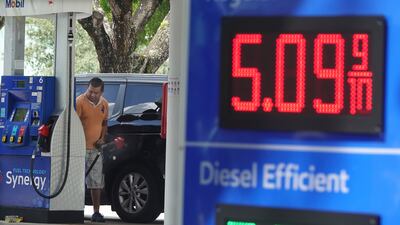
For the first time ever, the price for a gallon of regular petrol has hit more than $5. AP -

US President Joe Biden speaks about the economy and inflation at the Port of Los Angeles in California. AFP -
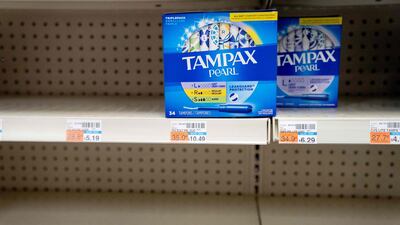
Tampons have reportedly been in short supply in stores across the US due to global supply chain issues. AFP -

Pay rates displayed at a Taco Bell fast food outlet in Sacramento, after the California minimum wage was increased due to inflation. AP -
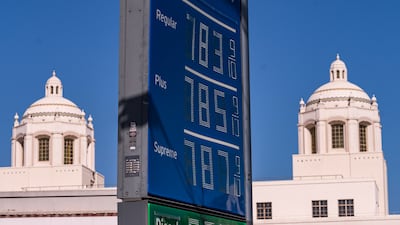
Various grades of petrol, with prices above $7 per gallon, are displayed at a Chevron gas station in central Los Angeles, California. AP -

The rising cost of items including clothing, food, petrol and cars is hitting Americans' pockets, despite historically low unemployment. AFP -
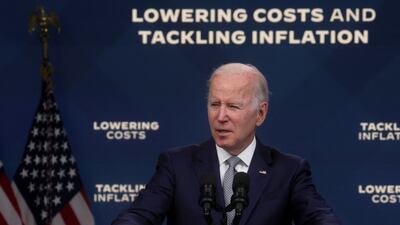
Mr Biden announces plans to fight inflation and lower costs. Reuters -
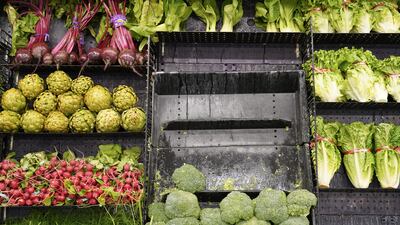
Supermarkets across the US are struggling to keep shelves stocked because of supply chain issues. Willy Lowry / The National -
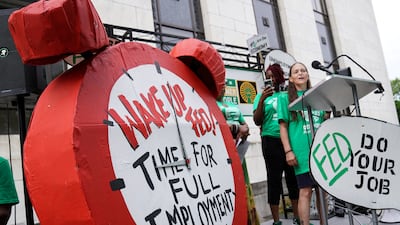
Protesters with the Centre for Popular Democracy stage a demonstration in support of employment rights in June 2022. Reuters -

Diners in San Francisco, California. With prices so high, many US consumers say they are cutting back on eating out. AFP -

Bags of purchases from a Dollar Tree store in Jackson, Mississippi. The company sells items at $1. AP -
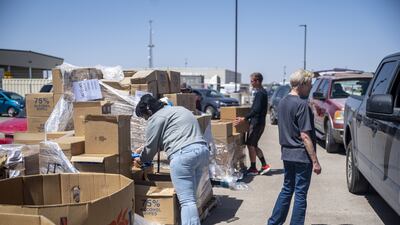
Volunteers gather food to hand out at a West Texas Food Bank drive-through in Odessa, Texas. Bloomberg -

A hiring poster at a Chipotle fast food restaurant in Los Angeles, California. US unemployment stands at 3.6 per cent, about 0.1 per cent above a 50-year low in 2019. EPA -

Supermarket shoppers in Rosemead, California. High food prices are causing hardship for some Americans. AFP -
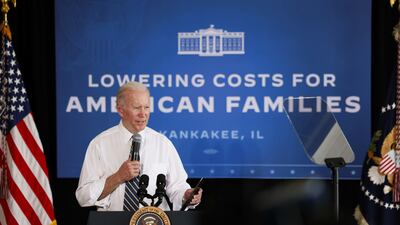
Mr Biden speaks on lowering costs for American families in Illinois. Bloomberg -

Nearly empty shelves in a supermarket in Orlando, Florida. AP


“The costs of further disintegration would be enormous across countries. And people at every income level would be hurt — from highly-paid professionals and middle-income factory workers who export, to low-paid workers who depend on food imports to survive. More people will embark on perilous journeys to seek opportunity elsewhere,” they said.
Reconfigured supply chains and higher barriers to investment could make it more difficult for developing nations to sell to the rich world, gain know-how and build wealth, according to the officials.
The officials outlined four priorities to restore trust in the global system. These include strengthening trade to increase resilience, stepping up joint efforts to deal with debt, modernising cross-border payments and confronting climate change through investments in renewables and other measures.
“We can start now by lowering trade barriers to alleviate shortages and lower the prices of food and other products,” officials said.
“Not only countries, but also companies need to diversify imports — to secure supply chains and preserve the tremendous benefits to business of global integration. While geo-strategic considerations will drive some sourcing decisions, this need not lead to disintegration. Business leaders have an important role to play in this regard.”
Stepping up joint efforts to deal with debt can be helpful to restore trust in the global system.
“With roughly 60 per cent of low-income countries with significant debt vulnerabilities, some will need debt restructuring. Without decisive cooperation to ease their burdens, both they and their creditors will be worse off,” they said.
Countries could also work together to develop a global public digital platform, with clear rules to boost efficiency in payment systems “so that everyone can send money at minimal cost and maximum speed and safety. It could also connect various forms of money, including central bank digital currencies”.
“There is no silver bullet to address the most destructive forms of fragmentation. But by working with all stakeholders on urgent common concerns, we can begin to weave a stronger, more inclusive global economy,” the officials said.

