

China’s central bank has announced a spate of measures to help an economy that has been hit by lockdowns to control the current Covid-19 outbreak, but the focus on boosting credit probably means the chances for broad-based easing are shrinking.
The People’s Bank of China (PBOC) told banks to meet the “reasonable funding needs” of local government financing vehicles (LGFV), according to a document released with the foreign exchange regulator on Monday.
It also urged more lending to people with “flexible employment” such as taxi drivers, online shop owners and truck drivers, and provide longer-term and cheaper loans to small businesses.
In the announcement of 23 measures, the central bank vowed to step up the use of targeted tools including the relending programme, which provides funds for banks to lend to sectors that include those hit by the pandemic.
The various relending programmes are expected to lead to 1 trillion yuan ($157 billion) in additional bank loans, it said.
The measures came after China reported its biggest decline in consumer spending and worst unemployment rate since the early months of the pandemic in March 2020, as lockdown measures to stop Covid-19 infections disrupted activity.
-

People line up for Covid-19 tests in a residential community under lockdown in Shanghai, China. EPA -

Shanghai reported 3,590 new locally transmitted Covid-19 cases and 19,923 local asymptomatic infections on April 16, according to the Shanghai Health Commission. EPA -

On April 1 the city went into a general lockdown for 4 days. Those 4 days turned into 16 days – and counting. EPA -

Some lockdown restrictions have been lifted. EPA -

Most delivery services are blocked, making it difficult for people to buy food and groceries. EPA -

A man seen through a fence stands in a residential community under lockdown. EPA -

A man takes a Covid-19 test in Shanghai. EPA -

A woman wearing a mask for protection sits with her dog after Covid-19 testing. EPA -
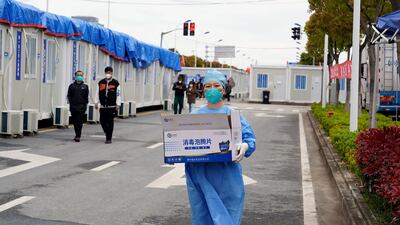
A woman carries a box of supplies at a makeshift hospital in Shanghai. AP


The support for LGFV financing is rare as regulators have been tightening the rules governing the sector in recent years in an attempt to push local governments to bring their debts back on to their official balance sheets.
The announcement suggests “the chance of broad policy interest rate and RRR [reserve requirement ratio] cuts is lowered further as the PBOC did not mention them in the discussion on monetary policy tools”, Goldman Sachs analysts including Hui Shan wrote in a report.
“Instead, the PBOC’s monetary easing could be more reliant on targeted policy tools in coming quarters.”
Banks should lend more to infrastructure projects and purchase local government bonds to help them front-load investment, and shouldn’t “blindly” suspend or withdraw loans from LGFVs, to ensure they can deliver projects under construction, the PBOC said.
Policy banks will also need to step up their financing to major investment projects, it said.
On housing policy, the PBOC called on local authorities to set appropriate minimum down payments and mortgage rates based on each city’s conditions, and urged banks to support the reasonable financing needs of property developers and construction companies.
The central bank also asked banks to increase the share of private companies among the recipients of new corporate loans.
The PBOC has transferred 600bn yuan of profit to the central government as of mid-April and this was mainly used for tax rebates and transfer payments to local governments, it said.
The profit transfer had the impact of increasing the base money supply by 600bn yuan, which has the same effect as a 25 basis-point cut in the RRR, it said.
The statement followed the central bank’s move on Friday to provide lenders with a modest cash boost while refraining from cutting interest rates. That cautious approach to monetary easing comes as some analysts argue the key to bolstering growth now lies in adjusting strict Covid-19 controls rather than offering more liquidity.
Separately, the China Banking and Insurance Regulatory Commission vowed to increase financial resources for the logistics, transportation and courier industries, and use relending funds to lower financing costs.
This will provide funding help to smaller businesses suffering from temporary difficulties due to Covid-19, the regulator said.

