


Pakistan’s new Prime Minister Shehbaz Sharif has a tough 18 months or so ahead of him before the South Asian nation is scheduled to vote in general elections.
His biggest challenge will be to rescue a sagging economy and weakening currency, and to deal with a balance of payments crisis amid extreme political volatility in the country.
Mr Sharif’s ascent to the premiership followed a week-long constitutional crisis that reached its height with the removal of former prime minister Imran Khan through a no-confidence motion in Parliament.
As Mr Sharif took office on Monday, more than 100 MPs loyal to Mr Khan resigned, stoking already heightened instability.
This is a major headache for the new prime minister, who is trying to chart a course to bring the deeply polarised country out of its political and economic crisis.
The new government needs to rein in inflation of 12.5 per cent and has little in foreign exchange reserves, underscoring the task at hand for Mr Sharif, who opposes engaging the International Monetary Fund.
Moody’s Investors Service, which considered the no-confidence vote against Mr Khan to be credit negative for Pakistan, said the country’s current account deficit amounted to more than $12 billion between July 2021 and February 2022, a stark contrast to a $1bn surplus in the same period a year earlier.
“We now expect the deficit to widen to 5 per cent to 6 per cent of GDP [gross domestic product] in fiscal 2022 [ending in June] compared with our previous forecast of 4 per cent,” the rating agency said in a note.
This will put “greater pressure on Pakistan’s foreign reserves”, which dwindled to $14.9bn as of February 2022 from $18.9bn in July 2021, sufficient to cover only about two months of imports, Moody’s said, quoting IMF data.
Mr Sharif said the country must tackle the economic malaise in which the rupee has hit an all-time low. The currency dropped to about 188 rupees to $1 last week, down from a high of 152.27 rupees in May 2021.
“If we have to save the sinking boat, what we all need is hard work and unity, unity and unity,” he told Parliament. “We are beginning a new era of development today.”
-

The new Pakistani Prime Minister Shahbaz Sharif, centre, is congratulated by former president Asif Ali Zardari during a National Assembly session in Islamabad on Monday. AP -
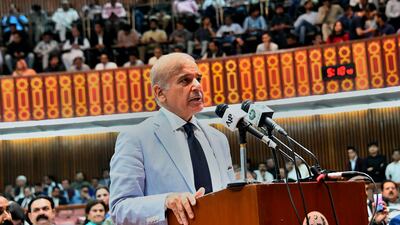
Shahbaz Sharif addresses the National Assembly in Islamabad. AP -
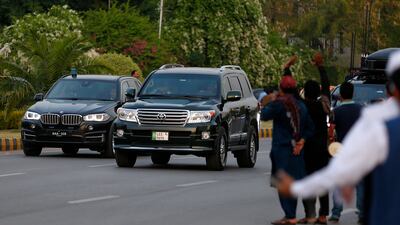
Supporters line the street as Shahbaz Sharif’s motorcade leaves the session, after Pakistan's Parliament elected him as the new prime minister. AP -

Shahbaz Sharif takes over from Imran Khan after a week of political turmoil ended in the latter being removed from office. AP -
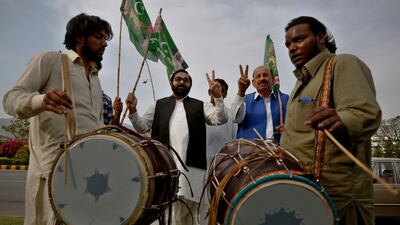
Supporters of Shahbaz Sharif celebrate outside the National Assembly in Islamabad. AP -
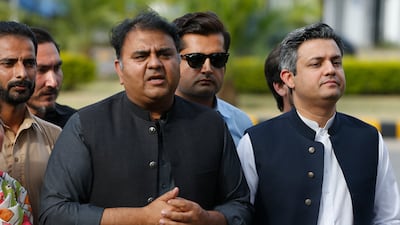
Fawad Chaudhry and Hammad Azhar, leaders of the Pakistan Tehreek-e-Insaf opposition party, speak to the media outside the National Assembly. AP -
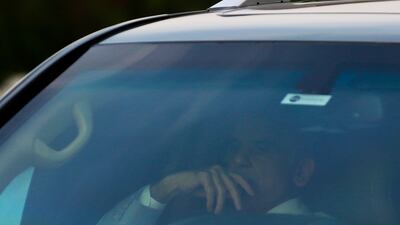
Shahbaz Sharif leaves after attending a National Assembly session as Pakistan’s new prime minister. AP -

People in Pakistan watch a televised speech by newly elected prime minister Shahbaz Sharif. AP -

Shahbaz Sharif addresses the National Assembly. He takes over after a vote of no confidence in Imran Khan. AP -

Jubilant Sharif supporters gather near the office of his party, Pakistan Muslim League (Nawaz), in Lahore on Monday. AFP -

Supporters of the newly elected prime minister flash victory signs in celebration. AP -
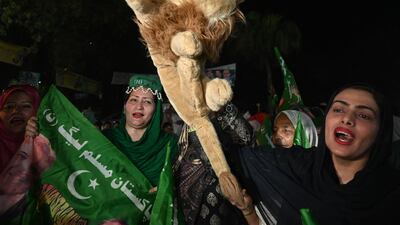
A supporter of Shahbaz Sharif holds a toy lion. His party, PML-N, has a tiger as its mascot. AFP


Mr Sharif mentioned Chinese funding for major projects but not the IMF’s remaining $3bn funding open to Pakistan if the country can meet the lender’s requirements.
They include electricity and fuel tariff reforms, which are highly unpopular moves in a country struggling with rising consumer prices.
But policymakers remain engaged with the IMF, said Pakistan’s central bank, which last week implemented an emergency 250-basis point rate increase – the biggest since 1996 – to stem the rupee’s slide and stabilise financial markets.
“The engagement with the IMF remains strong, both with the finance ministry as well as the central bank,” State Bank of Pakistan Governor Reza Baqir, a veteran IMF executive, told Bloomberg.
“In the current political environment, it is no surprise that the unpopular decision being required by the IMF of raising fuel and electricity prices are proving difficult.”
Mr Baqir said that delays were common in countries facing a political crisis.
“We are quite confident that we will be able to put the delay behind us and soon announce the good news of completing the next tranche of the IMF [reforms],” he said.
Last week, the fund indicated it was willing to support Pakistan and engage with the new government.
But “economic conditions are changing fast on the ground”, and the longer the seventh review is delayed, the “greater the chance that the programme will have to be renegotiated to reflect updated quantitative benchmarks”, said Hasnain Malik, strategy and head of equity research at Tellimer.
“The new government, the PTI, and any technocratic interim administration should there be early elections, accept there is no alternative to remaining engaged with the IMF, subject to delays resulting from any change in personnel.”
governor, State Bank of Pakistan
Securing external financing, including from the IMF, will be “key for Pakistan to continue to meet its external obligations given the pressures on its foreign-exchange reserves”, Moody’s said.
The fundamentals of Pakistan remain strong and the country’s economy grew 5.5 per cent in the last fiscal year, Mr Baqir said.
“Our projection for this fiscal remains around 4 per cent despite the [interest rate] hike that we have done,” he said.
The country is at the halfway mark of the IMF’s $6bn programme and its “goal is to complete the work that is necessary to draw the remaining $3bn”, Mr Baqir said.
After that, if “we need to, we can have a conversation” about more funding from the IMF or other sources, he said.
The IMF is not important only for money, but also for “the signal that it sends on good housekeeping on the economic policy front that catalyses funding from other bilateral creditors as well as private capital markets”, the central bank governor said.
“We are hopeful that with that positive message coming out, we will be able to mobilise funding from other sources.”

