


As the climate heats up, so does action to move to a cleaner energy future.
The UAE faces intense scrutiny and a towering diplomatic task to run the Cop28 conference in November. The Climate Tech event in Abu Dhabi earlier this month was a step forward in assembling the next suite of environment-friendly technologies.
The gathering saw the launch of the Decarbonisation Technology Challenge, offering a prize of up to $1 million for winners selected from 10 finalists in December.
Many exciting and innovative companies appeared — from known companies to start-ups. Without prejudice to any that aren’t mentioned or others that may enter the competition later, some hitherto lesser-known companies span solutions to four of the critical climate challenges.
First, reducing emissions from the oil and gas sector itself — with the Abu Dhabi National Oil Company (Adnoc) one of the event’s organisers, highlighting efforts to address the challenge. Fossil fuels still yield 83 per cent of global primary energy and will remain important even to 2050 and beyond, in a world on track for net-zero carbon. The surviving producers will be those that can keep their costs and carbon footprints low.
Companies such as the military and technology group Edge, G42 and AIQ, all based in Abu Dhabi, offer advanced digitalisation and artificial intelligence. Saildrone provides autonomous, solar-powered floating vehicles that collect maritime data, with obvious applications in keeping offshore oil and gas platforms safe and secure.
Second, to find solutions for what are called “hard-to-abate” sectors. The path to decarbonising electricity and ground transport is well understood — solar, wind, nuclear power and battery cars. Of course, these solutions have plenty of room for improvement. But heavy industry, long-distance shipping and air travel, and long-term energy storage need work. They are probably not so much “hard-to-abate”, as “feasible to abate with the right technologies”.
UK-based Carbon Clean raised $150 million last May, a record round for a point-source carbon capture company. Its modular system is intended to be more efficient and lower-cost, and able to be retrofitted to existing industrial or power plants, trapping their carbon dioxide for reuse or safe disposal.
Dubai-headquartered Enerwhere provides modular, mobile solar power and energy use optimisation for temporary or remote sites such as drilling rigs, tourist resort islands and construction. Commonwealth Fusion Systems secured a remarkable $1.8 billion in funding in November 2021 to advance the limitless energy source that fuels the Sun and the other stars.
Hydrogen is attracting avid attention across the Mena region. Its many advantages come with practical challenges on making and transporting it cost-effectively. Baker Hughes is well-known as an oil services major, but at the event it agreed with Adnoc to work on innovations in this light, clean energy carrier.
-

Day one of the UAE Climate Tech forum in Abu Dhabi. All photos: Victor Besa / The National -
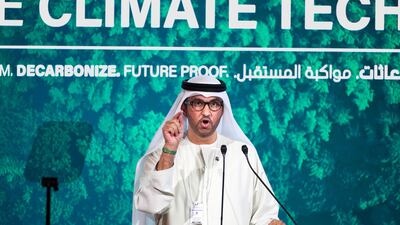
Dr Sultan Al Jaber delivers the keynote address at the UAE Climate Tech forum. -
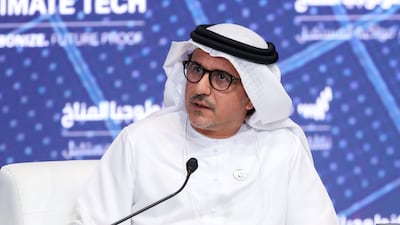
Musabbeh Al Kaabi, head of Adnoc's international growth directorate, speaks at the forum -
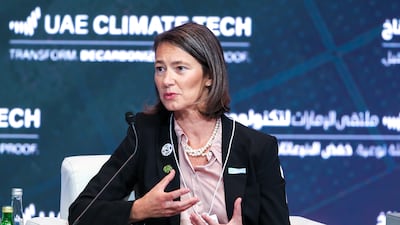
Adnoc's chief technology officer Sophie Hildebrand takes part in a panel discussion at the forum -

Ms Hildebrand and other panelists discussed the commercial case for decarbonisation -
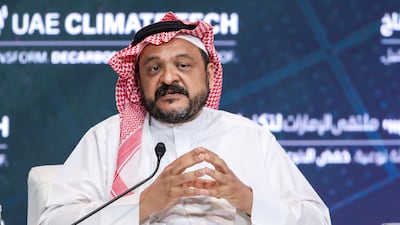
Aramco's chief technical officer Ahmad Al Khowaiter speaks during a discussion on technology's role in ensuring energy security and climate action -
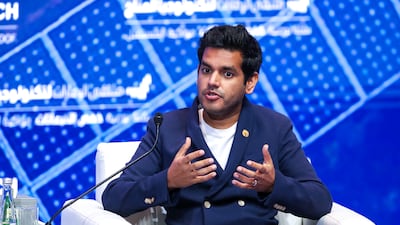
Talal Hassan, chief executive of 44.01, takes part in the panel discussing the commercial case for decarbonisation -
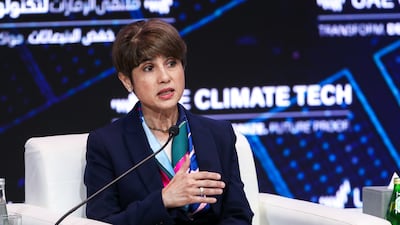
Dr Pratima Rangarajan, chief executive of OGCI Climate Investments, at the forum -
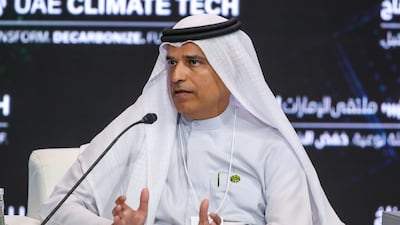
Abdulnasser bin Kalban, chief executive of Emirates Global Aluminum, addresses delegates at the forum -
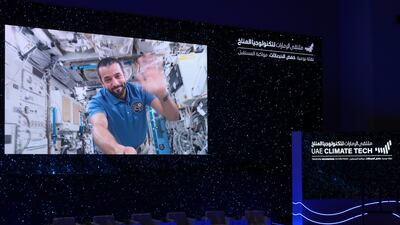
UAE astronaut Sultan Al Neyadi gives some words of encouragement from space during the forum -

Dr Jennifer Holmgren, chief executive of Lanza Tech, at the forum -
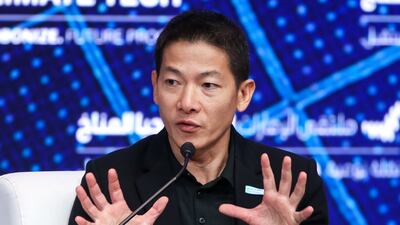
Peng Xiao, group chief executive of G42, speaks on how innovation could support energy security and climate action -
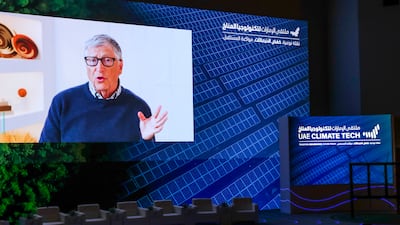
Bill Gates addresses delegates at the forum -

Mohamed Al Hammadi, managing director and chief executive of Enec, takes part in a panel discussion -
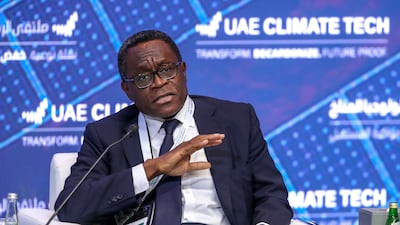
Bernard Mensah, president of the International Bank of America, at the forum -
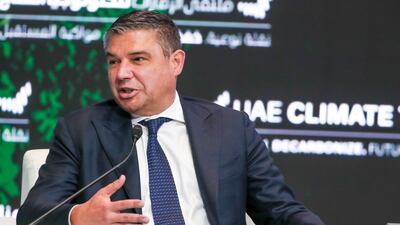
Lorenzo Simonelli, chairman and chief executive of Baker Hughes, at the forum


US-headquartered Ohmium makes proton exchange membrane electrolysers, which use electricity to split water into hydrogen and oxygen. Efficient, low-cost and long-life electrolysers are essential to bringing versatile hydrogen into the mainstream — as a way of storing electricity over long periods, providing heat and feedstock for heavy industries and a base for synthetic fuels.
Hydrogen is key to decarbonising four sectors — air travel, shipping, steel and fertilisers — which together account for more than 14 per cent of global greenhouse gas emissions.
Third, to build the future clean-energy economy. Here’s where the event’s other backer, the Ministry of Industry and Advanced Technology, comes in. The US, EU, China and India are pouring hundreds of billions – if not trillions — of dollars into manufacturing future energy materials and equipment. Other countries have to find where they can contribute and compete.
The humble building material cement produces as much as 8 per cent of global emissions and is an important industry in the UAE. Khalifa University showcased cement enhanced with the 2D material graphene, as well as one made from sulphur, a by-product from the petroleum industry.
Several other graphene innovators, such as Levidian and the University of Manchester’s Graphene Innovation Engineering Centre, represented the circular carbon economy, which aims to reuse carbon indefinitely rather than releasing it into the air.
On a different track, LanzaTech uses bacteria to make synthetic fuels, chemicals and plastics from captured carbon dioxide.
And fourth, to reverse decades of past pollution. All credible pathways to keeping warming below 1.5°C or even 2°C by 2100 involve sucking huge amounts of carbon dioxide back out of the atmosphere.
1PointFive might one day rival its parent, the US-based Occidental, a leading oil and gas operator in the GCC and elsewhere. The subsidiary is working on a series of direct air capture facilities that remove carbon dioxide from the atmosphere and store it underground, starting with a $1 billion, 1 million tonne per year plant in Texas.
Vesta adds sand made from the mineral olivine to coastlines. This both protects against marine erosion and captures carbon dioxide as the ground-up mineral reacts. This mimics the natural weathering that forms Earth’s long-term thermostat, but much faster.
44.01, led by Omani entrepreneur Talal Hasan, has a different twist on the same idea. It injects carbon dioxide and water into olivine-rich rocks, such as those found in the mountains of the UAE and Oman, and some other locations around the world. In January, the company agreed with Adnoc to start a pilot in Fujairah.

Many more technologies and companies were represented at Climate Tech and there is no doubt that others will compete for the prize.
It is essential to be bold and take some chances to get the best ideas operating in the real world on a massive scale.
The far bigger prize is global decarbonisation, which will make winners of the nations and corporations that lead it.
Robin M. Mills is chief executive of Qamar Energy and author of The Myth of the Oil Crisis

