

As business leaders and global investors navigate an increasingly complex landscape, it has never been more important to maintain a long-term perspective and understand the structural shifts that are shaping the world.
Difficult financial conditions, recessionary pressures, supply chain disruptions, energy and food security concerns, and a host of other issues are challenging business leaders like never before. They must look beyond the day-to-day and focus on the future transformative changes that will have the biggest impact on the way we live, work and invest.
For long-term investors like Mubadala, understanding megatrends can help identify growth opportunities, mitigate risk, and capitalise on emerging trends that have the potential to disrupt traditional industries and create new ones.
We adopt a forward-leaning investment strategy and allocate capital in line with our long-term views on megatrends, to shape our portfolio and generate long-term sustainable performance while delivering positive impact to current and future generations.
As part of Mubadala’s periodic strategy review, we ensure that we stay ahead of the curve.
This year, to help better understand global market perceptions across generations, we commissioned a research with Bloomberg Media. The study polled 1,800 people from the West (US, UK and France) and the East (India and China), as well as the UAE.
We looked at three distinct groups — seasoned investors, engaged and informed millennials, and Generation Z.
The study evaluated five specific megatrends affecting the economic, social and environmental outcomes — climate change, big demographic shifts, especially ageing societies and generational shifts, digital and disruptive technologies, urbanisation and inequality.
According to the findings, climate change represents the greatest risk to the well-being of the world. It impacts health, degrades the environment and harms business performance, underlining the case for greater levels of investment in the energy transition to low-carbon economies.
All groups polled considered climate as the biggest opportunity for companies to change the world for the better.
Mubadala invested early in the energy transition, for example, establishing Masdar in 2006, which has grown to become one of the world’s most prominent renewable energy companies. Masdar now operates in more than 30 countries, with a goal to provide 100 gigawatts of renewable power by 2030.
-
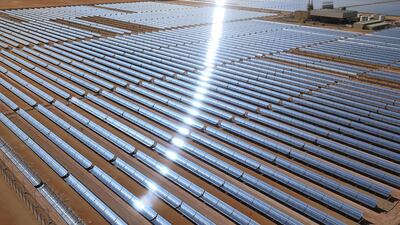
Shams 1 Solar Power Station in Abu Dhabi's Al Dhafra region. Photo: Masdar -

Shams 1 opened in 2013 and generates enough electricity to power tens of thousands of homes. Photo: Masdar -
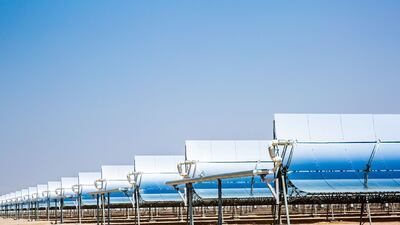
Shams uses 'parabolic trough' systems, meaning it directs heat on to liquid, which causes steam that then drives a turbine. Photo: Masdar -
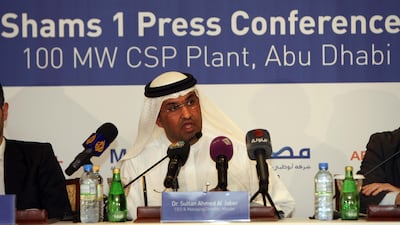
Dr Sultan Al Jaber announces the Shams 1 project back in 2010. Stephen Lock / The National -
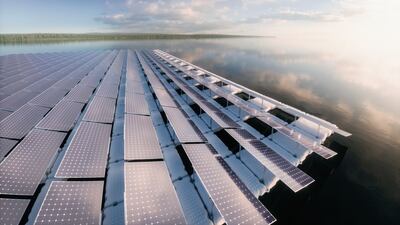
Cirata, a floating solar plant in Indonesia, expected to enter operation in 2022. Photo: Masdar -
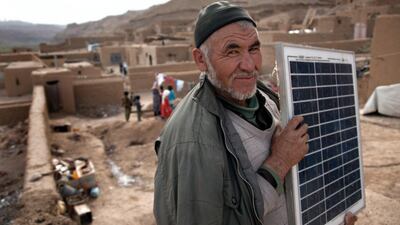
Masdar helped thousands of people in Afghanistan to access power though solar rooftop panels. Photo: Masdar -

It was the first time thousands of Afghan people had an electricity supply. Photo: Masdar -

Masdar's rooftop project in Afghanistan. Photo: Masdar -
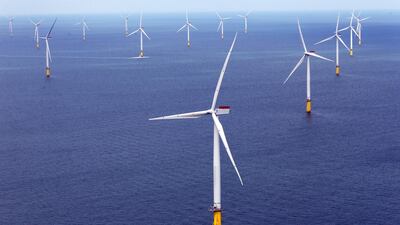
The London Array, the world's largest offshore wind farm in the Thames Estuary off the coast of the UK. Stephen Lock / The National -

Another view of the London Array. Stephen Lock / The National -

A model of Masdar City, which champions sustainable living. Pawan Singh / The National -
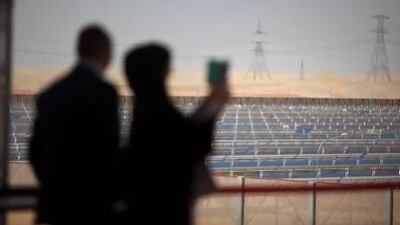
The opening of Shams 1 in 2013. Silvia Razgova / The National -

The Shams 1 plant was one of the first concentrated solar power plants in the region. Christopher Pike / The National -
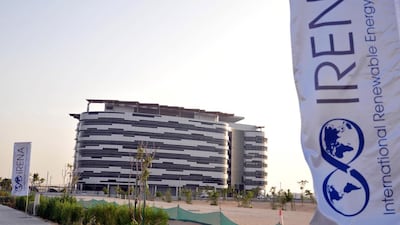
Irena's headquarters in Masdar City, Abu Dhabi. Wam -
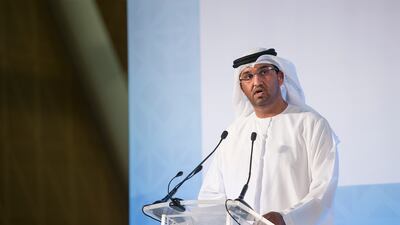
Dr Al Jaber is leading the charge to a greener tomorrow. Mona Al Marzooqi / The National


Digital technologies were rated by survey respondents as the megatrend that will have the most relevance to investors and businesses. Technology acts as an enabler across the world, supporting people, businesses and society to develop solutions to tackle environmental concerns and help eradicate food scarcity, poor sanitation, lack of access to education, poverty and other health and social issues.
Mubadala invests heavily in breakthrough technological innovation including semi-conductors, artificial intelligence, advanced mobility and autonomous driving.
The same also applies to our work with Hub71, which is supporting Abu Dhabi in positioning itself as a global hub for start-ups and innovation, including in ClimateTech, FinTech and HealthTech.
In our study, there was also concern about demographic shifts affecting the quality of life, the talent pool, poverty levels and public-sector spending. However, investors see demographic shifts as the most important of the megatrends, as challenges posed by ageing societies help some countries to drive new business opportunities.
Mubadala leverages the demographics trend by investing in health, with a focus on wellness and longevity, as well as new ways of living and changing patterns of consumption, with a focus on experiences, sustainability and tech-compatibility.
In health care, Mubadala has supported Abu Dhabi in developing a robust healthcare sector with the creation of Cleveland Clinic Abu Dhabi, as well as a broader network of healthcare facilities. This has helped to address the specialist healthcare needs of Abu Dhabi and the UAE, reducing the need for people to travel abroad for treatment.
Overall, our study reinforced the belief that companies that factor megatrends into their business strategies typically benefit from improved overall performance.
Indeed, respondents expect businesses to play a big role in responding to megatrends, with India and the UAE feeling this most strongly at 95 per cent and 91 per cent, respectively, followed by the US with 85 per cent.
Mubadala identifies investment opportunities that align with the company’s long-term investment approach and our focus on generating sustainable returns over time. We continue to deploy capital locally and internationally with partners who share similar beliefs. Here in the UAE, we partner with like-minded leaders to find pragmatic solutions to tackle some of the world's most pressing challenges.
Marc Antaki is head of Portfolio Strategy at Mubadala

