


The covers have come off the hotly anticipated Infiniti Q30 at an exclusive unveiling in Beirut.
Infiniti Middle East officially launched the new vehicle, Infiniti's first entry into the fast-growing premium compact segment, at the event.
At launch, the Infiniti Q30 will be available with 1.6 litre or 2 litre Turbo variants in a two-wheel configuration. The 2 litre Turbo will also be offered with an optional all-wheel drive drivetrain. The Turbo engine delivers 208hp and when equipped with front-wheel drive or all-wheel drive, the highest-performing engine in the range is capable of powering the car from 0 to 100kph in 7.3 seconds.
"The Infiniti Q30 active compact is a new type of premium vehicle for a new type of consumer," the company said.
Juergen Schmitz, the managing director for Infiniti Middle East said: "When we first debuted the Infiniti Q30 to the region at the Dubai International Motor Show last year it was met with widespread critical acclaim.
"We are extremely proud to be here today when we can officially launch the car to all markets in the Middle East. The Infiniti Q30 is a completely new segment and direction for the Infiniti brand."
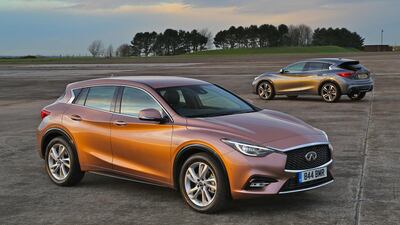
The Q30, which is available across the Middle East starting at Dh105,000, takes Infiniti's signature design cues repurposes them on the new car. The double-arch grille with 3D mesh, for example, is from the Q50.
The signature C-pillar arcs forward in "a dynamic crescent shape that emphasises motion, even when stationary", said Inifiniti, the luxury arm of the Japanese car maker Nissan.
Infiniti is a technical partner of the Renault Sport Formula One team for the 2016 season.
"The Q30 Sport stands a little lower, accentuating the already distinctive, coupe-like silhouette, while also providing for agile ride and handling."
A first for Infiniti and, the company says, this category, the car's Intelligent Parking Assist uses 12 sensors in the front and rear to automatically steer the vehicle into place while the driver controls the brake and accelerator.
Infiniti will also be the marque in which Nissan will unveil a new type of petrol engine it says may make some of today's advanced diesel engines obsolete.
In the wake of the diesel emissions cheating scandal that has rocked Volkswagen, "Diesel engine is a hot topic globally," said Kinichi Tanuma, a senior Nissan engineer who leads product development for Infiniti.
"We believe this new engine of ours is an ultimate gasoline engine that could over time replace the [advanced] diesel engine of today," he said.
James Chao, the Asia-Pacific managing director at consultant IHs, said: "Everyone's been working on variable compression and other technologies to significantly improve gasoline engine fuel economy ... at least for the last 20 years or so. "
The new engine uses variable compression technology, which Nissan engineers say allows it at any given moment to choose an optimal compression ratio for combustion – a key factor in the trade-off between power and efficiency in all petrol-fuelled engines.
The technology gives the new engine the performance of turbo-charged petrol engines while matching the power and fuel economy of today's diesel and hybrid powertrains – a level of performance and efficiency the conventional petrol engine has so far struggled to achieve.
The new Variable Compression-Turbo (VC-T) powertrain, expected to be officially unveiled at next month's Paris motor show, will initially be showcased in an Infiniti car to be unveiled next year, Nissan engineers said, without elaborating.
Eventually, it is expected to be used in Nissan cars and possibly by Renault.
The turbo-charged, 2-litre, four-cylinder VC-T engine averages 27 per cent better fuel economy than the 3.5-litre V6 engine it replaces, with comparable power and torque. Nissan says the new engine matches the diesel engine in torque – the amount of thrust that helps determine the car's acceleration.
The engine is also cheaper than today's advanced turbo-charged diesel engines, Nissan engineers said at a briefing at the company's technical and design center in Atsugi, south of Tokyo.
They said it should also meet nitrogen oxide (NOx) and other emissions rules in certain markets without requiring costly treatment systems.
The compression ratio measures how much the air-fuel mix is reduced, or compressed, in the gasoline engine's cylinders before it is ignited and produces energy. The higher the ratio, the more efficiently the engine works, producing better fuel economy and, with the addition of a turbo-charger, more power.
Traditionally, design engineers had to fix a petrol engine's combustion compression ratio, essentially deciding whether to go for power or economy.
Nissan says the new VC-T engine can choose an optimal compression ratio variably between 8:1 and 14:1. That compares with mainstream production petrol engines that run at compression ratios of 8:1 to 10:1. Exotic sports cars and racing cars run at 12:1 or more.
"We think the VC-T engine could replace or become an alternative to some of today's advanced diesel engines," Mr Tanuma said, noting the new engine's fuel economy and performance could be significantly boosted by coupling it to a petrol-electric hybrid system, an option Nissan said it's considering.
chnelson@thenational.ae
Follow The National's Business section on Twitter
-
-

The Q30's styling cues are taken and developed from other models such as the Q50. Courtesy : Infiniti Middle East -

The interior of the new Infiniti Q30. The car features a new automatic parking assistance system. Courtesy : Infiniti Middle East -

The Infiniti Q30 is now available across the Middle East starting at Dh1,05,000. Courtesy : Infiniti Middle East -

The top-end Infiniti Q30 can hit 100kph in about 7 seconds. Courtesy : Infiniti Middle East
Beirut hosts Infiniti’s latest car launch and Nissan invents new petrol engine
Most popular today

