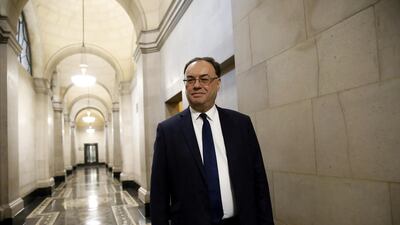

Bank of England governor Andrew Bailey said the UK economy is bouncing back very strongly from the pandemic, but managing the country's trillion-pound balance sheet will be one of the central bank’s biggest challenges over the next five years.
Mr Bailey said while the UK is "coming out" of the Covid crisis, it is doing so with about £1tn ($1.4tn) in British government bond purchases, leaving the BoE with a balance sheet that is “substantially bigger" that its balance sheet in the past.
“It’s necessary, it’s been done for a very, very good reason, but we have to think hard about how we manage that going forward … That is going to be a major issue for us over the five years ahead," Mr Bailey told delegates attending a virtual webinar hosted by the Association of Corporate Treasurers' Annual Conference.
The BoE doubled its bond purchase target to £895 billion in November last year to help bolster the UK economy against its biggest recession in 300 years, after the country almost completely shut down at the start of the pandemic last year.
While Britain's economic recovery accelerated in April, growing 2.3 per cent from March, the fastest growth in nine months, Mr Bailey said the economy is still about 5 per cent smaller than it was pre-Covid.
“That gap is closing quite rapidly but you do have to assess the paradox”, Mr Bailey told a virtual webinar hosted by the ACT.
“The good news is that we are only 5 per cent smaller but that is a huge number in any historical context so we have to track the recovery.”
The second issue, Mr Bailey said, is the UK's recovery needs to be tracked because it is entering a period when inflation is on the rise.
The UK is not facing "a normal recession", he said, where demand in the economy typically falls much more rapidly than supply, leading to long-term unemployment.
Instead the UK has seen both demand and supply falling, although the fall in demand is "nowhere near as high as the relative drop in supply", because it was caused by the economy being closed and the furlough scheme, which helped to prop up the jobs market.
“What it does mean though, is that the recovery of the economy is down to what we tend to call two big moving parts: both supply and demand are moving at the same time and of course, they can move at different speeds in different sequences and sometimes the sequence works and sometimes it doesn't – so we are getting bottlenecks,” he said.
Mr Bailey pointed to supply challenges faced across the globe, including high freight costs and rising energy costs, and said the issue going forward will be to what extent the challenges will be temporary and to what extent they will cause a knock-on in terms of inflation and wage levels.
“The second big question is, what sort of economy are we going to return to when this bounce back is done? Are we going to return to the sort of economy we had before Covid – that had structurally low interest rates, relatively low investment levels at times ... and relatively low productivity growth and low inflation?”
Mr Bailey said there will be big structural changes in the economy going forward caused by the huge acceleration to online shopping in the retail sector and the shift to working from home caused by the government's work-from-home directive.
The BoE expects 2021 to be the UK's strongest year of growth since the Second World War, with a surge in output of 7.25 per cent and the economy returning to its pre-pandemic level by the end of the year.

