

Turkish banks are offering the world’s cheapest loans, but they are only available for a select few.
That’s because policymakers want to avoid a currency crisis while maintaining strong economic growth ahead of elections next year, where President Recep Tayyip Erdogan seeks another term.
Regulators are forcing commercial lenders to prioritise exporters and smaller businesses that account for nearly three-quarters of the job market.
New lira loans for smaller firms — a key group targeted for credit growth — rose nearly 10-fold on an annual basis during the first 10 months of this year, compared to a seven-fold increase for large corporates, according to the central bank.
Businesses that don’t fit the government’s image of worthy borrowers, including those rich in foreign currency, are struggling to secure cheap credit, even as rates were slashed to 9 per cent on Thursday despite inflation at 85 per cent.
Curtailing lending in this way could dent growth projected to reach 5 per cent this year.
“Only exporters with little import needs can get loans, which is only a handful of people,” said Eren Gonul, a sales manager at an Ankara-based furniture maker.
Mr Gonul said his business — like many others — did not aim to grow because they would need to take out loans at elevated costs in order to import more raw material, an expensive move with the lira at record lows.
“Lending rules aim to promote exports without fuelling inflation. Caps on lending rates already pose an obstacle to lending appetite, and clashes with other policies will further limit these policies’ success. The upcoming Treasury-backed credit guarantee fund is sure to spur demand, and feed into inflation,” said Selva Bahar Baziki, Turkey economist at Bloomberg.
Banks can either offer cheap loans to high-priority clients or lend at higher costs to others. The latter, though, requires them to buy a large amount of government debt to be parked at the central bank. That leaves little incentive to lend to second-tier clients.
The impact became more pronounced after Turkey started lowering interest rates in August in line with Mr Erdogan’s demands. The key objective is to avoid a sharp drop in the lira that followed past periods of rapid growth in loans.
-
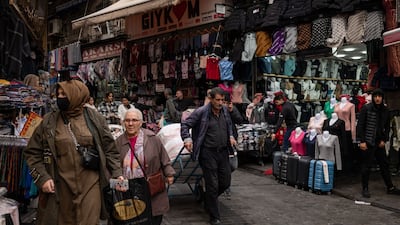
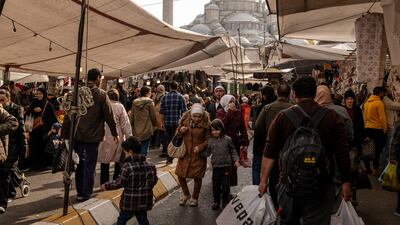
A market in Istanbul, Turkey, which is suffering its worst cost of living crisis in decades. All photos by Bloomberg -
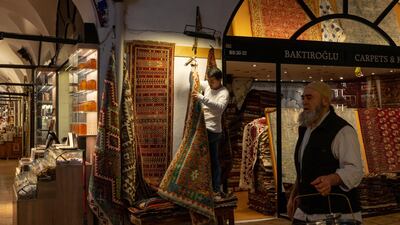
There are few shoppers in sight as a trader hangs carpets outside his store in the Grand Bazaar in Istanbul -
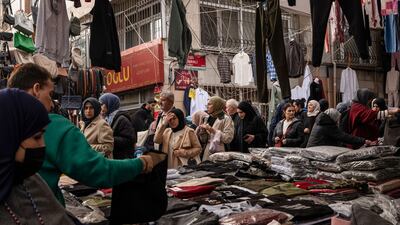
Shoppers look for a bargain at the city's Wednesday Market -
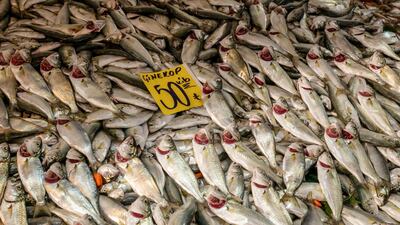
Fresh fish for sale in Istanbul. Food prices have risen by 99 per cent in a year -
Inflation in Turkey is running at 86 per cent -

A shopkeeper waits for customers in an alleyway of the Grand Bazaar in Istanbul -

A currency exchange bureau in Istanbul. Tourists are shielded from the rising prices -

Tourists queue to enter the Hagia Sophia mosque in Istanbul -
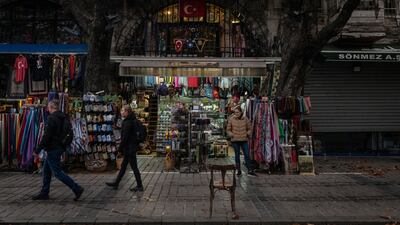
A vendor waits for customers at a souvenir store -

A price banner for a tour of the Bosphorus Strait on the side of a passenger ferry in Istanbul -
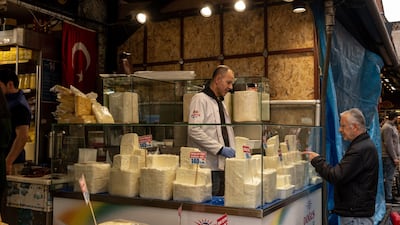
A customer at a cheese and fresh produce store in Istanbul -

Workers package ground coffee at a coffee shop. Half of Turks survive on the minimum wage -
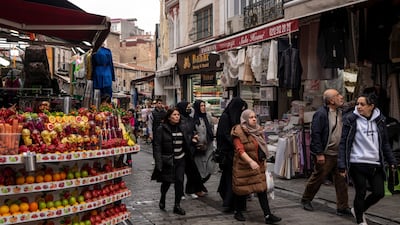
Pedestrians walk past a fresh fruit juice stand in Istanbul -
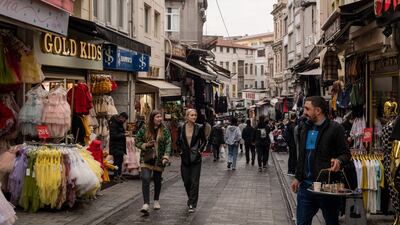
Shoppers and tourists in Istanbul


The financial engineering under way is enabling credit growth without derailing the lira. But banks are wary of risks from taking on large amounts of government debt with long maturity.
“Erdogan learnt from the experiences of 2018 and 2020”, when explosion in loans boosted imports, inflation and eventually resulted in a weaker currency, said Nick Stadtmiller, emerging markets director at Medley Global Advisors in New York.
The fine-tuning is a key part of Mr Erdogan’s game plan to keep markets stable ahead of next year’s presidential vote.
Growing discontent over price pressures makes it paramount to anchor the lira. But Turkey is running low on net foreign reserves, and a rate hike to defend the currency in the case of another rout is hardly a choice, since that could cause a recession right before the elections.
Policymakers are thus pushing for “selective lending”, a practice that allows only some of the Turkish businesses to benefit from falling interest rates.
The so-called small-to-medium sized enterprises borrowed a record $35 billion this year, accounting for nearly half of all commercial loans, according to the central bank.
The average cost of commercial loans fell from 30 per cent in July to about 16 per cent last week, following four rounds of rate cuts.
But selective lending stopped that from translating into another boom and, instead, credit growth dropped from this year’s peak in June.
Regulations that saddled lenders with a large amount of low-yield government debt are causing an outcry among bankers.
The central bank told banking executives that they shouldn’t expect a reversal in policies until after the elections, according to sources.

