


The banking industry is far more resilient than it was before the global financial crisis and is in a stronger position to face changing macroeconomic dynamics amid rising interest rates and rampant inflation, panellists told the Future Investment Initiative.
The US Federal Reserve is moving on a defined path of raising policy rates to control inflation, which could significantly impact the economy's direction, Charles Scharf, chief executive of US bank Wells Fargo, said.
There are geopolitical events, “which can certainly change everything”, and the markets are factoring in all these eventualities, MrScharf, told delegates during a panel discussion on Thursday.
However, what is perceived by equity markets should be separated from the real economy as bourses are “appropriately incredibly nervous but the real economy is still particularly strong”, he added.
“The banks per se are just in really great shape,” Mr Scharf said.
“The [financial] institutions are so much stronger today than they were pre-financial crisis and it's not just their capital levels.”
Banks across the globe have taken measures to improve the quality of their assets and have changed the way they book businesses, whether extending loans or underwriting mortgages.
This comes after many institutions failed and several were rescued by governments after the 2008-2009 financial crisis, which was triggered by the collapse of Lehman Brothers.
Banks have also evolved their contingency systems and undergo regular stress testing to assess their ability to weather severe economic and financial headwinds.
The resilience of lenders in the UK and their ability to handle economic and financial stress has equally improved since 2008-2009 crisis, said Dame Susan Rice, chair of the Global Ethical Finance Initiative's global steering committee.
“The resilience is there and the desire to be resilient [as well] because no one wants to go through what happened in the financial crisis in terms of resilience and turn that on its head,” she said.
Lenders in the Gulf that faced a drop in profits and a rise in credit losses in the aftermath of the financial crisis have also significantly beefed up their capital buffers to meet potential macroeconomic and geopolitical changes.
The global economy, which is still emerging from the Covid-19 pandemic, is facing fresh headwinds as economic activity has slowed amid rising interest rates and spiralling inflation.
However, economic momentum in the Middle East, especially in the six-member GCC economic bloc, has bucked the global trend.
The Gulf economies that bounced back strongly last year from the pandemic-driven slowdown are expected to expand sharply this year amid elevated oil prices and inflation that is significantly lower than in US and European economies.
Saudi Arabia, Opec’s biggest oil producer and the world’s top crude exporter, offers significant investment opportunities, Samer Haj-Yehia, chairman of Israel’s Bank Leumi told delegates.
“The economy here is thriving, and you have significant progress [under vision 2030] well under execution,” he said.
-

Left to right: Bill Winters, chief executive officer of Standard Chartered, Lorenzo Simonelli, chief executive officer of Baker Hughes, Jennifer Holmgren, chief executive officer of Lanzatech NZ, Matthew Harris, founding partner of Global Infrastructure Partners, Henrik Andersen, chief executive officer of Vestas Wind Systems A/S, Abdulaziz bin Salman, the kingdom's Minister of Energy, and Yousef Gamal El-Din, Bloomberg Television anchor, at the 'Science in Action' panel session at the Future Investment Initiative conference in Riyadh. Bloomberg -
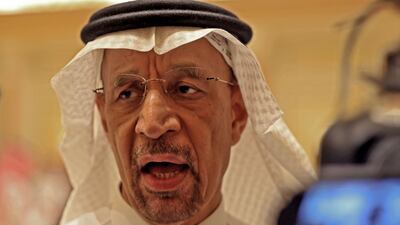
Saudi Arabia's Minister of Investment Khalid Al Faleh is pictured during an interview with AFP TV on the sidelines of the annual FII conference in the Saudi capital Riyadh. AFP -

Tareq Al Sadhan, chief executive of Riyadh Bank, centre, at the FII conference. Rising energy prices are likely to linger for some time, posing one of the most serious challenges to the global economic recovery and raising the potential risk of social unrest, some of the world's top executives said on the first day of the investment forum. Bloomberg -

Joseph Bradley, chief executive of NEOM's Tech and Digital Holding Company, speaks during an interview with AFP on the sidelines of the annual FII conference. AFP -
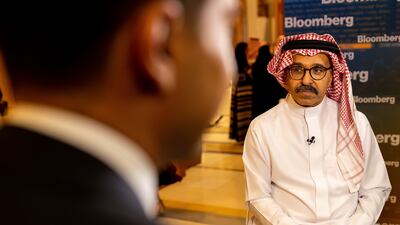
Nadhmi Al Nasr, chief executive officer of NEOM, during a Bloomberg Television interview at the FII conference. Saudi Arabia said global efforts to cut planet-warming emissions must avoid hurting poor countries' economies. Bloomberg -

Steven Mnuchin, former US Treasury secretary, attends a Bloomberg Television interview at the conference. Bloomberg -
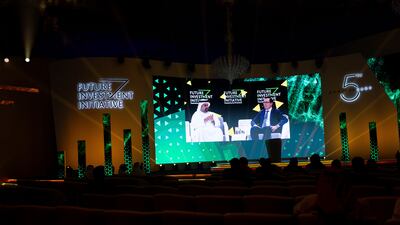
Mr Mnuchin, right, attends a panel session at the conference. Bloomberg -

Saudi Arabia's Minister of Energy Abdulaziz bin Salman at the conference. Saudi Arabia could go carbon neutral before its target of 2060 if technology evolves quickly enough, he said, days before the Cop26 climate summit. AFP -
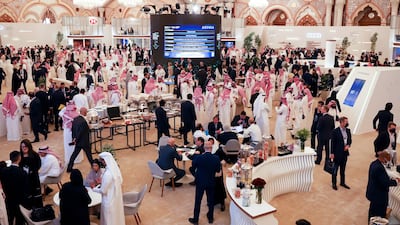
Attendees between panel sessions at the FII conference in Riyadh. Bloomberg -
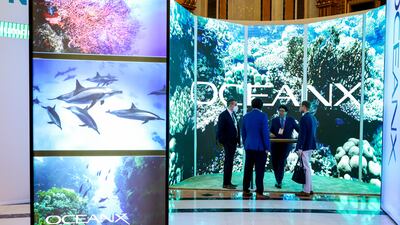
A promotional booth for Oceanx at the conference. Bloomberg -

Attendees during a break between panel sessions. Bloomberg -
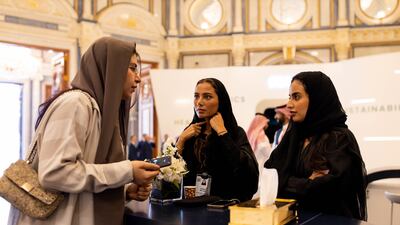
Female employees assist a guest at the conference. Bloomberg


Saudi Arabia’s economy grew 12.2 per cent in the second quarter, exceeding initial estimates and registering the fastest expansion in more than a decade on the back of higher oil prices.
Annualised real gross domestic product growth for the three months to the end of June was the quickest since the third quarter of 2011, according to the kingdom’s General Authority for Statistics (Gastat) data.
The kingdom's economy is set to grow at the quickest pace in a decade and could be one of the world’s fastest-growing economies this year, the International Monetary Fund said in August.
“So, there is a lot to do here from a GDP perspective, which is coupled with the banking industry,” Mr Haj-Yehia said.
“That, together [with when] we look at the population growing with a high percentage of youth … and you have a huge population that is unbanked or underbanked, the potential here is huge.”
The opportunities the kingdom is offering are “amazing” and the FinTech industry in particular is on the rise.
“We see companies are very healthy, unlike other economies around the world, and the prospects of the future are very positive,” he said.
From the regulations perspective, which is important for the growth of the country’s economy and its banking sector, regulators are providing “tailwinds”, he added.

