Restrictions on global air travel to curb the virus have led to airlines grounding their fleet temporarily. Getty Images/AFP

Global airlines and airports seek storage space as coronavirus pandemic grounds aircraft


Deena Kamel
  • English
  • Arabic

Airlines around the world are scrambling for space to park their aircraft as the coronavirus outbreak brings passenger flights to a halt.

The number of planes in storage around the world has reached 8,500 since the beginning of 2020, with the biggest number of jets parked in Europe, according to data from aviation research firm Cirium.

The Middle East is hosting nearly 700 stored aircraft at about 30 locations, Cirium said in its latest report.

Tracking storage locations shows Europe has the largest share with about 2,800 aircraft across 210 airports. Asia-Pacific has just over 2,000 aircraft at more than 150 locations, while the latest figures for North America are 1,600 jets at 130 locations.

Asked if there is sufficient storage space for airlines to park their jets, Alexandre de Juniac, director general of International Air Transport Association, said: "It creates issues, we have to close runways and convert it to parking space," adding that airports and airlines co-ordinate plans.

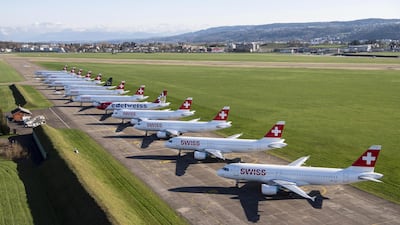
  • Swiss International Air Lines aircraft are parked on the tarmac at the airport in Zurich, Switzerland. EPA
    Swiss International Air Lines aircraft are parked on the tarmac at the airport in Zurich, Switzerland. EPA
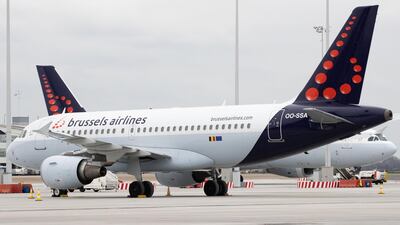
  • Brussels Airlines planes stand on the tarmac at Brussels Airport, after the suspension of more than 2/3 of the flights of Brussels Airlines, in Zaventem. AFP
    Brussels Airlines planes stand on the tarmac at Brussels Airport, after the suspension of more than 2/3 of the flights of Brussels Airlines, in Zaventem. AFP
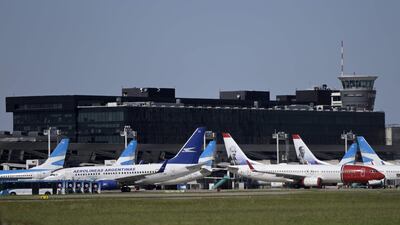
  • Commercial aircrafts remain at the tarmac of closed Jorge Newbery airport in Buenos Aires, Argentina. AFP
    Commercial aircrafts remain at the tarmac of closed Jorge Newbery airport in Buenos Aires, Argentina. AFP
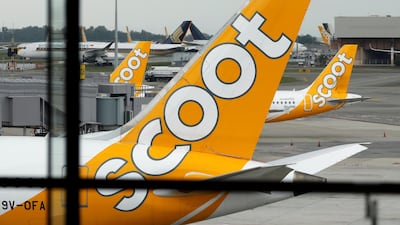
  • Scoot and Singapore Airlines planes sit on the tarmac, as airlines reduce flights following the outbreak of the coronavirus disease (COVID-19), at Singapore's Changi Airport. Reuters
    Scoot and Singapore Airlines planes sit on the tarmac, as airlines reduce flights following the outbreak of the coronavirus disease (COVID-19), at Singapore's Changi Airport. Reuters
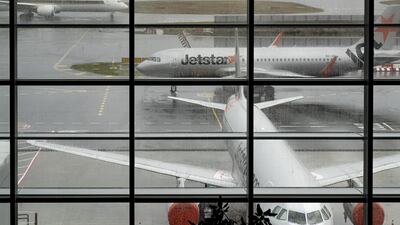
  • A Singapore Airlines flight goes past some Jetstar planes parked at the tarmac of Changi Airport in Singapore. Getty Images
    A Singapore Airlines flight goes past some Jetstar planes parked at the tarmac of Changi Airport in Singapore. Getty Images
  • Emirates' aircrafts are pictured grounded at Dubai international Airport in Dubai after Emirates suspended all passenger operations. AFP
    Emirates' aircrafts are pictured grounded at Dubai international Airport in Dubai after Emirates suspended all passenger operations. AFP
  • Cathay Pacific aircraft are seen parked on the tarmac at the airport, following the outbreak of the new coronavirus, in Hong Kong. Reuters
    Cathay Pacific aircraft are seen parked on the tarmac at the airport, following the outbreak of the new coronavirus, in Hong Kong. Reuters
  • Korean Air's passenger planes are parked on the tarmac at Incheon International Airport in Incheon, South Korea. Reuters
    Korean Air's passenger planes are parked on the tarmac at Incheon International Airport in Incheon, South Korea. Reuters
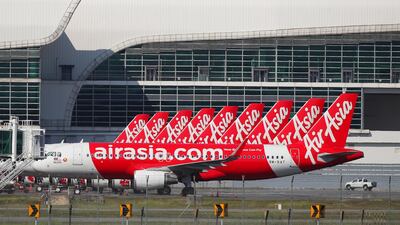
  • AirAsia aircraft are parked on the tarmac at the Kuala Lumpur International Airport 2 in Sepang, Malaysia. EPA
    AirAsia aircraft are parked on the tarmac at the Kuala Lumpur International Airport 2 in Sepang, Malaysia. EPA
  • Planes of the German carrier Lufthansa are parked on a closed runway at the airport in Frankfurt, Germany. Reuters
    Planes of the German carrier Lufthansa are parked on a closed runway at the airport in Frankfurt, Germany. Reuters
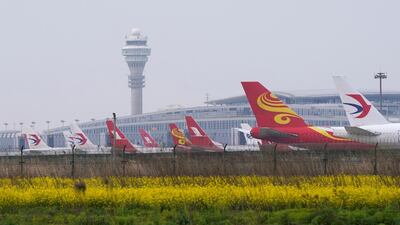
  • Aircrafts of China Eastern Airlines, Shanghai Airlines and Hong Kong Airlines are seen on the tarmac at the Pudong International Airport in Shanghai, China. Reuters
    Aircrafts of China Eastern Airlines, Shanghai Airlines and Hong Kong Airlines are seen on the tarmac at the Pudong International Airport in Shanghai, China. Reuters

The aviation industry is approaching the milestone of one third of the global fleet in storage, which is the equivalent of about 8,800 passenger jets, according to Cirium.

Airlines across the globe are grounding planes as tighter travel restrictions and border closures were put in place to contain the spread of the deadly virus.

Facing a liquidity crisis, many airlines said they are seeking government support to survive.

Global airlines will lose $252 billion (Dh925bn) in passenger revenue this year, a 44 per cent drop from 2019, as air travel demand is forecast to plunge 38 per cent in 2020, according to Iata.

As airlines reduce capacity, operators are hunting for space to store their jets. Parking planes at airports is a logistically complex and costly operation.

Furthermore, airlines must ensure the planes are maintained during storage so they can return to service in the best form when passenger flights eventually resume.

The UAE, the region's transit and financial hub, halted all passenger flights starting from March 25 for two weeks, as the Covid-19 outbreak plunges the global aviation industry into a deepening crisis. Its flag carrier Emirates has the world's largest widebody fleet.

Meanwhile, Saudi Arabia said on Sunday it is extending the suspension of all international and domestic passenger flights indefinitely amid heightened precautions to contain the spread of the coronavirus pandemic. Kuwait and Jordan have also suspended all flights.


COMPANY PROFILE

Company: Bidzi

● Started: 2024

● Founders: Akshay Dosaj and Asif Rashid

● Based: Dubai, UAE

● Industry: M&A

● Funding size: Bootstrapped

● No of employees: Nine

The five pillars of Islam
AI traffic lights to ease congestion at seven points to Sheikh Zayed bin Sultan Street

The seven points are:

Shakhbout bin Sultan Street

Dhafeer Street

Hadbat Al Ghubainah Street (outbound)

Salama bint Butti Street

Al Dhafra Street

Rabdan Street

Umm Yifina Street exit (inbound)

Mercer, the investment consulting arm of US services company Marsh & McLennan, expects its wealth division to at least double its assets under management (AUM) in the Middle East as wealth in the region continues to grow despite economic headwinds, a company official said.

Mercer Wealth, which globally has $160 billion in AUM, plans to boost its AUM in the region to $2-$3bn in the next 2-3 years from the present $1bn, said Yasir AbuShaban, a Dubai-based principal with Mercer Wealth.

Within the next two to three years, we are looking at reaching $2 to $3 billion as a conservative estimate and we do see an opportunity to do so,” said Mr AbuShaban.

Mercer does not directly make investments, but allocates clients’ money they have discretion to, to professional asset managers. They also provide advice to clients.

“We have buying power. We can negotiate on their (client’s) behalf with asset managers to provide them lower fees than they otherwise would have to get on their own,” he added.

Mercer Wealth’s clients include sovereign wealth funds, family offices, and insurance companies among others.

From its office in Dubai, Mercer also looks after Africa, India and Turkey, where they also see opportunity for growth.

Wealth creation in Middle East and Africa (MEA) grew 8.5 per cent to $8.1 trillion last year from $7.5tn in 2015, higher than last year’s global average of 6 per cent and the second-highest growth in a region after Asia-Pacific which grew 9.9 per cent, according to consultancy Boston Consulting Group (BCG). In the region, where wealth grew just 1.9 per cent in 2015 compared with 2014, a pickup in oil prices has helped in wealth generation.

BCG is forecasting MEA wealth will rise to $12tn by 2021, growing at an annual average of 8 per cent.

Drivers of wealth generation in the region will be split evenly between new wealth creation and growth of performance of existing assets, according to BCG.

Another general trend in the region is clients’ looking for a comprehensive approach to investing, according to Mr AbuShaban.

“Institutional investors or some of the families are seeing a slowdown in the available capital they have to invest and in that sense they are looking at optimizing the way they manage their portfolios and making sure they are not investing haphazardly and different parts of their investment are working together,” said Mr AbuShaban.

Some clients also have a higher appetite for risk, given the low interest-rate environment that does not provide enough yield for some institutional investors. These clients are keen to invest in illiquid assets, such as private equity and infrastructure.

“What we have seen is a desire for higher returns in what has been a low-return environment specifically in various fixed income or bonds,” he said.

“In this environment, we have seen a de facto increase in the risk that clients are taking in things like illiquid investments, private equity investments, infrastructure and private debt, those kind of investments were higher illiquidity results in incrementally higher returns.”

The Abu Dhabi Investment Authority, one of the largest sovereign wealth funds, said in its 2016 report that has gradually increased its exposure in direct private equity and private credit transactions, mainly in Asian markets and especially in China and India. The authority’s private equity department focused on structured equities owing to “their defensive characteristics.”

Key facilities
  • Olympic-size swimming pool with a split bulkhead for multi-use configurations, including water polo and 50m/25m training lanes
  • Premier League-standard football pitch
  • 400m Olympic running track
  • NBA-spec basketball court with auditorium
  • 600-seat auditorium
  • Spaces for historical and cultural exploration
  • An elevated football field that doubles as a helipad
  • Specialist robotics and science laboratories
  • AR and VR-enabled learning centres
  • Disruption Lab and Research Centre for developing entrepreneurial skills
F1 The Movie

Starring: Brad Pitt, Damson Idris, Kerry Condon, Javier Bardem

Director: Joseph Kosinski

Rating: 4/5

Company profile: buybackbazaar.com

Name: buybackbazaar.com

Started: January 2018

Founder(s): Pishu Ganglani and Ricky Husaini

Based: Dubai

Sector: FinTech, micro finance

Initial investment: $1 million