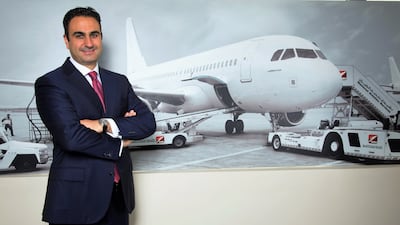

Airport ground handler Menzies Aviation is planning expansion in the Gulf and US, while the Syrian market is of interest, as it aims to sustain its “aggressive” growth despite Iran war-related travel disruptions and higher costs.
The aviation services company, which has a regional office in Dubai, is keen to serve airports in the UAE and Saudi Arabia, which has a “very fast-growing, large, dynamic” market, chief executive Hassan El-Houry told The National.
Kuwait is also a potential future market, after Menzies concluded operations at Kuwait International Airport when its contract expired in January. It already operates in Iraq, Jordan and Egypt.

“We want to be a part of the incredible investment that's going into aviation and aviation infrastructure in the Gulf,” he said. “We take a long-term view on all of our investments.”
Menzies is also considering opportunities in Syria as the country reconnects with the global travel and financial markets.
“We need to look at the economics and legalities of the market, but overall interested,” he said. “We look at every opportunity objectively, commercially and operationally, not politically.”
Syria's civil aviation sector may attract new foreign investment after the US removed the country from its list of state sponsors of terrorism last month, ending a 47-year designation.
Menzies also aims to grow further in the US, where it has doubled its footprint in the last two years to serve 108 airports.
“We see the US as a key market. We will continue to growth there,” Mr El-Houry said. This follows its $305 million acquisition of Texas-based G2 Secure Staff that was completed in August 2025.
London-based Menzies, part of UAE's Agility Global, provides ground handling, aircraft fuelling, cargo and lounge services at nearly 350 airports in 65 countries, including at London Heathrow and the world’s busiest hub, Hartsfield-Jackson Atlanta International Airport.
The company recorded a 31 per cent year-on-year increase in second-quarter revenue to $908 million, driven by contribution from G2, new contract wins, better yield and “resilient” operations despite geopolitical disruptions in the Middle East, Agility said in an August statement.
“I am navigating the company in a time when there is significant disruption and uncertainty in the aviation sector,” Mr El-Houry said. “But at the same time, our company has been sustainably growing quite aggressively … and will continue to grow aggressively year-on-year.”
Before joining Menzies, Mr El-Houry was chief executive of Kuwait's National Aviation Services (NAS) and played a major role in Agility’s acquisition of Menzies in 2022 and in Menzies' integration with NAS. He became executive chairman of Menzies in 2022 before being appointed its chief executive in July.
Middle East growth
“The Middle East broadly is a very attractive market for us,” Mr El-Houry said, pointing to airlines such as Emirates, Etihad Airways, Qatar Airways, Saudia and new start-up Riyadh Air. “We want to grow in the Middle East if we can. The problem is that there's high barriers to entry.”
Emirates Group-owned dnata, which provides ground handling, travel, catering, retail and cargo services, has extensive operations in the UAE.
The six-month Iran war is unlikely to hamper Menzies' growth ambitions in the region. Mr El-Houry pointed to the Gulf airlines' “incredible” recovery despite operational challenges as they restore their route networks to about 90 per cent of prewar levels, thanks to the strength of their business models and management.
“When you think about it, there are missiles and drones flying around, airspaces closing and opening literally on an hour-by-hour basis, your biggest cost – fuel – has skyrocketed, passenger confidence probably plummeted and still you're flying. That's incredible,” he said.
The war has exerted push-pull forces on the aviation industry. While travel demand is high, the cost of jet fuel has soared, making planning a tough task for airlines.
“The challenge that the aviation industry has is how to navigate through this incredible uncertainty: there's very robust demand but very unpredictable costs,” he said.
The global aviation industry will record a sharp decline in profit this year, raking in only about half the collective earnings previously predicted, Iata said in its June forecast.
In response, cost-conscious airlines are cutting unprofitable routes, renegotiating supplier contracts and demanding more efficiency from service providers, Mr El-Houry said.
“I'm seeing airlines become a lot more aggressive and assertive in cutting costs,” he said. “We're seeing airlines revisiting contracts and pushing for cost reductions where possible. We are seeing airlines become a lot more scientific and innovative in how they look at the resources we allocate to serve them.”
SAF ambitions face tailwinds
Global jet fuel shortages and price spikes due to the Iran war are making the aviation industry's transition to cleaner fuels even tougher. Airlines are shifting their focus from long-term decarbonisation to the immediate need for securing enough conventional fuel supplies to keep flying.
They are focused on surviving and trying to “make ends meet” rather than long-term investments in sustainable aviation fuels (SAF), Mr El-Houry said.
At the same time, current SAF production remains far below demand. “You need not double, or triple, you need 20x the number of facilities and staff in order for SAF to become a viable alternative to aviation fuel,” he said.
SAF production is expected to reach around 2.4 million tonnes in 2026, representing just 0.8 per cent of aviation fuel use, at a cost to airlines of $4.3 billion, Iata said. Airlines in 2020 pledged to reach net-zero by 2050, with SAF comprising 65 per cent of the carbon reductions needed to meet that target.
Crisis planning
Menzies is constantly reviewing the markets in which it operates, Mr El-Houry said.
Its operations in Africa are hit harder than those in North America due to the crisis, while Australia is affected more than Europe as many Gulf airlines flew cargo to Australia and New Zealand but many of these flights have now been reduced significantly, he said.
“There are some markets that are hit harder than others, and those markets would be subject to a higher level of scrutiny, but as it stands today, I can't think of a single airport where we're going to pull out because of the crisis,” he said.
Demand for aviation services such as ground handling and lounges continues to grow. “Ground handling is really the backbone of our industry,” he said, noting the need to check in passengers, clean aircraft, load luggage and pushback of aircraft.
However, air cargo demand is “volatile” mainly due to the US suspending a “de minimis” exemption that allowed low-value commercial shipments to be imported into the country without facing tariffs, he said.
“We're planning as though this crisis will continue for the foreseeable future,” he said. “Every leader needs to have a certain level of insecurity that's healthy, and plan for the worst and hope for the best. And the truth will most likely end up somewhere in the middle.”
The company is also continuing to expand its workforce of 65,000 employees. “We're certainly not letting go of people. We're hiring, we're always looking to hire, retain and train the best talent in aviation,” he said. “We're open for business.”