

A blueprint for a third runway at London’s Heathrow Airport has been published by the UK government, describing its expansion as “critical to national growth”.
The government launched a 10-week consultation on the renamed Heathrow Expansion National Policy Statement (HENPS), setting out the conditions needed if the project is to be given the go-ahead. It said the move is a milestone towards delivering a final planning decision in 2029.
Expansion plans must meet four tests: a credible and meaningful contribution to UK-wide economic growth, abiding by legally binding climate targets, not causing new air quality breaches and not increasing noise levels.

Applicants must also demonstrate how the transport network would accommodate increased passenger numbers, including how any necessary road and rail improvements would be delivered.
The blueprint states that the government is “committed to harnessing the opportunities Heathrow expansion creates to deliver a modern, efficient transport system that attracts international investment, improves connectivity and enhances the UK’s global competitiveness”.
The London airports system – which also includes Stansted, Luton, Gatwick, Bristol and London City – is forecast to be full by the mid to late 2040s. Heathrow, the busiest two-runway airport in the world, has been at or near full capacity for more than 20 years.
The Airports Commission concluded in 2015 that a third runway at Heathrow presented the clearest case for increasing capacity with the greatest economic benefit.
The government estimates that a third runway would result in 217,000 additional flights a year by 2055 across the UK, including 38,000 long-haul, and 45 million additional passengers a year. It believes expansion would attract international investment, boost Britain’s connectivity to new markets, and could deliver more than £40 billion of benefits to the UK.
Chancellor Rachel Reeves, who announced in January 2025 that the government would back a third runway to “kick-start economic growth”, said she was determined to get “spades in the ground”, saying Heathrow was “not punching its weight” as a hub airport.
Speaking at the Times CEO Summit in London, she said: “We have – in record time for a national policy statement – published today the draft Heathrow national policy statement. We are on track to get spades in the ground in this parliament, and to have that third runway built by 2035. And this is the next stage of that, being published today to give confidence to investors that we are going to crack on and deliver this project.”

Ms Reeves argued that Heathrow was “the perfect example of the problem in the UK in being able to get stuff done”, with people knowing “for years, decades” that a third runway was needed but failing to build one.
She said: “We’ve got to have that hub airport if we are going to be globally competitive, open for business, open for investment, and open for talent. And so somebody had to bite the bullet and say: ‘Do you know what? We are actually going to pick a fight, choose that fight, and win it.’
“And I am determined that by the time of the next election, there are spades in the ground, and people can see that once again this is a country that can get things done, that is confident in ourselves, not just in our past glories, but in our future success too.”
Two proposals to expand Heathrow, which last month marked its 80th anniversary – have previously been presented to the government.
The airport’s owners – Heathrow Airport Limited (HAL) – want to obtain permission to build a full-length, 3,500-metre runway, which would require the M25 motorway being moved. It also plans to modernise and reconfigure existing terminals.
Hotel tycoon Surinder Arora wants his company to install a 2,800-metre runway which would not involve moving the motorway.
The challenger said the door had been left open for his proposal. “We welcome the Government progressing Heathrow expansion. We specifically welcome them leaving the door open to competitive tenders to ensure the best proposals can be advanced," Mr Arora said. "This is in addition to making allowances for a runway of up to 3500m which makes the scheme more flexible in order to deliver benefits in timescale and affordability."
Transport Secretary Heidi Alexander announced in November that her preference was for a full-length runway. Voice against the full HAL scheme have grown, including Willie Walsh, the chairman of IATA.
HAL’s scheme is estimated to cost £33 billion, including £1.5 billion to move the M25, and is expected to be fully privately financed. It would see Heathrow’s capacity increase to 756,000 flights and 150 million passengers per year.
Passenger numbers at Heathrow fell last month due to the impact of the Iran war on international travel, despite the airport notching up its busiest ever day in May.
The west London airport said 7.1 million passengers passed through its four terminals in May, down 1.2 per cent year-on-year.
In pictures – decades of flight from Heathrow
-

Heathrow Airport in London, the UK's busiest, has been a travel hub for decades. Here The National takes a look back at Heathrow through the years. All photos: Getty Images -

An Airco De Havilland biplane of the British airline, Aircraft Transport and Travel Limited, about to leave on the company’s inaugural flight from Hounslow Heath Aerodrome, later known as Heathrow, to Le Bourget, Paris, in August 1919 -

Waterlogged runways at London Airport - Heathrow's original name - one week before it became Britain's main aerial gateway to the US in 1946 -
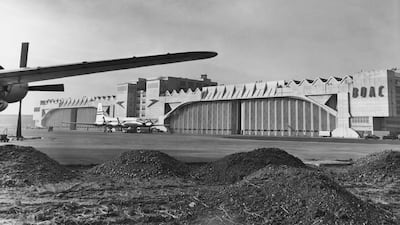
The new BOAC maintenance headquarters at London Airport circa 1955 -
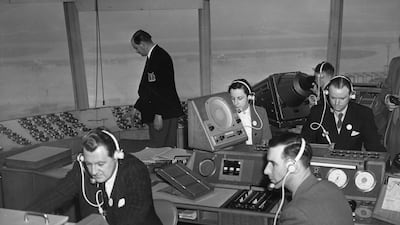
The air traffic control room at the airport's new terminal in 1955 -

US film star Marilyn Monroe with her husband, playwright Arthur Miller, after arriving at the airport in July 1956 -
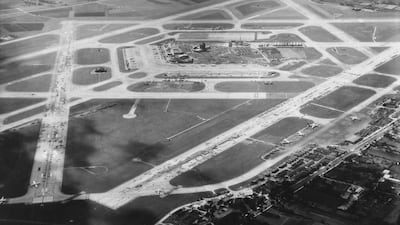
An aerial view showing the runways in 1958 -

The arrivals and departures board in 1960 -

A new airport gift shop, selling items by Chanel, Wedgwood and Pringle of Scotland, in 1961 -
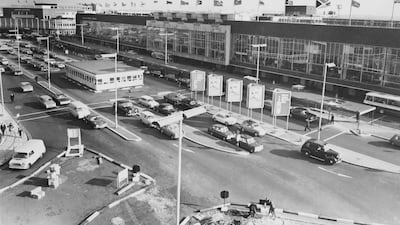
The Queen's Building and the No. 1 Building Europa at Heathrow in 1965 -
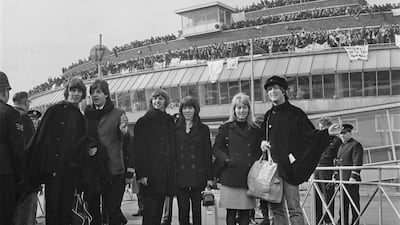
The Beatles leave Heathrow for Salzburg in Austria, to resume filming of the movie Help!, in 1965 -
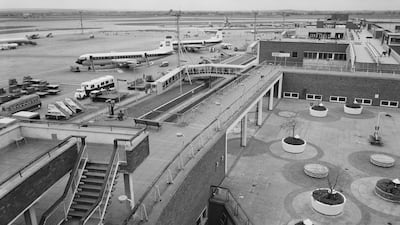
Passenger terminal gates at Heathrow in 1966 -
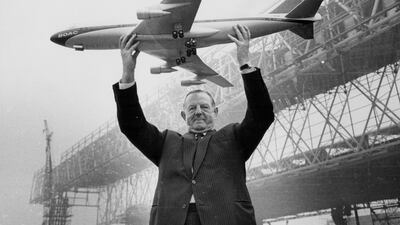
Keith Granville, managing director of BOAC, holding up a model of the Boeing 747 jet, with the new aircraft hangars under construction in the background, at Heathrow in 1969 -
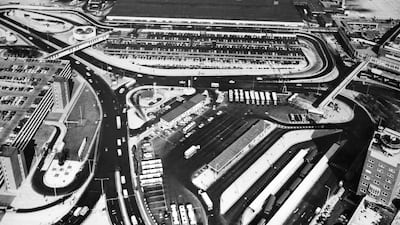
An aerial view of Heathrow in 1970 -
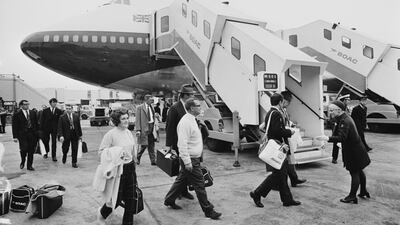
Passengers boarding the first BOAC Jumbo Jet 747 used for a commercial flight, from London Heathrow to New York, in 1971 -
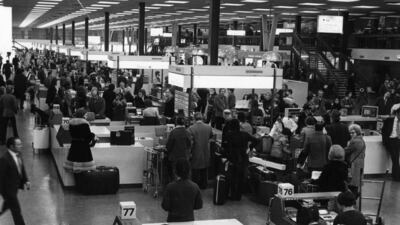
Passengers going through the departure lounge at Heathrow in 1973 -
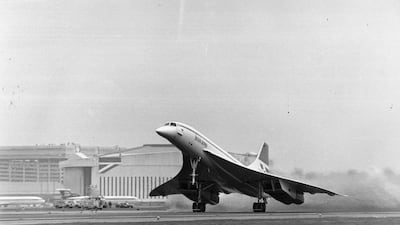
Concorde takes off from Heathrow on her first commercial flight for British Airways in 1976 -
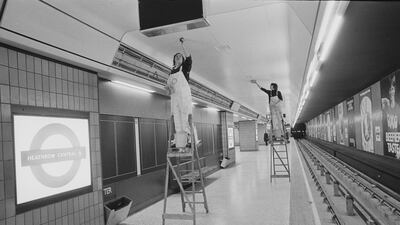
Men at work finalising the Heathrow Central underground station before its opening in 1977 -
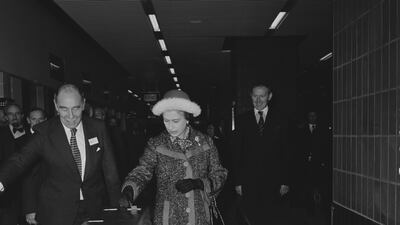
Queen Elizabeth II passing though the Tube gates at Heathrow Central station on its opening in 1977 -
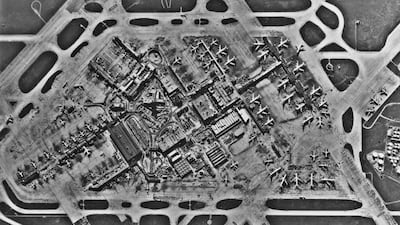
An aerial view of Heathrow in 1978 -

Passengers waiting near a departures board in 1979 -
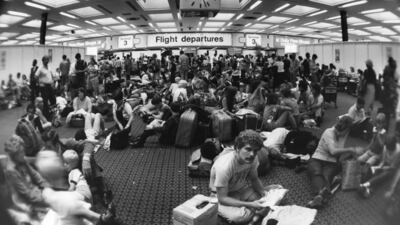
Holidaymakers waiting in the departure lounge at Terminal 3 of Heathrow in 1981 -
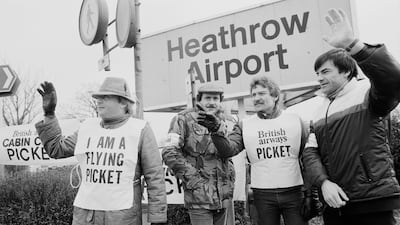
British Airways employees protesting at Heathrow in 1984 -
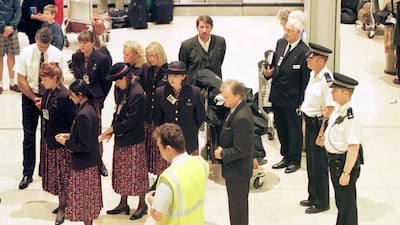
Passengers and staff observe a silence in Heathrow's Terminal One to mark the beginning of the funeral of Diana, Princess of Wales, in 1997 -
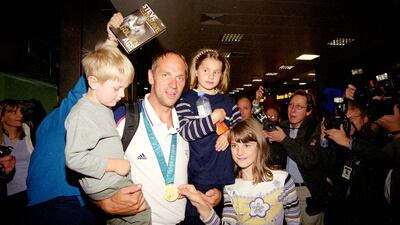
Rower Steve Redgrave at Heathrow with daughters Sophie and Natalie and son Zak after returning from the Sydney 2000 Olympic Games with his gold medal -

Spectators watch the last Concorde land at Heathrow in 2003 -
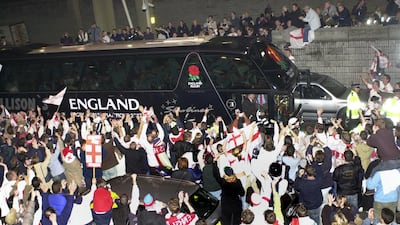
Fans surround the coach carrying the England rugby team at Heathrow, as they arrived from Sydney after winning the World Cup in 2003 -
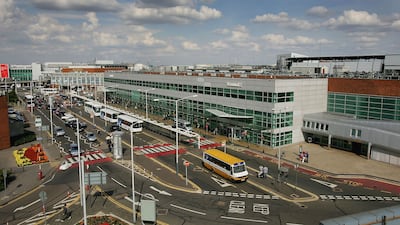
Heathrow's Terminal 2 in 2004 -
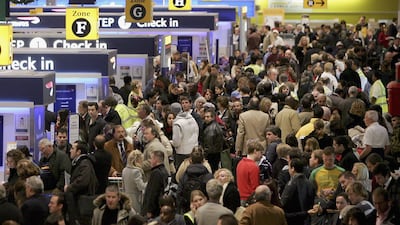
Passengers queue to check in at Terminal 1 of Heathrow Airport during the Christmas 2006 and New Year period -
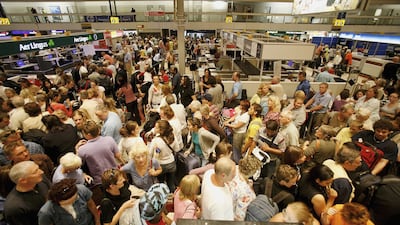
Passengers wait at Terminal 1 on August 10, 2006, after airport security was raised to critical when a terrorist plot to blow up planes in mid-flight from the UK to the US was disrupted by police -
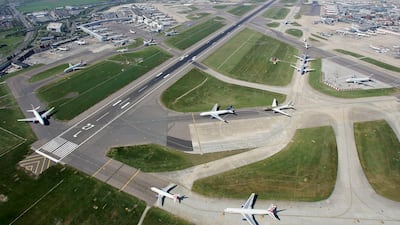
Planes queueing to take off at Heathrow in 2007 -
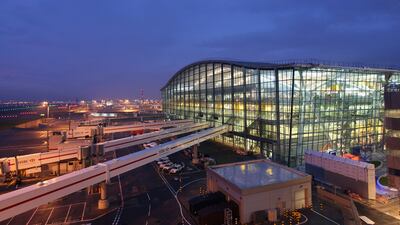
The new Terminal 5 at Heathrow in 2008 -
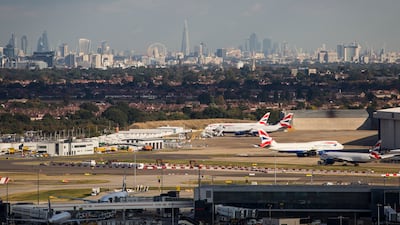
Aircraft at Heathrow Airport in front of the London skyline in 2016 -
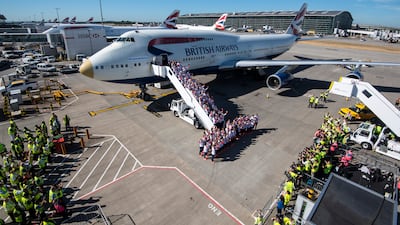
Members of Team GB arrive from Rio de Janeiro at Heathrow, after returning from the 2016 Olympics, which saw Great Britain's strongest performance at the Games in over a century -

A composite photo shows planes taking off from Heathrow in November 2016. Forty-two planes were captured between 10.17am and 11.17am and a montage was created from those single images -
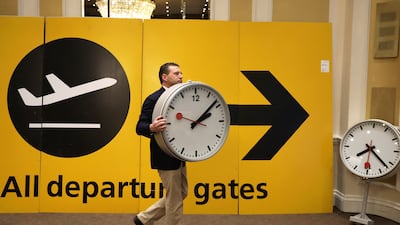
Items are arranged during an auction preview at Heathrow in 2018. The contents of Terminal 1, which closed in 2015, were being sold -
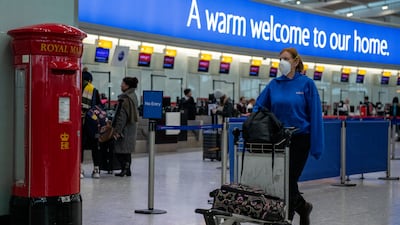
An airline passenger wearing a face mask pushes her bags through Heathrow's Terminal 5 during the coronavirus pandemic in 2020 -
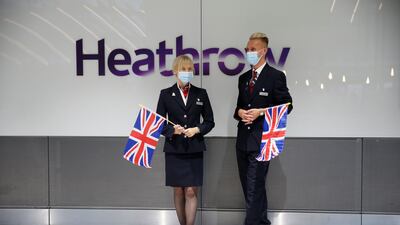
British Airways employees welcome Olympians returning from the Tokyo Olympics in 2021 -
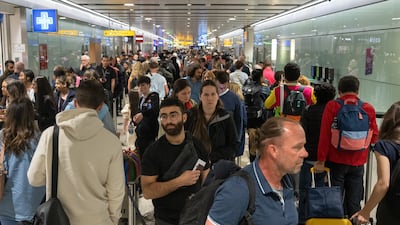
Travellers wait in a long queue to pass through the security check in 2022


UK passenger numbers fell 1.9 per cent, while those from the Middle East were 31 per cent lower as the Iran war continues to impact the global travel sector.
On Thursday, Ms Alexander said: “The Government considers that the development covered by the Heathrow expansion NPS is critical to national growth and therefore plans to designate expansion at Heathrow as critical national growth infrastructure.
“This is a signal of the importance the Government places on the need for expansion and will be an important additional factor in the planning balance.”
The HENPS states that in 2023, the air transport and aerospace sectors directly contributed around £23 billion to UK GDP and directly provided around 240,000 jobs across the UK.
Heathrow chief executive Thomas Woldbye said the expansion statement "represents something Britain has often found difficult in recent years: progress".
He said: “The UK cannot realise its full economic potential without an expanded Heathrow and this is an important step towards delivering the capacity the country needs.
“Our plan is privately funded by some of the largest investors in the world, widely supported by businesses, trade unions and communities across the country, and it’s ready to go after years of scrutiny.
“We will now focus on securing planning permission and delivering this vital project.”
Alethea Warrington, head of aviation at climate charity Possible, said: “The Government is living in a fantasy land if it thinks it can allow a new runway without making noise pollution even worse, making our air even more toxic, or crashing through our climate targets.”

