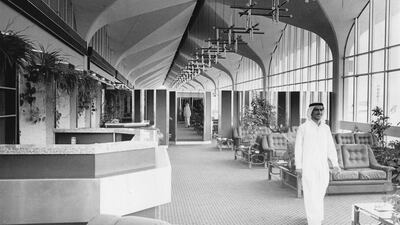
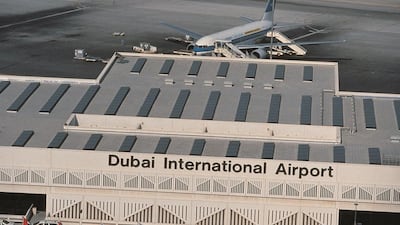
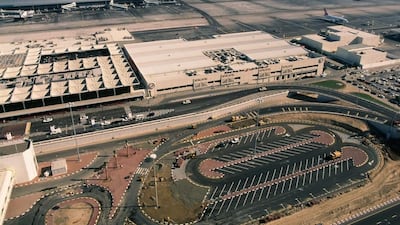
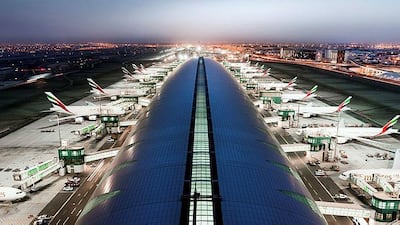
Dubai International Airport's Terminal 3 Arrivals Hall. The airport handled 14.2 million passengers in the three-month period to the end of June. Photo: Dubai Airports

Dubai International Airport to reach pre-Covid monthly passenger level by end of 2023


Deena Kamel
  • English
  • Arabic

Monthly passenger traffic at Dubai International Airport is expected to reach pre-Covid-19 pandemic levels by the end of 2023 as air travel demand continues to surge, with a full recovery within sight earlier than expected.

Passenger volumes at Dubai International Airport could hover around the pre-pandemic rates of 7.8 million a month in the latter half of next year, Paul Griffiths, chief executive of Dubai Airports, told The National on Wednesday.

The airport operator now expects the Gulf hub to handle 77.8 million passengers in 2023, up from an earlier projection in April of 75.5 million, Mr Griffiths said.

This is a nearly 25 per cent increase on the 62.4 million passengers Dubai Airports expects will travel through the airport in 2022, raising its annual traffic forecast from an earlier projection in May of 58.3 million, after first-half volumes more than doubled.

"If the second half of 2022 is as strong as the first half suggests it may be, we can reach pre-pandemic levels on a rolling monthly basis before the end of 2023," Mr Griffiths said.

"If trends continue in the way we’ve seen them for the past two to three quarters, then we could be back to pre-pandemic levels earlier than we thought."

Dubai Airports had previously said that annual passenger volumes at the hub could rebound to pre-pandemic levels by 2024. Dubai International Airport handled 86.4 million passengers in 2019.

The number of passengers using Dubai International Airport (DXB) nearly tripled to 14.2 million during the second quarter of 2022, despite reduced capacity from the closure of one of its two runways for 45 days for refurbishment work. This was its ninth consecutive quarter of continued growth since the start of the pandemic.

First-half passenger volumes more than doubled year on year to 27.9 million.

The recovery was mainly driven by travellers beginning or ending their trip in Dubai, with point-to-point traffic exceeding pre-pandemic levels as the Dubai government's safety measures made the emirate an attractive destination, Mr Griffiths said.

Transit traffic is starting to recover, reaching 75 per cent of pre-pandemic levels, with markets such as Japan, Thailand, Australia and New Zealand reopening their borders and the world, with the exception of China, largely returning to normal, he said.

India is DXB’s top source country by passenger numbers, with traffic for the first half of the year reaching four million passengers — driven mainly by top city destinations such as Mumbai, Delhi and Hyderabad.

Saudi Arabia followed with two million passengers, then the UK with 1.9 million passengers.

The top three cities were London with 1.3 million passengers, Riyadh with 910,000 passengers, and Mumbai with 726,000 passengers.

Recession fears

The outlook for a "very strong" second half of the year is driven by expectations of a strengthening recovery in transit markets, tourists flocking to Dubai in the cooler weather and the Fifa World Cup in Qatar starting in November, Mr Griffiths said.

The global football tournament will attract millions of fans, with shuttle flights operating between Doha and Dubai as some spectators stay in the UAE and travel to Qatar for matches because of constrained hotel supply in Qatar.

Concerns about a global economic recession are unlikely to dent travel demand, Mr Griffiths said.

"Everyone is concerned about a recession but travel will be resilient for a while because it is a commodity that people have missed for years and they're willing to spend money to travel," he said.

The 'honeymoon period'

Recession fears are unlikely to dent the ongoing recovery in travel in the short term, depending on the extent and duration of the economic downturn, according to Mr Griffiths.

"People are desperate to get on aeroplanes, and with a dearth in capacity with airlines retiring aircraft, this is a honeymoon period where supply is not keeping up with travel demand," he said.

A perfect storm of higher oil prices, rising inflation rates and a global economic slowdown is brewing over the aviation industry's recovery from the pandemic.

But Mr Griffiths said the travel industry is "remarkably resilient" and even with smaller disposable incomes, people will continue to see travel as an essential lifestyle need, so "there won't be a massive stunt in [demand] growth".

"Recessionary pressure will have an impact, but if a business keeps its head above water, there is not too much to worry about," he said.

Asked about the potential effect on DXB, Mr Griffiths said the airport already took measures during the pandemic to preserve cash, minimise costs, invest in technology and adapt its business model.

"We cast a 21st-century eye at processes and re-appraised them — changing them for the better or eliminating them — which led to better economic results," he said.

Airfares to stabilise

Airfares have peaked as a higher-than-expected recovery in travel demand outpaced airlines' available seats and skilled workers to handle the surge in passenger numbers.

Ticket prices have soared as airlines try to recoup losses incurred during the pandemic, capacity reduced as carriers retired less economical aircraft models and airlines struggled to restart operations because they could not hire staff quickly enough to meet travel demand.

Over the next year, prices will start to normalise as supply and demand become more balanced with airlines taking delivery of more aircraft, staffing issues get resolved and demand begins to "calm down" after people visit family and friends and go on business trips, Mr Griffiths said.

Asked about earlier plans to expand the passenger terminal of Al Maktoum International Airport (DWC), Dubai's second hub, Mr Griffiths said the focus for the airport has changed.

DXB's capacity will be expanded to 120 million passengers annually through the use of new technology to process travellers, while DWC will be used by foreign carriers that handle more point-to-point traffic, he said.

__________________________

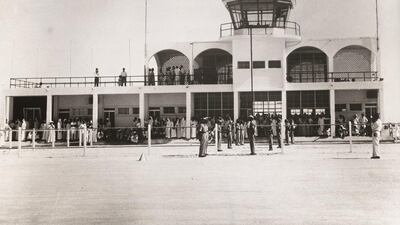
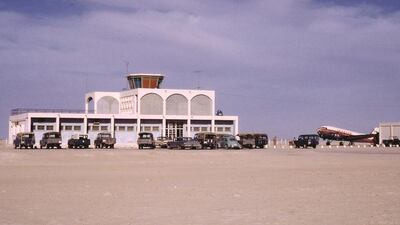
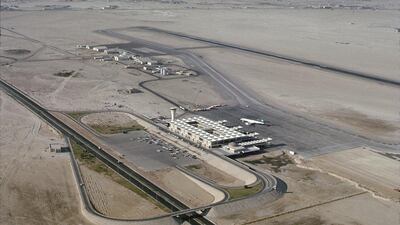
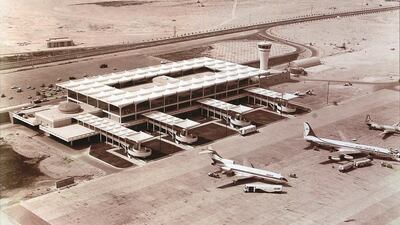
The changing face of Dubai International Airport, over 50 years – in pictures

  • 1960s: plenty of parking space and a single aircraft.
    1960s: plenty of parking space and a single aircraft.
  • 1970s: a single runway stretches across a barren city.
    1970s: a single runway stretches across a barren city.
  • 1971: the first airport had only four gates.
    1971: the first airport had only four gates.
  • 1970s: the lounge was somewhat minimal 47 years ago.
    1970s: the lounge was somewhat minimal 47 years ago.
  • 1980s: passengers pass the time before their flight the old fashion way, without WiFi
    1980s: passengers pass the time before their flight the old fashion way, without WiFi
  • 1990s: The airport is expanded.
    1990s: The airport is expanded.
  • 2000s: the airport is expanded to include more runways, another terminal and serves more passengers.
    2000s: the airport is expanded to include more runways, another terminal and serves more passengers.
  • Dubai International Airport in all its glory, now.
    Dubai International Airport in all its glory, now.

__________________________

Amid disruption and long queues at major airports in Europe, DXB said that 96 per cent of passengers queued for fewer than five minutes at the departure passport control.

The average queuing times at security check on departure was less than three minutes for 97 per cent of passengers.

“We knew at the start of the pandemic that the dramatic downturn would be followed by an equally dramatic upturn, so we were well prepared for it and using all of the business data at our disposal were able to predict the start of the recovery,” Mr Griffiths said.

Paul Griffiths, chief executive of Dubai Airports. Leslie Pableo for The National

Air cargo business

In terms of the air-freight business, cargo volumes for the first six months of the year fell nearly 19 per cent year on year to 910,075 tonnes.

DXB’s cargo traffic was hit during the second quarter, as major freight operators shifted back to Dubai World Central (DWC) in March, Dubai Airports said.

Total cargo volumes were hit by a reduced capacity during the northern runway refurbishment programme from May 9 to June 22, as a significant portion of the cargo traffic at DXB is carried in the belly-hold of passenger aircraft, it said.

Mr Griffiths said he is optimistic about a resurgence in cargo by year end amid significant freight demand and as more capacity becomes available.


GAC GS8 Specs

Engine: 2.0-litre 4cyl turbo

Power: 248hp at 5,200rpm

Torque: 400Nm at 1,750-4,000rpm

Transmission: 8-speed auto

Fuel consumption: 9.1L/100km

On sale: Now

Price: From Dh149,900

Jetour T1 specs

Engine: 2-litre turbocharged

Power: 254hp

Torque: 390Nm

Price: From Dh126,000

Available: Now

FIVE%20TRENDS%20THAT%20WILL%20SHAPE%20UAE%20BANKING
%3Cp%3E%E2%80%A2%20The%20digitisation%20of%20financial%20services%20will%20continue%3C%2Fp%3E%0A%3Cp%3E%E2%80%A2%20Managing%20and%20using%20data%20effectively%20will%20become%20a%20competitive%20advantage%3C%2Fp%3E%0A%3Cp%3E%E2%80%A2%20Digitisation%20will%20require%20continued%20adjustment%20of%20operating%20models%3C%2Fp%3E%0A%3Cp%3E%E2%80%A2%20Banks%20will%20expand%20their%20role%20in%20the%20customer%20life%20through%20ecosystems%3C%2Fp%3E%0A%3Cp%3E%E2%80%A2%20The%20structure%20of%20the%20sector%20will%20change%3C%2Fp%3E%0A
UAE currency: the story behind the money in your pockets
How to help

Send “thenational” to the following numbers or call the hotline on: 0502955999
2289 – Dh10
2252 – Dh 50
6025 – Dh20
6027 – Dh 100
6026 – Dh 200

UAE currency: the story behind the money in your pockets
Barings Bank

 Barings, one of Britain’s oldest investment banks, was
founded in 1762 and operated for 233 years before it went bust after a trading
scandal. 

Barings Bank collapsed in February 1995 following colossal
losses caused by rogue trader Nick Lesson. 

Leeson gambled more than $1 billion in speculative trades,
wiping out the venerable merchant bank’s cash reserves.  

Winners

Best Men's Player of the Year: Kylian Mbappe (PSG)

Maradona Award for Best Goal Scorer of the Year: Robert Lewandowski (Bayern Munich)

TikTok Fans’ Player of the Year: Robert Lewandowski

Top Goal Scorer of All Time: Cristiano Ronaldo (Manchester United)

Best Women's Player of the Year: Alexia Putellas (Barcelona)

Best Men's Club of the Year: Chelsea

Best Women's Club of the Year: Barcelona

Best Defender of the Year: Leonardo Bonucci (Juventus/Italy)

Best Goalkeeper of the Year: Gianluigi Donnarumma (PSG/Italy)

Best Coach of the Year: Roberto Mancini (Italy)

Best National Team of the Year: Italy 

Best Agent of the Year: Federico Pastorello

Best Sporting Director of the Year: Txiki Begiristain (Manchester City)

Player Career Award: Ronaldinho

The Sand Castle

Director: Matty Brown

Stars: Nadine Labaki, Ziad Bakri, Zain Al Rafeea, Riman Al Rafeea

Rating: 2.5/5

UAE currency: the story behind the money in your pockets
What are NFTs?

Are non-fungible tokens a currency, asset, or a licensing instrument? Arnab Das, global market strategist EMEA at Invesco, says they are mix of all of three.

You can buy, hold and use NFTs just like US dollars and Bitcoins. “They can appreciate in value and even produce cash flows.”

However, while money is fungible, NFTs are not. “One Bitcoin, dollar, euro or dirham is largely indistinguishable from the next. Nothing ties a dollar bill to a particular owner, for example. Nor does it tie you to to any goods, services or assets you bought with that currency. In contrast, NFTs confer specific ownership,” Mr Das says.

This makes NFTs closer to a piece of intellectual property such as a work of art or licence, as you can claim royalties or profit by exchanging it at a higher value later, Mr Das says. “They could provide a sustainable income stream.”

This income will depend on future demand and use, which makes NFTs difficult to value. “However, there is a credible use case for many forms of intellectual property, notably art, songs, videos,” Mr Das says.

The%20specs
%3Cp%3E%3Cstrong%3EEngine%3A%3C%2Fstrong%3E%201.8-litre%204-cyl%20turbo%0D%3Cbr%3E%3Cstrong%3EPower%3A%20%3C%2Fstrong%3E190hp%20at%205%2C200rpm%0D%3Cbr%3E%3Cstrong%3ETorque%3A%3C%2Fstrong%3E%20320Nm%20from%201%2C800-5%2C000rpm%0D%3Cbr%3E%3Cstrong%3ETransmission%3A%20%3C%2Fstrong%3ESeven-speed%20dual-clutch%20auto%0D%3Cbr%3E%3Cstrong%3EFuel%20consumption%3A%3C%2Fstrong%3E%206.7L%2F100km%0D%3Cbr%3E%3Cstrong%3EPrice%3A%3C%2Fstrong%3E%20From%20Dh111%2C195%0D%3Cbr%3E%3Cstrong%3EOn%20sale%3A%20%3C%2Fstrong%3ENow%3C%2Fp%3E%0A
The specs: 2018 Nissan 370Z Nismo

The specs: 2018 Nissan 370Z Nismo
Price, base / as tested: Dh182,178
Engine: 3.7-litre V6
Power: 350hp @ 7,400rpm
Torque: 374Nm @ 5,200rpm
Transmission: Seven-speed automatic
​​​​​​​Fuel consumption, combined: 10.5L / 100km

The specs
Engine: 2.0-litre 4-cyl turbo

Power: 201hp at 5,200rpm

Torque: 320Nm at 1,750-4,000rpm

Transmission: 6-speed auto

Fuel consumption: 8.7L/100km

Price: Dh133,900

On sale: now 

Mercer, the investment consulting arm of US services company Marsh & McLennan, expects its wealth division to at least double its assets under management (AUM) in the Middle East as wealth in the region continues to grow despite economic headwinds, a company official said.

Mercer Wealth, which globally has $160 billion in AUM, plans to boost its AUM in the region to $2-$3bn in the next 2-3 years from the present $1bn, said Yasir AbuShaban, a Dubai-based principal with Mercer Wealth.

Within the next two to three years, we are looking at reaching $2 to $3 billion as a conservative estimate and we do see an opportunity to do so,” said Mr AbuShaban.

Mercer does not directly make investments, but allocates clients’ money they have discretion to, to professional asset managers. They also provide advice to clients.

“We have buying power. We can negotiate on their (client’s) behalf with asset managers to provide them lower fees than they otherwise would have to get on their own,” he added.

Mercer Wealth’s clients include sovereign wealth funds, family offices, and insurance companies among others.

From its office in Dubai, Mercer also looks after Africa, India and Turkey, where they also see opportunity for growth.

Wealth creation in Middle East and Africa (MEA) grew 8.5 per cent to $8.1 trillion last year from $7.5tn in 2015, higher than last year’s global average of 6 per cent and the second-highest growth in a region after Asia-Pacific which grew 9.9 per cent, according to consultancy Boston Consulting Group (BCG). In the region, where wealth grew just 1.9 per cent in 2015 compared with 2014, a pickup in oil prices has helped in wealth generation.

BCG is forecasting MEA wealth will rise to $12tn by 2021, growing at an annual average of 8 per cent.

Drivers of wealth generation in the region will be split evenly between new wealth creation and growth of performance of existing assets, according to BCG.

Another general trend in the region is clients’ looking for a comprehensive approach to investing, according to Mr AbuShaban.

“Institutional investors or some of the families are seeing a slowdown in the available capital they have to invest and in that sense they are looking at optimizing the way they manage their portfolios and making sure they are not investing haphazardly and different parts of their investment are working together,” said Mr AbuShaban.

Some clients also have a higher appetite for risk, given the low interest-rate environment that does not provide enough yield for some institutional investors. These clients are keen to invest in illiquid assets, such as private equity and infrastructure.

“What we have seen is a desire for higher returns in what has been a low-return environment specifically in various fixed income or bonds,” he said.

“In this environment, we have seen a de facto increase in the risk that clients are taking in things like illiquid investments, private equity investments, infrastructure and private debt, those kind of investments were higher illiquidity results in incrementally higher returns.”

The Abu Dhabi Investment Authority, one of the largest sovereign wealth funds, said in its 2016 report that has gradually increased its exposure in direct private equity and private credit transactions, mainly in Asian markets and especially in China and India. The authority’s private equity department focused on structured equities owing to “their defensive characteristics.”

Key findings of Jenkins report
  • Founder of the Muslim Brotherhood, Hassan al Banna, "accepted the political utility of violence"
  • Views of key Muslim Brotherhood ideologue, Sayyid Qutb, have “consistently been understood” as permitting “the use of extreme violence in the pursuit of the perfect Islamic society” and “never been institutionally disowned” by the movement.
  • Muslim Brotherhood at all levels has repeatedly defended Hamas attacks against Israel, including the use of suicide bombers and the killing of civilians.
  • Laying out the report in the House of Commons, David Cameron told MPs: "The main findings of the review support the conclusion that membership of, association with, or influence by the Muslim Brotherhood should be considered as a possible indicator of extremism."
Updated: August 17, 2022, 4:30 PM