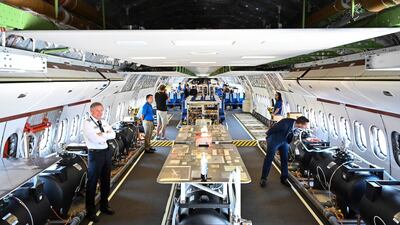
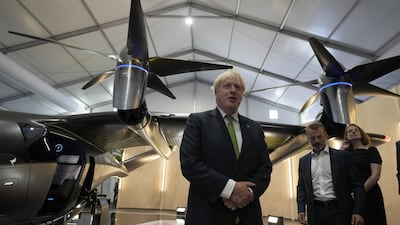
The global air industry is in the midst of a post-pandemic rebound, but supply chain problems have left suppliers and manufacturers scrambling to source everything from raw materials to small electronic components to keep production moving.
From multinationals to family-run stockists, few have been spared the impact of shortages or delays. As a result, this week's Farnborough Airshow has been more about the factory floor than the usual shop window for new orders.
"We are keeping our head above water, keeping the flow happening, but the gymnastics required to make that happen are as difficult now as they have ever been," Stephen Timm, president of industry major Collins Aerospace, said.
At the other end of the spectrum, where suppliers lack the clout of a Collins or Honeywell, things are even more uncertain.
"At the moment it's extremely challenging because of the lack of raw materials," said Paul Wingfield, business development manager at Stokenchurch, England-based Aircraft Materials, which supplies alloys including aluminium, nickel, magnesium, titanium and nickel for the industry.
Not only are the mills that his company works with having trouble finding raw materials, but distributors are wary of holding on to inventory when there is a risk of recession.
"Nobody knows what the economy is going to do, so nobody's willing to invest in stock at the moment," Mr Wingfield said.
In conversations at this week's show, suppliers say material and parts delays have meant pushing manufacturers to order earlier, while manufacturers like Boeing have found themselves wading into the supply chain to keep parts flowing.
"We're going deeper into the supply chain than we've ever had to go to help our suppliers solve problems," said Cory Gionet, Boeing's vice president in charge of supply chains for commercial airplanes.
Earlier this year, Boeing said its 737 MAX aircraft production and deliveries were hit by shortages of a particular wiring connector.
Suppliers face lengthening lead times to source materials or components that can now run six months to over a year, threatening the manufacturers' plans to ramp up output.
To guarantee parts delivery, some suppliers are pushing manufacturers to order many months in advance, even if it means suppliers have to tie up capital by holding on to inventory for longer.
Switching their own suppliers can be almost impossible in a highly-regulated industry where components have to undergo rigorous approval processes.
"It's not a case of picking up and going to a different supplier, the validation process for doing that is actually often longer than the lead time," said Neil Lawrence, business development engineer at Woking, England-based Magnet Schultz.
It makes solenoids — electromagnetic valves — used in everything from plane hydraulics controls to air conditioning. Those valves range in price from a few hundred to tens of thousands of pounds.
Shortages of electronics components mean some will not be delivered for more than a year.
"We're getting terrible, terrible lead times on some parts," Mr Lawrence said.
Supply chain problems come at a time when the industry is eager to build ever more planes.
Airbus wants to raise A320 production rates to 75 single-aisle aircraft monthly over the next three years, from 50 now. But delays in engine supplies have held back aircraft deliveries.
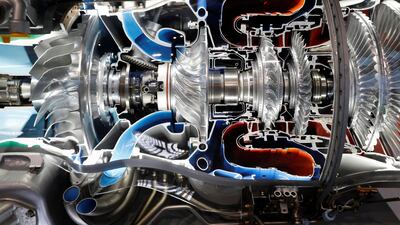
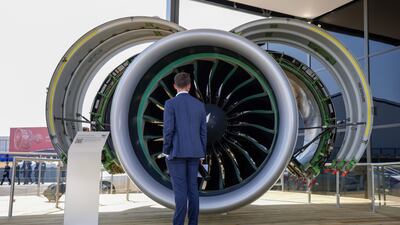
Engine maker Pratt & Whitney, like Collins, a unit of Raytheon Technologies, said this week it aimed to get its engine deliveries for the A320 back on track by early 2023 as it battles labour shortages and supply chain snags.
"Certainly we're not happy about the position that we're in right now," Pratt & Whitney president Shane Eddy said.
Airbus chief executive Guillaume Faury said the show had brought slightly more comfort on engine delays.
But France's Dassault Aviation said it was "very concerned" about supply chains.

UAE currency: the story behind the money in your pockets
The specs
Engine: 2.0-litre 4-cyl
Power: 153hp at 6,000rpm
Torque: 200Nm at 4,000rpm
Transmission: 6-speed auto
Price: Dh99,000
On sale: now
Timeline
2012-2015
The company offers payments/bribes to win key contracts in the Middle East
May 2017
The UK SFO officially opens investigation into Petrofac’s use of agents, corruption, and potential bribery to secure contracts
September 2021
Petrofac pleads guilty to seven counts of failing to prevent bribery under the UK Bribery Act
October 2021
Court fines Petrofac £77 million for bribery. Former executive receives a two-year suspended sentence
December 2024
Petrofac enters into comprehensive restructuring to strengthen the financial position of the group
May 2025
The High Court of England and Wales approves the company’s restructuring plan
July 2025
The Court of Appeal issues a judgment challenging parts of the restructuring plan
August 2025
Petrofac issues a business update to execute the restructuring and confirms it will appeal the Court of Appeal decision
October 2025
Petrofac loses a major TenneT offshore wind contract worth €13 billion. Holding company files for administration in the UK. Petrofac delisted from the London Stock Exchange
November 2025
180 Petrofac employees laid off in the UAE
Kanye%20West
%3Cp%3EYe%20%E2%80%94%20the%20rapper%20formerly%20known%20as%20Kanye%20West%20%E2%80%94%20has%20seen%20his%20net%20worth%20fall%20to%20%24400%20million%20in%20recent%20weeks.%20That%E2%80%99s%20a%20precipitous%20drop%20from%20Bloomberg%E2%80%99s%20estimates%20of%20%246.8%20billion%20at%20the%20end%20of%202021.%3Cbr%3EYe%E2%80%99s%20wealth%20plunged%20after%20business%20partners%2C%20including%20Adidas%2C%20severed%20ties%20with%20him%20on%20the%20back%20of%20anti-Semitic%20remarks%20earlier%20this%20year.%3Cbr%3EWest%E2%80%99s%20present%20net%20worth%20derives%20from%20cash%2C%20his%20music%2C%20real%20estate%20and%20a%20stake%20in%20former%20wife%20Kim%20Kardashian%E2%80%99s%20shapewear%20firm%2C%20Skims.%3C%2Fp%3E%0A
UAE currency: the story behind the money in your pockets
BMW M5 specs
Engine: 4.4-litre twin-turbo V-8 petrol enging with additional electric motor
Power: 727hp
Torque: 1,000Nm
Transmission: 8-speed auto
Fuel consumption: 10.6L/100km
On sale: Now
Price: From Dh650,000
The biog
Favourite hobby: I love to sing but I don’t get to sing as much nowadays sadly.
Favourite book: Anything by Sidney Sheldon.
Favourite movie: The Exorcist 2. It is a big thing in our family to sit around together and watch horror movies, I love watching them.
Favourite holiday destination: The favourite place I have been to is Florence, it is a beautiful city. My dream though has always been to visit Cyprus, I really want to go there.
Previous men's records
- 2:01:39: Eliud Kipchoge (KEN) on 16/9/19 in Berlin
- 2:02:57: Dennis Kimetto (KEN) on 28/09/2014 in Berlin
- 2:03:23: Wilson Kipsang (KEN) on 29/09/2013 in Berlin
- 2:03:38: Patrick Makau (KEN) on 25/09/2011 in Berlin
- 2:03:59: Haile Gebreselassie (ETH) on 28/09/2008 in Berlin
- 2:04:26: Haile Gebreselassie (ETH) on 30/09/2007 in Berlin
- 2:04:55: Paul Tergat (KEN) on 28/09/2003 in Berlin
- 2:05:38: Khalid Khannouchi (USA) 14/04/2002 in London
- 2:05:42: Khalid Khannouchi (USA) 24/10/1999 in Chicago
- 2:06:05: Ronaldo da Costa (BRA) 20/09/1998 in Berlin
Credit Score explained
What is a credit score?
In the UAE your credit score is a number generated by the Al Etihad Credit Bureau (AECB), which represents your credit worthiness – in other words, your risk of defaulting on any debt repayments. In this country, the number is between 300 and 900. A low score indicates a higher risk of default, while a high score indicates you are a lower risk.
Why is it important?
Financial institutions will use it to decide whether or not you are a credit risk. Those with better scores may also receive preferential interest rates or terms on products such as loans, credit cards and mortgages.
How is it calculated?
The AECB collects information on your payment behaviour from banks as well as utilitiy and telecoms providers.
How can I improve my score?
By paying your bills on time and not missing any repayments, particularly your loan, credit card and mortgage payments. It is also wise to limit the number of credit card and loan applications you make and to reduce your outstanding balances.
How do I know if my score is low or high?
By checking it. Visit one of AECB’s Customer Happiness Centres with an original and valid Emirates ID, passport copy and valid email address. Liv. customers can also access the score directly from the banking app.
How much does it cost?
A credit report costs Dh100 while a report with the score included costs Dh150. Those only wanting the credit score pay Dh60. VAT is payable on top.
Stan%20Lee
%3Cp%3E%3Cstrong%3EDirector%3A%3C%2Fstrong%3E%20David%20Gelb%3C%2Fp%3E%0A%3Cp%3E%3Cstrong%3ERating%3A%3C%2Fstrong%3E%203%2F5%3C%2Fp%3E%0A
UPI facts
More than 2.2 million Indian tourists arrived in UAE in 2023
More than 3.5 million Indians reside in UAE
Indian tourists can make purchases in UAE using rupee accounts in India through QR-code-based UPI real-time payment systems
Indian residents in UAE can use their non-resident NRO and NRE accounts held in Indian banks linked to a UAE mobile number for UPI transactions
UAE v IRELAND
All matches start at 10am, and will be played in Abu Dhabi
1st ODI, Friday, January 8
2nd ODI, Sunday, January 10
3rd ODI, Tuesday, January 12
4th ODI, Thursday, January 14
If you go...
Fly from Dubai or Abu Dhabi to Chiang Mai in Thailand, via Bangkok, before taking a five-hour bus ride across the Laos border to Huay Xai. The land border crossing at Huay Xai is a well-trodden route, meaning entry is swift, though travellers should be aware of visa requirements for both countries.
Flights from Dubai start at Dh4,000 return with Emirates, while Etihad flights from Abu Dhabi start at Dh2,000. Local buses can be booked in Chiang Mai from around Dh50
Ten tax points to be aware of in 2026
1. Domestic VAT refund amendments: request your refund within five years
If a business does not apply for the refund on time, they lose their credit.
2. E-invoicing in the UAE
Businesses should continue preparing for the implementation of e-invoicing in the UAE, with 2026 a preparation and transition period ahead of phased mandatory adoption.
3. More tax audits
Tax authorities are increasingly using data already available across multiple filings to identify audit risks.
4. More beneficial VAT and excise tax penalty regime
Tax disputes are expected to become more frequent and more structured, with clearer administrative objection and appeal processes. The UAE has adopted a new penalty regime for VAT and excise disputes, which now mirrors the penalty regime for corporate tax.
5. Greater emphasis on statutory audit
There is a greater need for the accuracy of financial statements. The International Financial Reporting Standards standards need to be strictly adhered to and, as a result, the quality of the audits will need to increase.
6. Further transfer pricing enforcement
Transfer pricing enforcement, which refers to the practice of establishing prices for internal transactions between related entities, is expected to broaden in scope. The UAE will shortly open the possibility to negotiate advance pricing agreements, or essentially rulings for transfer pricing purposes.
7. Limited time periods for audits
Recent amendments also introduce a default five-year limitation period for tax audits and assessments, subject to specific statutory exceptions. While the standard audit and assessment period is five years, this may be extended to up to 15 years in cases involving fraud or tax evasion.
8. Pillar 2 implementation
Many multinational groups will begin to feel the practical effect of the Domestic Minimum Top-Up Tax (DMTT), the UAE's implementation of the OECD’s global minimum tax under Pillar 2. While the rules apply for financial years starting on or after January 1, 2025, it is 2026 that marks the transition to an operational phase.
9. Reduced compliance obligations for imported goods and services
Businesses that apply the reverse-charge mechanism for VAT purposes in the UAE may benefit from reduced compliance obligations.
10. Substance and CbC reporting focus
Tax authorities are expected to continue strengthening the enforcement of economic substance and Country-by-Country (CbC) reporting frameworks. In the UAE, these regimes are increasingly being used as risk-assessment tools, providing tax authorities with a comprehensive view of multinational groups’ global footprints and enabling them to assess whether profits are aligned with real economic activity.
Contributed by Thomas Vanhee and Hend Rashwan, Aurifer
Killing of Qassem Suleimani
The view from The National
INDIA SQUAD
Virat Kohli (capt), Rohit Sharma, Shikhar Dhawan, KL Rahul, Vijay Shankar, MS Dhoni (wk), Kedar Jadhav, Dinesh Karthik, Yuzvendra Chahal, Kuldeep Yadav, Bhuvneshwar Kumar, Jasprit Bumrah, Hardik Pandya, Ravindra Jadeja, Mohammed Shami
The specs: 2017 Porsche 718 Cayman
Price, base / as tested Dh222,500 / Dh296,870
Engine 2.0L, flat four-cylinder
Transmission Seven-speed PDK
Power 300hp @ 6,500rpm
Torque 380hp @ 1,950rpm
Fuel economy, combined 6.9L / 100km
Bundesliga fixtures
Saturday, May 16 (kick-offs UAE time)
Borussia Dortmund v Schalke (4.30pm)
RB Leipzig v Freiburg (4.30pm)
Hoffenheim v Hertha Berlin (4.30pm)
Fortuna Dusseldorf v Paderborn (4.30pm)
Augsburg v Wolfsburg (4.30pm)
Eintracht Frankfurt v Borussia Monchengladbach (7.30pm)
Sunday, May 17
Cologne v Mainz (4.30pm),
Union Berlin v Bayern Munich (7pm)
Monday, May 18
Werder Bremen v Bayer Leverkusen (9.30pm)
The specs: Lamborghini Aventador SVJ
Price, base: Dh1,731,672
Engine: 6.5-litre V12
Gearbox: Seven-speed automatic
Power: 770hp @ 8,500rpm
Torque: 720Nm @ 6,750rpm
Fuel economy: 19.6L / 100km
The biog
Favourite films: Casablanca and Lawrence of Arabia
Favourite books: Start with Why by Simon Sinek and Good to be Great by Jim Collins
Favourite dish: Grilled fish
Inspiration: Sheikh Zayed's visionary leadership taught me to embrace new challenges.
Mercer, the investment consulting arm of US services company Marsh & McLennan, expects its wealth division to at least double its assets under management (AUM) in the Middle East as wealth in the region continues to grow despite economic headwinds, a company official said.
Mercer Wealth, which globally has $160 billion in AUM, plans to boost its AUM in the region to $2-$3bn in the next 2-3 years from the present $1bn, said Yasir AbuShaban, a Dubai-based principal with Mercer Wealth.
“Within the next two to three years, we are looking at reaching $2 to $3 billion as a conservative estimate and we do see an opportunity to do so,” said Mr AbuShaban.
Mercer does not directly make investments, but allocates clients’ money they have discretion to, to professional asset managers. They also provide advice to clients.
“We have buying power. We can negotiate on their (client’s) behalf with asset managers to provide them lower fees than they otherwise would have to get on their own,” he added.
Mercer Wealth’s clients include sovereign wealth funds, family offices, and insurance companies among others.
From its office in Dubai, Mercer also looks after Africa, India and Turkey, where they also see opportunity for growth.
Wealth creation in Middle East and Africa (MEA) grew 8.5 per cent to $8.1 trillion last year from $7.5tn in 2015, higher than last year’s global average of 6 per cent and the second-highest growth in a region after Asia-Pacific which grew 9.9 per cent, according to consultancy Boston Consulting Group (BCG). In the region, where wealth grew just 1.9 per cent in 2015 compared with 2014, a pickup in oil prices has helped in wealth generation.
BCG is forecasting MEA wealth will rise to $12tn by 2021, growing at an annual average of 8 per cent.
Drivers of wealth generation in the region will be split evenly between new wealth creation and growth of performance of existing assets, according to BCG.
Another general trend in the region is clients’ looking for a comprehensive approach to investing, according to Mr AbuShaban.
“Institutional investors or some of the families are seeing a slowdown in the available capital they have to invest and in that sense they are looking at optimizing the way they manage their portfolios and making sure they are not investing haphazardly and different parts of their investment are working together,” said Mr AbuShaban.
Some clients also have a higher appetite for risk, given the low interest-rate environment that does not provide enough yield for some institutional investors. These clients are keen to invest in illiquid assets, such as private equity and infrastructure.
“What we have seen is a desire for higher returns in what has been a low-return environment specifically in various fixed income or bonds,” he said.
“In this environment, we have seen a de facto increase in the risk that clients are taking in things like illiquid investments, private equity investments, infrastructure and private debt, those kind of investments were higher illiquidity results in incrementally higher returns.”
The Abu Dhabi Investment Authority, one of the largest sovereign wealth funds, said in its 2016 report that has gradually increased its exposure in direct private equity and private credit transactions, mainly in Asian markets and especially in China and India. The authority’s private equity department focused on structured equities owing to “their defensive characteristics.”