The UAE issued its federal corporate tax law on Friday that will levy a headline 9 per cent rate on taxable income exceeding Dh375,000 ($102,000).
Taxable profits below the aforementioned threshold will be subject to a 0 per cent rate of corporate tax. No corporate tax will apply on salaries or other personal income from employment — be it in the government, semi-governmental, or private sector, the Ministry of Finance said in a statement accompanying the 56-page law that was published on its website on Friday.
Businesses will become subject to the UAE corporate tax from the beginning of their first financial year that starts on or after June 1, 2023, as previously announced at the start this year.
The Federal Decree-Law No. (47) of 2022 on the Taxation of Corporations and Businesses provides the legislative basis for the introduction and implementation of a federal corporate tax in the UAE and is effective for financial years starting on or after June 1, 2023, the ministry said.
“The introduction of corporate tax is intended to help the UAE achieve its strategic objectives and accelerate its development and transformation,” the ministry said.
“The certainty of a competitive corporate tax regime that adheres to international standards, together with the UAE’s extensive network of double tax treaties, will cement the UAE’s position as a leading jurisdiction for business and investment,” it said.
The UAE corporate tax regime builds from best practices globally and incorporates principles that are internationally known and accepted, the ministry said.
“The principles of fairness and equity across sectors were at the forefront of the design of the corporate tax regime, given the UAE’s diverse economy and the importance of driving sustainable development,” it said.
Watch: UAE to introduce federal corporate tax on business profits
“To this end, the ministry involved relevant stakeholders through public consultation and took into account feedback and views in the final design of the corporate tax regime.”
The standard statutory corporate tax rate of 9 per cent positions the UAE competitively when compared with other financial centres and developed economies globally.
The average top corporate tax rate among EU27 countries is 21.3 per cent, 23.04 per cent among OECD countries, and 69 per cent in the G7, according to the Tax Foundation in Washington DC.
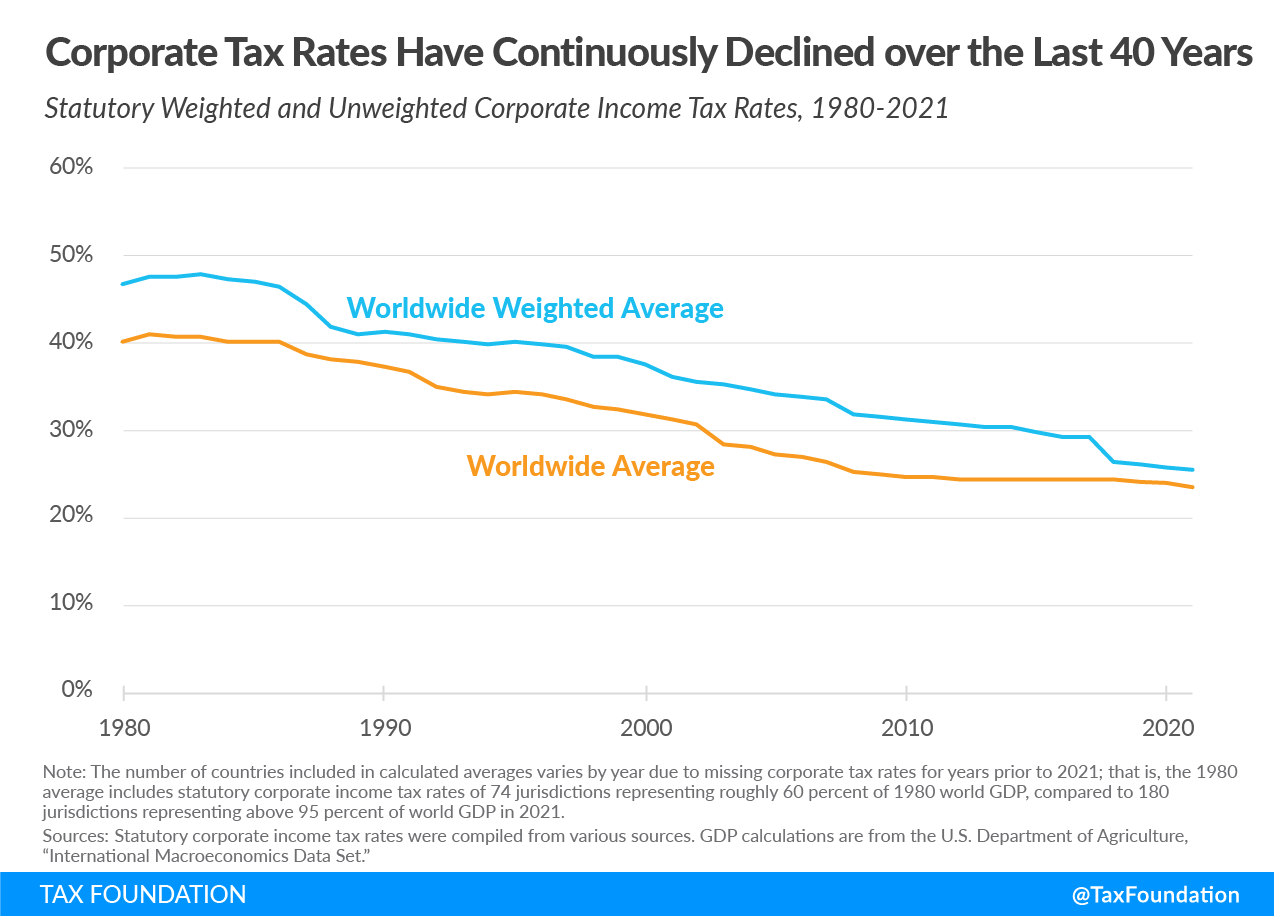
Corporate tax rates have continuously declined over the past 40 years, with the worldwide average falling from more than 40 per cent to between 25 and 30 per cent, according to Tax Foundation data.
The worldwide weighted average of corporate taxation has dropped from close to 50 per cent in the 1980s to about 25 per cent in 2021, according to the organisation.
The UAE corporate tax law exempts certain entities that include those involved in natural resource extraction activities in the country. However, they remain subject to existing local emirate-level taxation.
Other exemptions are available to organisations such as government entities, pension funds, investment funds and public benefit organisations “due to their vital importance and contribution to the social fabric and economy of the UAE”, the ministry said.
Existing free zone entities are eligible to benefit from a 0 per cent corporate tax rate on qualifying income, in recognition of the fundamental role they play in the promotion of free trade zones and helping drive the growth the UAE's economy.
The corporate tax regime provides generous relief for intra-group transfers and restructurings, and allows group companies to use each other’s available tax losses.
Interest and other personal income earned from bank deposits or savings programmes are also not subject to corporate tax, as well as investment in real estate by individuals in their personal capacity.
The Ministry of Finance will continue to oversee bilateral and multilateral agreements and the international exchange of information for tax purposes. The Federal Tax Authority will be responsible for the administration, collection, and enforcement of the corporate tax law.